

.svg)
.svg)
Working Time Directive Exemption Letter
 PDF and
 Word
Word
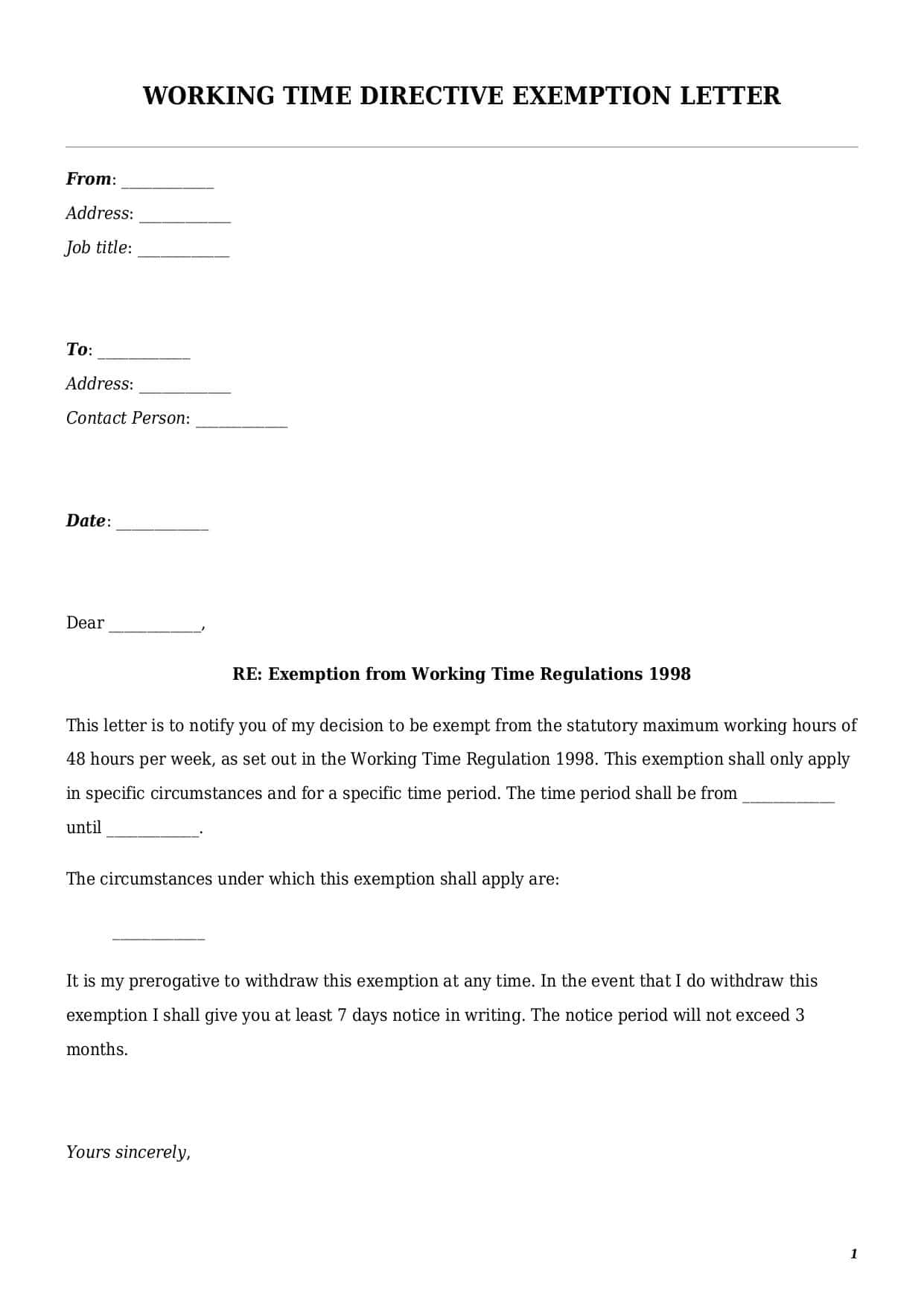
This template gives you a properly structured working time exemption letter (commonly called a 48-hour opt-out agreement), built around the actual statutory framework, not a generic HR form.
Reviews

When do you need a professional letter for a working time exemption?
Employers and employees in the UK may need this professionally drafted letter to opt out of maximum working hours when:
- A worker’s average weekly working hours may potentially exceed or are expected to exceed the maximum national threshold of 48 hours;
- An employer discovers a worker’s hours are at risk of regularly exceeding the limit and wants to put compliant arrangements in place going forward;
- A worker or employee engaged in sectors such as hospitality, healthcare, logistics, or any business that experiences seasonal or project-based surges in demand.
- A worker who agrees to work above the maximum weekly threshold.
The present letter template is not available for all types of workers. The exemption from the working time directive is not available to workers under the age of 18, or mobile workers in the road transport industry who fall within the scope of Section 18 of the Road Transport (Working Time) Regulations 2005.
Can an employer force you to sign a working time exemption letter?
Signing a working time exemption letter is an employee’s right rather than an obligation. By virtue of the Working Time Regulations (WTR) 1998, an opt-out is only valid if the worker has agreed to it voluntarily. Such an employee’s right is backed up by strong legal protection defined in the UK legal framework, including the following:
- The employer cannot apply pressure or sign the employment contract conditional upon signing this letter;
- The worker has the right not to be subjected to any detriment by the employer due to refusal to sign this letter (Section 45A Employment Rights Act (ERA) 1996);
- An employer cannot dismiss the worker on the grounds of refusal to sign this letter, as such a dismissal is treated automatically as unfair (Section 101A Employment Rights Act (ERA) 1996).
The list of legal guarantees defined above applies to all employees, whether they are remote, full-time or part-time employees or flexible workers. What is more important is that these statutory legal guarantees are available for all employees from day one of their employment.
If you are being forced to sign this working time exemption letter by your employer, first check the available grievance policy defining how the formal complaint can be submitted to your employer.
What is a working time directive exemption letter?
A working time exemption letter, also known as a 48-hour opt-out agreement, is a written document by which an individual worker agrees that the 48-hour average weekly working time limit set out in Regulation 4 of the WTR 1998 should not apply to them. This document template can be used across England, Wales and Scotland.
Signing this working time directive exemption letter is a voluntary act, which the employee can cancel at any time by giving the required notice.
If you are a domestic or family worker, a worker officiating at religious ceremonies in churches and religious communities, or a managing executive or other person with autonomous decision-taking powers, you do not need to sign this letter, as you are not protected by the weekly average 48-hour limitation under Regulation 19 and Regulation 20 of the WTR 1998.
What should a working time exemption letter cover?
A standard template of a working time exemption letter must cover the following important elements:
- the letter must include the full name, job title, and mailing address of the worker.
- letter’s title expressly pointing to the subject;
- express consent to opt out from the 48-hour average limit under Regulation 4 of the WTR;
- duration of such an opt-out (could be indefinite, until a specific date or until occurrence of specific circumstances);
- the duration of a notice period required to terminate the opt-out (it is advisable to have between 7 days and 3 months’ notice period to notify the employer);
- date and employee’s signature.
Important legal caveats UK employers and employees must consider before opting out
To prevent future misunderstanding, both the employer and the employee must be aware of the important legal caveats below.
Scope of Opt-out
By signing this letter, an employee or worker opts out only from the 48-hour average weekly limit defined by the WTR. All the other statutory guarantees and rights belonging to such an employee or worker under the WTR remain untouched, including:
- the 11-hour daily rest period;
- weekly rest periods;
- in-work rest breaks;
- night work limits; and
- statutory paid annual leave.
Best Practice: Keep the Opt-Out Separate From the Employment Contract
An opt-out letter is a separate document that should be signed by an employee and attached to the existing employment contract. Generally, a default opt-out clause cannot be included in the original employment contract’s provisions.
Sector-specific exclusions
Before requesting an employee to sign this working time exemption directive, the employer should verify the following two elements:
- First, the employer should check whether the worker falls into a category excluded from the opt-out entirely (for example, workers under 18 cannot opt out);
- Second, if protection offered by the WTR applies to the select category of an employee or type of a work being performed (for example, directors or the CEO of the company generally are not covered by the maximum 48-hour weekly limit).
48-hour aggregated limit
If an employee or worker is engaged by different employers, the 48-hour limit applies towards all their employers. For example, John works as an accountant in the London-based firm 30 hours per week, while he also plans to undertake a part-time employment under zero-hours contract with a Manchester accounting firm expecting to work for an additional 20 hours per week. In such a case, John needs to sign an opt-out letter with a second employer right after signing the employment contract, since the total aggregated number of weekly working hours is 50.
Flexible working hours
This letter template is different from a flexible working hours request letter, which employees may send to their employers to request a remote working arrangement or part-time working arrangement for an indefinite or defined period of time. A flexible working hours request does not deal with changing the total number of weekly workable hours; instead, it simply changes the allocation of these hours within the working week. For example, Lucy may wish to change her working hours from Monday to Friday to Monday to Thursday by working an extra hour each day. As a rule of thumb, a flexible working hours arrangement is regulated by the employer’s internal flexible working policy or other similar document.
How to use this letter?
To get a fully customisable letter template, follow a few steps below:
- Click the “Create Document” button.
- Answer simple questions in the form.
- Select a template’s format – a PDF or Word template.
- E-sign the document online for free.
- Make a payment.
- The document is ready for instant digital download immediately after making the payment.
- Print out the document and read it carefully.
- Send the document to your employer by email, post or deliver it in person.
- Keep a copy of the signed letter for your personal record.
- If you wish to amend the existing employment contract additionally, you may start this process by sending a letter to amend the employment contract to your employer.
This article is reviewed by Daria Turanska, a lawyer with 15 years’ contract drafting experience
Table of content
Frequently Asked Questions (FAQ)
-
1. Can my employer force me to sign? Will I lose my job if I refuse?
No. Refusing to sign is legally protected: under Section 45A of the Employment Rights Act 1996, you can’t be subjected to a detriment for refusing, and under Section 101A, dismissal for this reason is automatically unfair from day one of employment, with no minimum service requirement.
-
2. Can I change my mind later, and how do I cancel the opt-out?
Yes, you can cancel this letter at any time. If your letter doesn’t specify a notice period, the default under Regulation 5(2) is 7 days. If it does specify one, it cannot legally exceed 3 months.
-
3. How much notice do I actually need to give?
Between 7 days (if unspecified) and a maximum of 3 months (if the agreement specifies a longer period, up to that ceiling).
-
4. What exactly counts as working time? Does on-call time, training, or travel count?
UK court practice has already shaped a clear understanding of what is “working time’ for the purpose of application of the WTA. The working time covers:
- on-call time during which a worker must be physically present at the workplace (Landeshauptstadt Kiel v Jaeger (Case C-151/02));
- travel time for workers without a fixed workplace, including travelling from home to their first appointment and back (Federación de Servicios Privados del sindicato Comisiones obreras (CC.OO.) v Tyco Integrated Security SL (Case C-266/14));
- training time as part of an employment contract, including any introduction seminar, calls, or workshops, is also covered by the scope of the working time.
-
5. Does the 48-hour limit apply to each job separately, or are they combined?
No, a 48-hour weekly limit is an aggregated maximum threshold that applies to all employers an employee currently works for under the employment contract.
-
6. Can the opt-out be included in my employment contract, or does it have to be separate?
The employment cannot be conditional upon the opt-out mechanism. Therefore, the safest legal position here is to have a separate letter opt-in/out from the 48-hour limit that should be attached to the signed employment contract.

Looking for something Different?
Start typing to find out our collection of legal documents and contract templates