

.svg)
.svg)
Zero Hours Contract
 PDF and
 Word
Word
Create a legally compliant and fully customisable UK zero hours contract template designed for flexible staffing arrangements across hospitality, retail, healthcare, and seasonal businesses across the UK.
Reviews

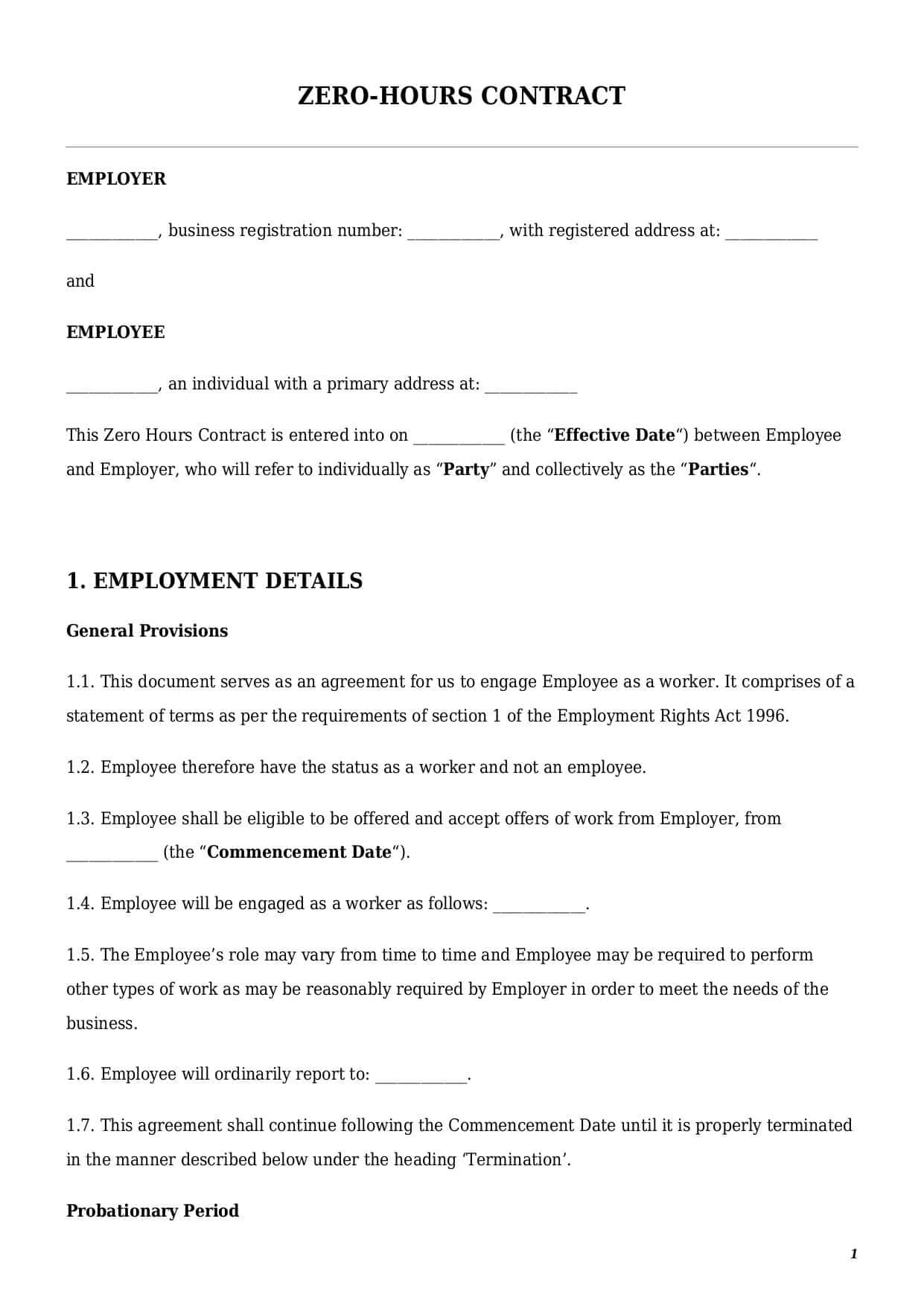
What is a zero-hours contract in the UK?
A zero-hours contract, or casual working arrangement, is a type of employment contract in the UK under which workers are being engaged for employment with no guaranteed hours of work. This document defines the scope of duties, job title, place of work, hourly rate, and termination details.
Under the zero hours contract template, UK businesses have a chance to engage more staff under a flexible staffing arrangement. This contract is commonly used by small SMEs, healthcare providers, private hospitals, and hospitality businesses across the UK.
Who should use this zero-hours contract template?
The usage of a zero-hours contract, or casual working arrangement, is limited in its use. In most of the cases UK businesses justify its usage due to inability to predict availability of work for an employee. The application of this type of contract is typical for the following:
- small businesses in the launch stage or businesses with low volatility;
- hospitality sectors, including cafes, restaurants or tourist shops;
- seasonal businesses in tourist locations;
- event companies;
- UK business employing students or recent graduates;
- delivery businesses or warehouse operators.
In all the rest of the cases, UK businesses should use a standard employment contract.
What does this UK zero-hours contract include?
A typical UK-compliant zero-hours contract does not differ structurally from an ordinary employment contract. Both documents have the same structure, including:
Employment Status
As per ACAS guidelines, the wording of the casual agreement template should clearly outline that this is casual employment. Besides that, the contract must specify:
- job title;
- full name of a line manager or a supervisor to whom a worker should report;
- duration of the contract (indefinite or fixed period).
Payment Structure
In a zero-hours contract template in the UK, the worker’s compensation package is defined as a fixed hourly rate in British pounds. This should be a gross rate before PAYE, such as National Insurance deductions, etc. A worker’s hourly rate under the casual working arrangement cannot be lower than the national minimum wage standard.
Additionally, the contract shall outline the payment frequency and payment method.
Holiday Entitlement
Workers have guaranteed rights for a paid annual holiday entitlement as per UK employment law. However, this is only on paper. Under the Employment Rights Act, statutory annual leave is accrued on a pro-rata basis in line with hours worked over the leave year, which in practice can leave workers on variable or part-time contracts with less predictable holiday entitlement.
Termination
Workers under the zero-hour contract template are usually under the risk of unpaid dismissal. The UK employment law allows termination of this type of contract by either party at any time with immediate effect.
At the same time the court practices in the UK have ruled out such a legislative loophole in favour of workers. Thus, workers working under the zero-hour contract for two consecutive years build up an approach according to which termination by the employer after two consecutive years of work can be considered unfair.
Governing Law
The governing law is the law of the jurisdiction of England and Wales, Northern Ireland or Scotland that shall apply to the provisions of this agreement. The parties usually select the law of the jurisdiction where the business is registered or mainly operates.
In case of a dispute, only the courts of a selected jurisdiction will be authorised to hear the case.
Difference Between Employee and Worker Status
A zero-hour contract template, also known as a casual worker agreement, can be easily confused with a standard employment contract. While both contracts offer employment, the status of employees under these two contracts as well as the scope of their employment rights differ significantly.
Working Schedule
A worker under a zero-hours contract may not know the exact days and hours of the work, the same as the employer. Under this type of contract, a worker is engaged once there is work. For example, John works as a nurse in the hospital and is engaged occasionally to help permanent staff during night shifts on pick days of the month.
Opposite to that, under the standard employment contract, the employer must define specific days and hours of work, as well as the total number of working hours per week. For example, Lucy has a part-time employment contract with a London accounting firm according to which she works 4 hours per day from Monday to Wednesday.
Employment Rights
A worker status under the casual worker agreement gives a limited number of employment rights. For example, a casual working contract in the UK can be terminated by either party with immediate effect. This significantly reduces predictability of employment relations. Or, your annual paid entitlement, which is being calculated pro rata to the actual hours worked, may not be enough even to cover one day of paid leave.
On the other hand, unlike the ordinary employment contract, the employer under a zero-hours contract template cannot limit the employee’s right to employment with other employers across the UK or outside.
Employment Status
The nature of an employment contract entitles an employee to a number of additional statutory entitlements in case of redundancy, suspension, protection against unfair dismissal or payment of additional entitlements.
What are the benefits of using this template?
Using the FasterDraft online platform for document customisation is the right choice, and here is why:
- Get a UK-specific zero-hours contract template in several minutes.
- Get a fully customisable document created by solicitors, not generated with AI.
- Download the document immediately after the purchase.
- Use the document immediately.
- Use the document for various industries, including hospitality, restaurants, event planners, healthcare, etc.
How to customise this zero-hours contract template with FasterDraft?
To get a fully customisable contract template, follow a few easy steps below:
- Click the “Create Document” button.
- Answer simple questions in the form.
- Select a template’s format – zero hours contract template PDF or Word.
- E-sign the document online.
- Make a payment.
The template is available for instant download immediately after the purchase. You can use it right away.
Table of content
Frequently Asked Questions (FAQ)
-
1. Are zero-hour contracts legal in the UK?
Yes, signing a zero-hours contract template in the UK is absolutely legal. The Employment Rights Act 1996 and numerous ACAS guidelines clearly define the purpose of a working arrangement under the zero hours contract, as well as cases in which it is frequently being used.
It is important to emphasise that a zero hours or casual employment contract is not sham employment. It is just a special type of a working contract.
-
2. What rights do zero-hours workers have?
The rights of a worker under a UK zero-hours contract template are being defined by numerous legislative acts, including the Employment Rights Act and Working Time Regulations, as well as ACAS best practices and recommendations. Amongst the main rights under casual employment, an employee has the right:
- to make breaks and to take paid leave entitlements and sick leaves;
- to get remuneration not less than that provided by the national minimum wage standard;
- to get wages through PAYE, including payment of all necessary deductions such as National Insurance;
- to have a safe workplace environment free from bullying, harassment or any other forms of discrimination;
- to challenge unfair dismissal.
-
3. Can a worker refuse shifts on a zero-hours contract?
Unlike a standard employment contract, a UK casual working arrangement generally allows the worker to refuse shifts offered by the employer. This reflects the nature of the arrangement, as the employer is not obliged to guarantee any fixed number of hours. In turn, the worker is not required to accept work whenever it is offered.
-
4. Is this template compliant with UK employment law?
Yes, this ACAS-compliant zero-hours contract is fully aligned with UK employment law, includes best business practices in the UK employment market, and also complies with recent recommendations provided by ACAS.
By customising this template with FasterDraft, you get a legally balanced document that equally protects the rights of both employer and employee.
-
5. Is the template suitable for England, Wales, Scotland, and Northern Ireland?
Yes, our zero-hour contract template can be easily customised to be compliant with the laws of England and Wales, Northern Ireland or Scotland.
-
6. Can I get a zero-hours contract template UK free from FasterDraft?
At FasterDraft we offer our customers a zero-hours contract template compliant with UK employment law at a very affordable price. Our templates are the result of in-depth research into UK contract and employment law, alongside established best practices for drafting employment agreements. Each template has been prepared by qualified solicitors and not generated using AI.

Looking for something Different?
Start typing to find out our collection of legal documents and contract templates