

.svg) USA
USA.svg) Australia
Australia

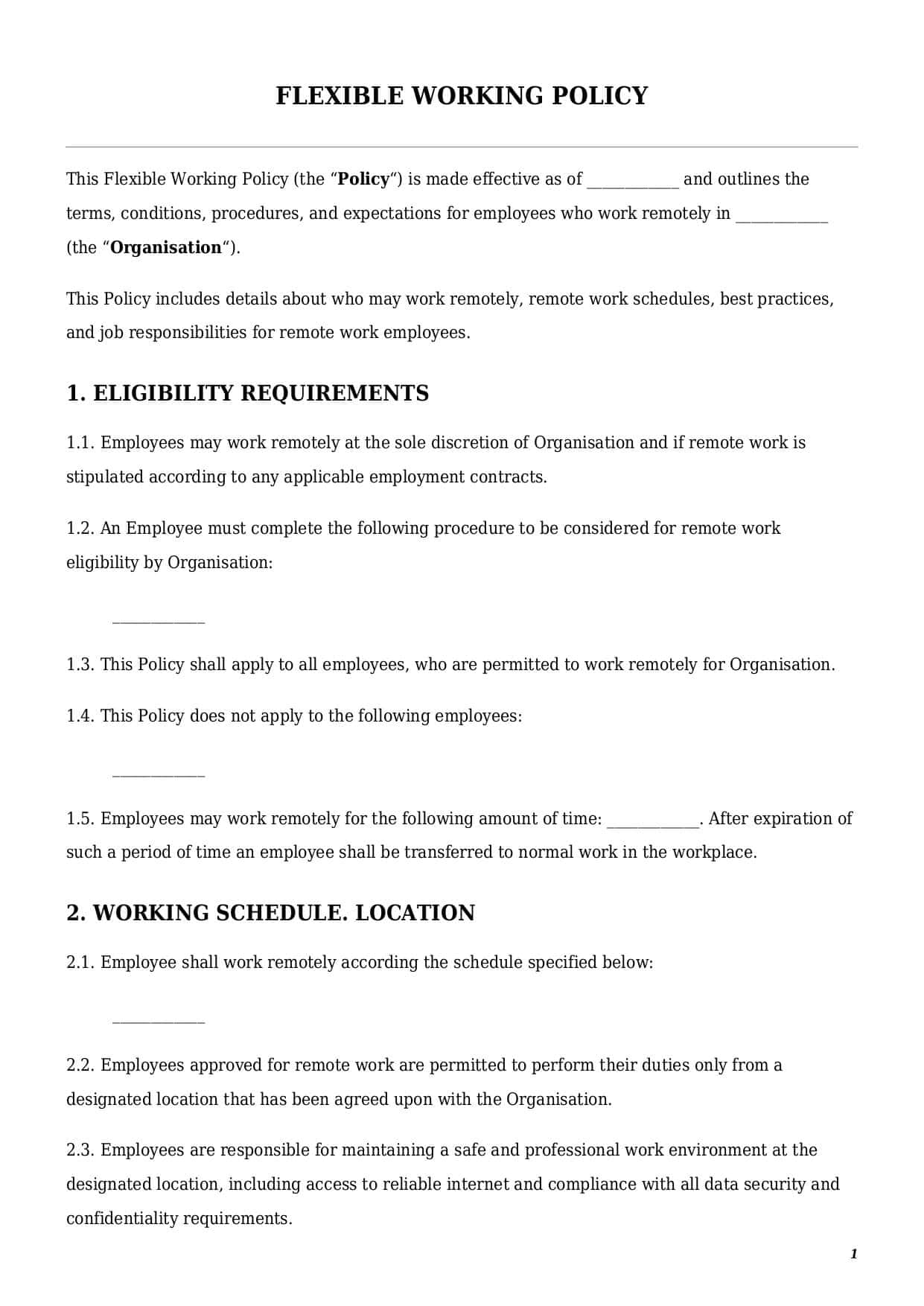
What is a flexible working policy?
A flexible working policy, also known as a hybrid or remote working policy, is an internal corporate document that defines how your organisation handles employee requests for remote or hybrid working arrangements. This policy template clearly sets the groundwork for flexible working arrangements, application processes, remote working equipment, and performance reviews.
This flexible working policy is drafted in line with Part VIIIA of the Employment Rights Act (ERA) 1996 and can be used by SMEs, start-ups and other types of businesses operating across the UK.
Do I have a right to request a flexible working arrangement as an employee in the UK?
The modern UK legal framework neither grants employees across the UK a statutory right to have a remote or hybrid working arrangement nor mandates employers to provide it. However, the wording of the ERA 1996 defines an employee’s “right to request” such a flexible working opportunity, as well as the employer’s obligation to properly consider and review such a request.
The flexible working arrangement only applies to individuals performing their duties under an employment contract, rather than independent contractors. Workers, most agency workers, and self-employed contractors are not covered, regardless of how long they have worked for the business.
Provisions of the Employment Relations (Flexible Working) Act 2023 define the following framework for flexible working:
- The right to request is available from day one of employment.
- The right to request can be used two times within any 12-month period.
- Employers must provide their decision within 2-month period maximum.
- Employees are no longer need to explain how the change might affect the business.
- The right to request is only available within England, Wales and Scotland.
What are the benefits of this professional template from FasterDraft?
By customising a flexible working policy for your business with FasterDraft, you get the following benefits:
- A template that reflects the current legal framework, including the most recent ACAS code of practice on requests for flexible working.
- A document that reduces inconsistency in managerial decisions related to the grant or refusal of flexible working arrangements.
- This document offers a more affordable and quicker legal solution than hiring a solicitor to create it from the ground up.
- Drafted by real legal practitioners and never by AI.
What should a flexible working policy cover?
A standard list of sections for a solid, flexible working policy must include the following:
- List of eligibility criteria confirming the right of all employees to request their flexible work arrangement from Day 1;
- Request procedure section with a detailed explanation regarding the format of the flexible working request letter and when and how it should be submitted;
- The employer’s decision timeframe defining the list of statutory grounds allowing refusal of a flexible working arrangement;
- Detailed appeal process that allows employees to challenge the refusal decision in a professional and compliant manner;
- Confidentiality and record-keeping commitments; and
- A non-discrimination statement, explicitly linking the policy to the employer’s obligations under the Equality Act 2010 or referring to the employer’s separate equality policy template.
Things to avoid when drafting a flexible working policy
A mistake in a flexible working policy has real legal consequences, including paying compensation or remedies to the employee. Ensure your business does not make mistakes below:
No blanket refusals
Avoid justifying your refusal for hybrid work with phrases like “We prefer you to be in the office,” “We do not like this idea,” “Others work in the office, so why don’t you stay with them?” and similar. Employers can refuse an application for any of the following reasons:
- Extra costs that will damage the business.
- The work cannot be reorganised among other staff.
- People cannot be recruited to do the work.
- Flexible working will affect quality.
- Flexible working will affect performance.
- The business will not be able to meet customer demand.
- There’s a lack of work to do during the proposed working times.
- The business is planning changes to the workforce.
No other grounds or reasons preventing the flexible working arrangement can be added to this list. Refusing every request from a particular role or department without individual consideration is exactly the kind of practice that gives rise to an indirect discrimination claim under the Equality Act 2010. Therefore, this policy shall apply with equal opportunities and diversity policy template to ensure there is no indirect or direct discrimination in place.
No skipping the consultation step
Since April 2024, going straight to a refusal without first discussing the request and exploring alternatives is a clear procedural failure under the amended framework — not an optional courtesy.
No refusing outside the eight statutory reasons
“We just prefer people in the office” is not, on its own, one of the permitted grounds. In fact, refusals need to map onto the statutory list (additional costs, effect on customer demand, inability to reorganise work, inability to recruit, effect on quality, effect on performance, insufficiency of work, and planned structural changes).
No ignoring the discrimination overlay
A refusal that happens to disproportionately affect women (given the well-recognised link between childcare responsibilities and flexible working requests) or a disabled employee needing flexibility as a reasonable adjustment carries real legal exposure, entirely separate from whether the flexible working process itself was followed correctly. The Court of Appeal’s guidance in Hardys & Hansons plc v Lax [2005] EWCA Civ 846 remains the leading authority on how tribunals scrutinise an employer’s justification for refusing this kind of request, including:
- independent evaluation of each request; and
- no range for reasonable responses.
How to customise and use this template with FasterDraft?
To get a fully customisable template, follow the instructions below:
- Click “Create Document” to open the questionnaire.
- Answer simple questions in the form to customise the final document.
- E-sign the document online for free.
- Select a template’s format – PDF or Word.
- Complete the payment.
- Download the document.
- Print it out and read carefully.
- Notify all your employees and staff about the release of this new policy.
- Circulate this document to managers and employees by email or in person.
- Review and update the policy annually or once the laws change.
This article is reviewed by Daria Turanska, a lawyer with 15 years’ contract drafting experience