

.svg)
.svg)
Employer Whistleblowing Policy
 PDF and
 Word
Word
This UK whistleblowing policy template helps employers to comply with the Public Interest Disclosure Act 1998 and ACAS guidance by establishing clear procedures for reporting, investigating, and managing protected disclosures in the workplace.
Reviews

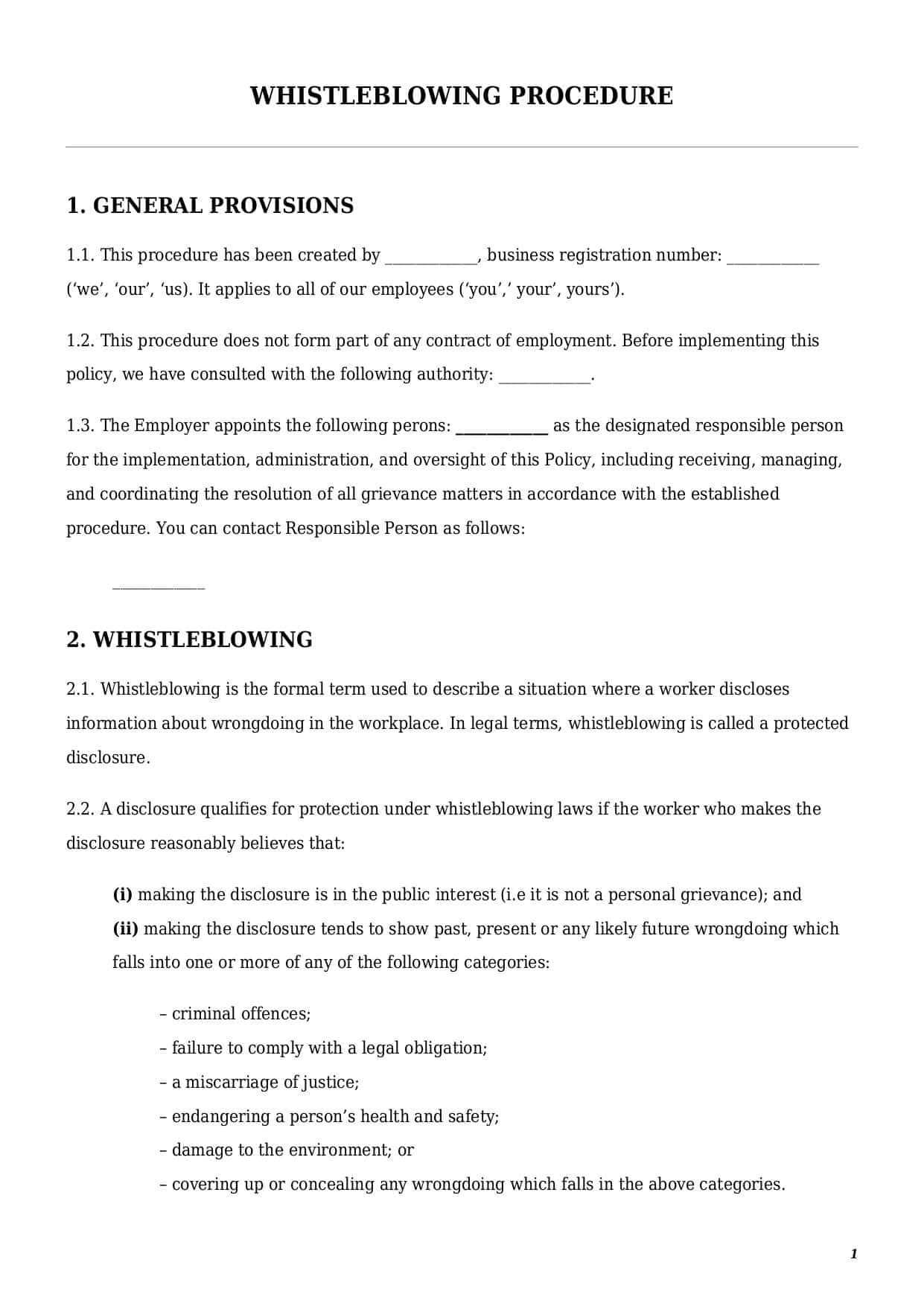
What is a whistleblowing policy in the UK?
A whistleblowing policy is a formal corporate document UK employers usually adopt to address, manage and investigate protected disclosures made by their employees in line with ACAS guidelines and the Public Interest Disclosure Act 1998 (PIDA). This template defines the scope of application, protected disclosure, and internal step-by-step investigation procedure, as well as external means of reporting the wrongdoing by employees.
A whistleblowing policy template is not a legally mandatory document for most UK employers, but it is widely regarded as essential for several reasons. First, the policy helps to ensure compliance with the most recent development of the UK employment law. Second, it enables businesses to identify and address internal concerns more quickly and effectively, supporting earlier intervention and reducing the risk of escalation.
This template whistleblowing policy is being used in conjunction with other policies, including the Code of Conduct and Disciplinary Procedure Policy.
What is considered a protected disclosure?
According to the Employment Rights Act 1996, whistleblowing is the formal term used to describe a situation where a worker discloses information about wrongdoing in the workplace. In legal terms, whistleblowing is called a protected disclosure. On the other hand, the PIDA enhances regulation for the protected disclosure by defining cases in which the protected disclosure arises.
The PIDA does not set out specific real-world examples of when a disclosure must be made. Instead, it defines broad categories of wrongdoing that qualify as a protected disclosure, including:
- breach of obligation;
- criminal offences;
- miscarriage of justice;
- environmental damage;
- danger to health or safety.
What should this whistleblowing policy template include?
A solid whistleblowing policy example must include a number of important legal clauses, as follows:
Scope of Application
The document should outline which types of employees the policy shall apply to. UK employers may choose to apply this policy to all employees or to certain categories of employees, including:
- part-time employees;
- full-time employees;
- remote workers;
- casual workers;
- contractors etc.
Protected Disclosure
In this part of the whistleblower policy template the employer must clearly outline cases of protected disclosure that are covered by this policy. A ‘protected disclosure’ means that the employee cannot be subsequently made redundant, dismissed, refused a promotion, or discriminated against for the fact of submission of such a complaint.
Protected disclosures can be made internally, that is, submitted directly to the employer, or externally to designated government agencies or bodies.
Internal reporting channels
For a compliant ACAS whistleblowing policy template, the policy should outline:
- How the protected disclosure should be made (in person, by email);
- To whom the disclosure should be made (line manager or head of the HR department);
- Format of disclosure (list of all information that should be included in the disclosure);
- Timeline within which the investigation should be performed by the employer.
External reporting guidance
In a situation when the employee is not comfortable reporting their concern to the employer, or in a situation when the concern shall be submitted to the person directly involved in the wrongdoing to be reported, the employee may choose to report externally. It is important to state that the employee has complete discretion in this regard, therefore any concern can be submitted either internally, externally or in both ways.
Confidentiality clauses
Every whistleblower policy template in the UK should incorporate a confidentiality clause. Under this clause all matters and discussions related to protected disclosures under this policy shall remain fully confidential between the employee submitting the complaint and the employer.
The confidentiality clause also implies that the employee may also submit their concern anonymously.
Who should use this whistleblowing policy template?
Having a solid and well-drafted whistleblowing policy UK can be suitable for:
- UK businesses that are engaged in public procurement tenders involving third parties or taxpayers’ monies;
- businesses whose operational activity can have a significant environmental effect, including manufacturing, energy production, waste management or construction;
- HR departments of big companies employing hundreds of employees and workers;
- Startups willing to ensure full compliance with effective UK employment laws.
Difference between a grievance procedure and a whistleblowing policy in the UK
If you are dealing with these two policies for the first time, it may be difficult to differentiate between the two policies, as both of them deal with the submission of the complaint by the employee. However, there is a major legal difference between those two documents.
Under a grievance procedure, the employee notifies their employer about any work-related or workplace complaints. The scope of these complaints usually involves violation of the employee’s personal interest or employment rights. This policy can be used to file a complaint or concern regarding the following:
- unfair dismissal;
- unpaid wages;
- unallocated annual paid entitlements;
- discrimination, harassment or bullying;
- sexual harassment etc.
On the other hand, a whistleblower policy template is used by employees to report a wrongdoing or legal or compliance concern at the workplace that does not involve personally the employee’s interests or rights. This policy can be used to report the following:
- a wrongdoing;
- injustice;
- danger to health and safety of other employees or environment;
- theft;
- criminal offence, etc.
How to customise this whistleblowing policy template UK with FasterDraft?
To get a fully customisable policy template that you can use within your organisation, follow the simple steps below:
- Click the “Create Document” button.
- Answer simple questions in the form.
- Select a template’s format – a whistleblowing policy template Word or PDF.
- Make the payment.
The document is ready for instant download and usage immediately after the purchase. Once the document is ready, you can notify your employees about it by posting the policy’s copy on the company’s website or distributing printed copies of that policy to employees.
Short Guide to Whistleblowing Procedures under UK Employment Law
If you are an employer who has just received a protected disclosure concern from one of the employees, follow these steps:
1. Review the Concern
Make sure the submitted concern provides all sufficient information necessary for further investigation, such as:
- date of submission;
- information about the sender;
- detailed description of the event or wrongdoing;
- any supporting documentation attached.
2. Confirm the Receipt
If the disclosure is not made anonymously, the employer should promptly acknowledge receipt to the employee, confirm who will handle the concern, and provide a brief summary of the next steps in the process that will be followed.
3. Investigate
Upon the receipt of the concern, the employer must call an internal investigation committee to investigate the circumstances. This stage may include:
- internal meetings;
- calling it witnessing;
- reviewing supporting documentation;
- making a final decision.
4. Final Decision
Once the investigation is completed, the employee who has made a protected disclosure as well as other parties involved should be notified immediately about the outcome of the internal investigation. The best way to do that is to make a formal written notification.
5. Additional Measures
If in the course of investigation the employer identifies a violation of the company’s other internal policies, they can apply either of the following measures:
- dismissal of an employee committing a wrongdoing;
- disciplinary warnings to an employee committing a wrongdoing;
- suspension.
If, during an investigation, the employer reasonably suspects that a criminal offence or legal breach may have occurred, they may be required to report the matter to the appropriate external authorities or regulatory bodies, depending on the nature of the issue.
Table of content
Frequently Asked Questions (FAQ)
-
1. Can employees report concerns externally in the UK?
Yes, employees and workers can choose whether to report the wrongdoing internally or externally. If the employee chooses to report the wrongdoing or injustice externally, they can do so to various state and government authorities depending on the type of concern, including:
- Financial and anti-money laundering – Financial Conduct Authority;
- Tax evasion and related – HR Revenue & Custom Authority;
- food safety and standards – Food Standards Agency;
- criminal offence or suspect of a criminal offence – police department or Crown Prosecution Service in case of a serious offence.
-
2. Do small UK businesses need a whistleblowing policy?
Neither the Employment Rights Act 1996 nor the Public Interest Disclosure Act 1998 requires employers to implement the whistleblower policy template in the workplace.
However, most businesses choose to have this type of document in place, as it helps to mitigate and prevent issues at the internal level without involving external bodies or government agencies.
-
3. Can a whistleblowing policy be customised for my company?
Yes, this whistleblowing policy template can be fully customised for the needs of your company, including the following:
- defining the scope of application;
- appointing employees responsible for investigation and implementation of this policy;
- setting up the timeline for investigation of the histebloing concern; and
- defining the list of disclosures which are protected and which are not under this policy.
-
4. What happens if an employer ignores a whistleblowing report?
If, within the specified period of time, the employee does not hear from the employer regarding the outcomes of the investigation, the employee may choose either of the options below.
First, the employee can send an additional reminder to the person responsible for processing protected disclosures within the organisation.
Second, the employee can submit their concern externally to the respective government agencies.
-
5. Can I get a free whistleblower policy template from FasterDraft?
At FasterDraft you purchase a whistleblowing policy UK template created by qualified solicitors in compliance with UK employment law and the Public Interest Disclosure Act 1998. We do not sell generic legal document templates or templates generated fully or partially by AI.

Looking for something Different?
Start typing to find out our collection of legal documents and contract templates