

.svg) USA
USA.svg) Australia
Australia

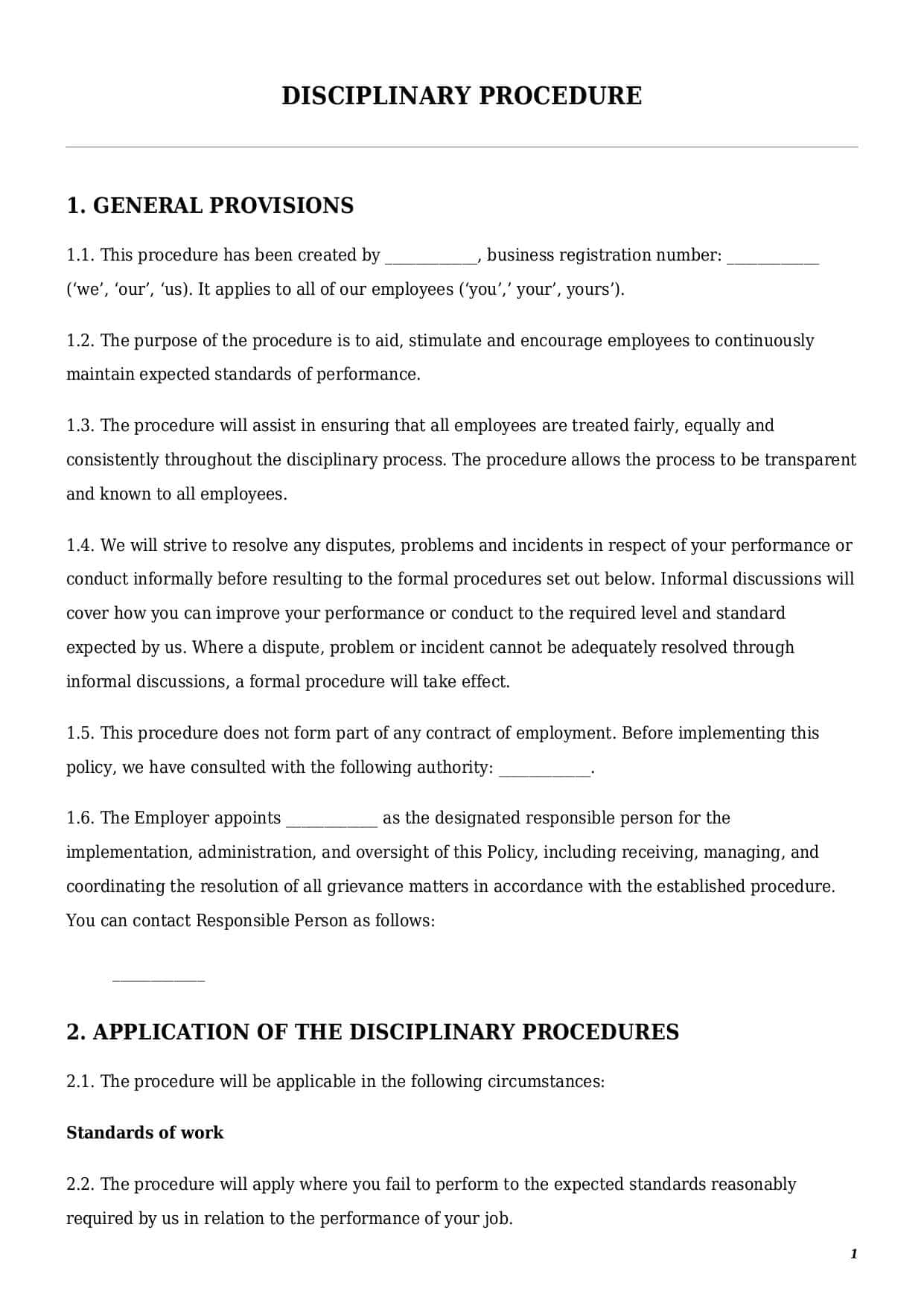
What is a disciplinary policy in the UK?
A disciplinary policy template is a company’s document that defines the internal procedure of managing, investigating and preventing employees’ misconduct and poor performance at the workplace. This document defines:
- types of conduct that shall be prohibited in the workplace;
- list of measures that apply in case of such misconduct;
- responsible staff for the investigation process and implementation of this policy.
The present disciplinary procedure policy template helps UK employers to effectively manage investigation procedures related to misconduct and poor performance in line with ACAS guidelines and best UK employment practices.
Why do UK employers need a disciplinary policy template?
A solid disciplinary policy template UK plays a central role in the company’s internal management of the behaviour of employees in the workplace. If you run a business in the UK, having this type of policy:
- helps to ensure compliance with the UK employment laws, including ACAS guidelines;
- ensures consistency in equal application of the policy towards all employees within the organisation;
- maintains standards of workplace behaviour throughout all departments and branches of the organisation;
- prevents unfair dismissal or treatments of employees in the course of disciplinary investigations;
- ensures that employees are aware of consequences of misconduct and poor performance in the workplace.
What should this disciplinary policy template include?
A disciplinary policy template UK shall have a mandatory structure defined by the ACAS guidelines. A standard template must include the following:
Scope of Application
A disciplinary rules and procedures template should clearly outline the types of misconduct and unsolicited behaviour that are being covered by the policy.
According to the UK employment law, there are two main categories of offence at the workplace that can trigger application of the present policy:
- General Misconduct. This category includes failure to follow industry-specific expected standards and reasonable expected standards for the performance of the job, failure to comply with other employers’ policies, absenteeism or unpunctuality.
- Serious Offences and Gross Misconduct. This category usually includes criminal activity at work, theft, falsification, bullying, harassment, victimisation, drug misuse in the workplace, and failure to comply with the safety rules.
Disciplinary Investigation Procedure
An ACAS-compliant disciplinary procedure template should outline rules for conducting internal investigations. Their rules usually include the following:
- requirements for recordkeeping of all procedures;
- list of responsible persons for implementation of the procedures (such as HR coordinator or HR manager);
- timeline for performance of the investigation (for example, a formal hearing should be organised within 5 days of issuance of the warning).
Disciplinary Outcomes
A well-drafted disciplinary policy and procedure template shall list all the outcomes the employee may face upon commitment of a disciplinary offence. The type of the applicable measure largely depends on whether it is a minor or serious misconduct.
- Formal written warnings. An employee should be notified in writing about found minor issues in the conduct or performance. The warning should also suggest areas for the improvements and the improvement period. Upon issuance of the written warning, an employee should have the right to appeal it.
- Dismissal. Termination of the employment relations is only possible if the employee fails to make improvements set out in the final warning. The employee should have the right to appeal such a decision within the period of time stated in the policy. Immediate dismissal is only possible in a case of gross misconduct such as theft or criminal activity.
- Suspension. In case of serious misconduct, the employer may suspend the employee from working duties for the whole period of investigation. This is an extreme measure that is being applied only in the case when the employee may pose a danger or risk to other employees or the employer’s property.
General Provisions
The text of the policy should also outline:
- employer’s full name and business registration number according to the Companies House;
- effective date of this policy;
- list of categories of employees to whom this policy shall apply (for example, casual workers, remote employees, and full-time employees); and
- approval of the trade union (provided there is an effective trade union agreement in place).
What are the main benefits of this company disciplinary procedure template?
By customising this policy template with FasterDraft, you get a document with the following benefits:
- a policy that is specifically designed for application in England, Wales, Scotland and Northern Ireland;
- a policy that is created by solicitors and never by AI;
- a policy that complies with the Employment Rights Act 1996, the Equality Act 2010 and ACAS guidelines on disciplinary and grievance procedures;
- a policy that can be used by SMEs, startups, and big companies operating in the UK;
- a policy with a professional structure;
- a policy that can be instantly used by your organisation immediately after the purchase.
What is the difference between a disciplinary policy template and a code of conduct?
Both the disciplinary policy and procedure template and the workplace code of conduct enforce the standard of professional behaviour and conduct at the workplace. However, they differ in their scope, purpose and grounds of application.
A workplace code of conduct establishes rules of behaviour so that all employees, workers and staff within the organisation act and perform in accordance with clearly defined standards. According to ACAS guidelines, all employees should be well aware of types of behaviour which are acceptable and which are not. It is easier to think about the workplace rules as the golden standard of behaviour.
A disciplinary procedure template UK allows employers to monitor and evaluate regularly the conduct of their employees and apply disciplinary measures to those who fail to follow the rules. In this regard, a disciplinary procedure policy template acts more as a set of measures and instruments the employer has to enforce better behaviours and conduct of their employees.
Both policies are essential HR documents most UK employers prefer to have.
How to customise this disciplinary policy template with FasterDraft?
To get a fully customisable policy template, follow a few easy steps below:
- Click the “Create Document” button.
- Answer simple questions in the form.
- Select a template’s format – disciplinary policy template PDF or Word.
- Make a payment.
The document is ready for instant download and implementation immediately after the purchase.