

.svg) USA
USA.svg) Australia
Australia

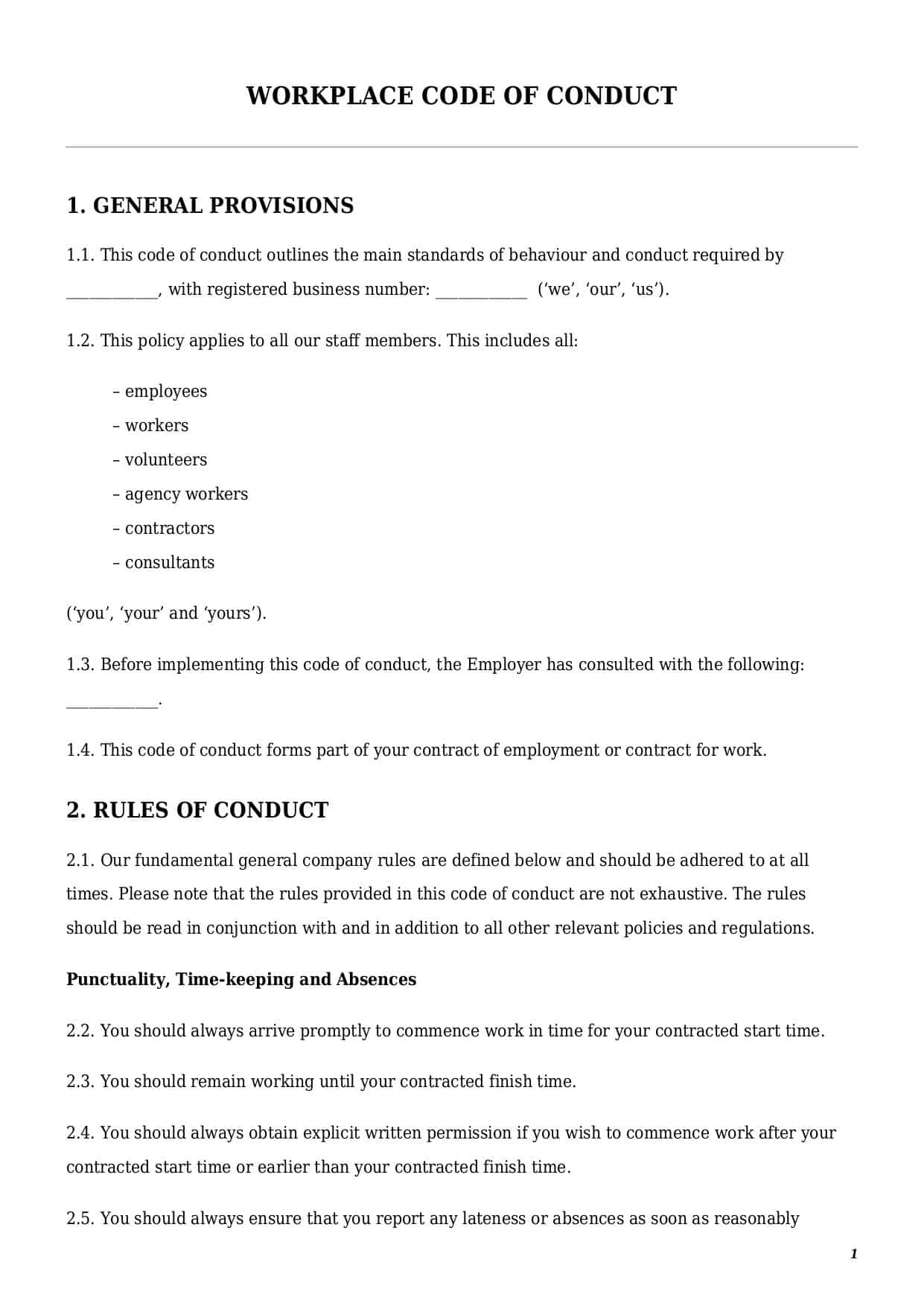
What is the workplace code of conduct in the UK?
A workplace code of conduct, also known as an employee code of conduct, is an internal HR document that includes a set of rules and requirements all employees and staff should follow while in the workplace. A standard code of conduct policy defines the scope of acceptable behaviour at the workplace, including acceptance of gifts, relationships between employees and with customers, dress code and uniform requirements, etc.
This document sets up the main legal foundation for standards of behaviour in the workplace. Therefore, the importance of the present document is hard to underestimate.
A code of conduct is a foundation for rules and standards of behaviour for employees in the workplace and is often being used in conjunction with various other policies, such as disciplinary, anti-harassment, grievance and other policies.
Who shall use this code of conduct for employees?
Having a code of conduct for employees is a standard business practice many UK employers follow nowadays. This policy can be customised for use by:
- growing startups and small companies at the phase of entering the market;
- well-established UK businesses;
- businesses operating in hospitality where the employee’s conduct, behaviour and dress code are of the highest importance;
- UK employers with big teams;
- retail businesses dealing with customers on a daily basis.
Why do employers need a code of conduct policy template?
If you are a business owner in the UK or a startup founder and are still hesitating over whether your company should have a code of conduct for employees, consider three important considerations below.
Employee Expectations
The policy helps to clearly outline what is expected from an employee in terms of behaviour at the workplace. This allows employees to quickly align their standards and work culture with the employer’s requirements.
For example, Luke has recently joined the new position in the team of accountants in the mid-tier firm in London. At his previous job Luke used to be late for work every morning for around one hour. Though this is not acceptable to the new employer. After reading the policy, Luke is being instructed that lateness may result in disciplinary proceedings and termination of employment. Now, Luke better understand what is expected from him at the new workplace.
Legal Compliance
In the UK there is no single law that mandates employers to have a written code of conduct for employees.
At the same time, separate legislative acts such as the Employment Rights Act 1996, the Equality Act 2010, and the Health and Safety at Work Act 1974 define a number of important compliance obligations for employers. For example, employers must ensure the workplace is a safe place for everyone and exclude any harassment, bullying or discrimination.
With this in mind, the creation of a unified document ensures better compliance with UK employment law.
HR Consistency
A standard code of conduct policy template helps HR departments and compliance managers to better monitor the workplace environment for spotting any violations or misconduct.
On top of that, a solid policy ensures smooth and even application of the same standards of behaviour across different departments within the same organisation.
What are the benefits of using this UK company code of conduct policy template?
By customising this template with FasterDraft, you get the document with the following benefits:
- a policy created by solicitors, never by AI;
- a policy that is fully compliant with the Equality Act 2010, the Employment Rights Act 1996 and recent ACAS guidelines;
- a policy that is editable in PDF and Word;
- a policy that is suitable for businesses operating across England, Wales and Scotland;
- a policy with a clear structure and professional wording.
What should be included in the employee code of conduct sample?
There is no gold standard UK employee must follow when creating an employee code of conduct sample. However, there is a list of the most common elements without which the creation of a solid workplace policy is not possible.
Employer’s Details
The text of every company code of conduct policy in the UK must define the employer’s full name and business registration number.
The business has to appoint a specially designated employee who will be in charge of the implementation of this policy in the workplace. This could be a head of the HR department, an HR specialist, a compliance manager or any other officer within the organisation. The policy must also outline full contact details of such a person, including their full name, working hours and contact details.
Punctuality
Time is of an essence for most employers. That is why the sample employee code of conduct policy includes the following:
- start time and end time of the workday;
- requirements to recordkeeping working time;
- requirements to log in/check in upon entering the office, etc.
Dress Code
The appearance and look of employees may significantly impact the impression of the company. Therefore, many UK employers are keen to set up strict rules related to dress code at the workplace. The standard rules may include the following:
- prohibition of wearing make-up;
- restrictions on wearing jewellery;
- restrictions on length of heels;
- prohibition on visible tattoos, etc.
Under the Health and Safety at Work Act 1974, employers should provide a special uniform to their employees when it is reasonably practicable. For example, warehouses, logistics companies, laboratories, and factories may oblige their employees to wear uniforms and other personal protective equipment at the workplace.
Professional Standards
While every role and position within the company is different, almost all staff and employees within the same organisation are required to follow general standards of professional behaviour. Some of those standards include:
- acting with honesty and integrity while performing job duties;
- treating all other employees, staff, customers and clients with respect in accordance with all relevant equality and diversity requirements;
- avoiding behaviour or decisions that may affect the well-being, health or safety of other employees or yourself;
- informing the line manager or HR department of any wrongdoing under the respective grievance or whistleblowing policies, etc.
How to customise this employee code of conduct sample with FasterDraft?
To get a fully customisable document template, follow a few easy steps below:
- Click the “Create Document” button.
- Answer simple questions in the form.
- Select a template’s format – a code of conduct for employees PDF or Word.
- Make a payment.
The fully customisable policy is ready for instant download immediately after the purchase. Once downloaded, you can use this policy right away for your business.