

.svg)
.svg)
Trade Mark Assignment Agreement
 PDF and
 Word
Word
Whether you're here to understand how trademark assignment actually works under UK law, or you're ready to buy a document template that gets the transfer legally right the first time, this page covers the complete legalities – the legislation behind it, the risks of getting it wrong, and exactly why this template is built to avoid those risks.
Reviews

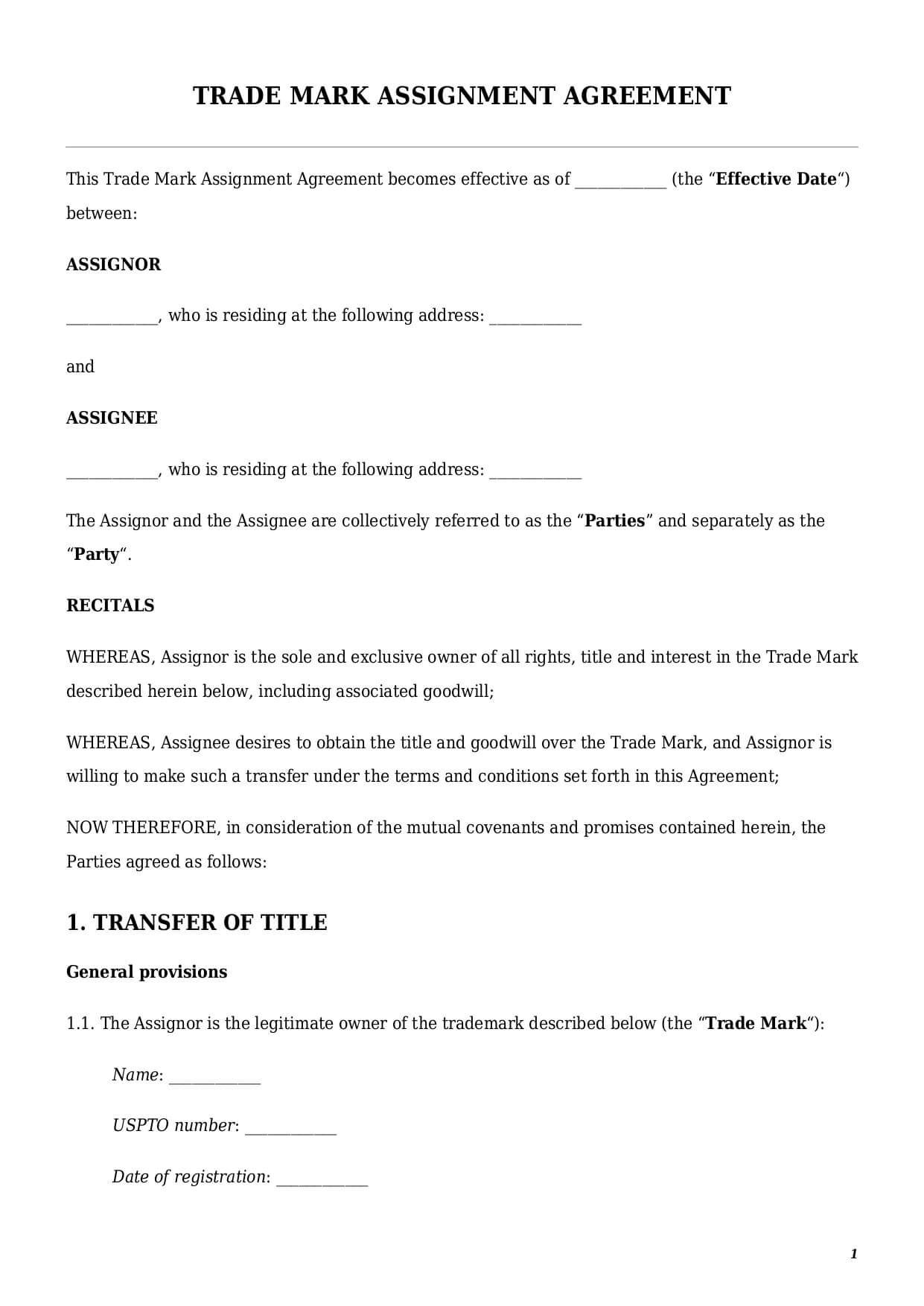
What is a trademark assignment agreement?
A trademark assignment agreement is the legal document that transfers ownership of a registered trademark from one party (the assignor) to another (the assignee). The transfer of the title for the trade mark is permanent, which means that the assignor gives up their ownership of the trade mark forever, while the assignee becomes the new registered proprietor with full rights to use, license, enforce, and further transfer the mark.
This template of a trademark assignment agreement is used to transfer the trade mark in the UK, whether registered or pending. It can be used for various situations, including a business sale, a corporate restructuring, an intra-group transfer, a settlement of an ownership dispute, or a standalone sale of a brand asset.
The assignment of trademark agreement is distinct from a trade mark licence agreement, which grants permission to use a trade mark while ownership stays with the original owner.
What are the benefits of using this template?
By customising this assignment of trademark agreement template with FasterDraft, you get the following benefits:
- Certainty of validity. This template is built to satisfy the statutory formalities outlined in the Trade Marks Act 1994, the Trade Marks Regulations 2008 and the most recent UK IPO practices.
- Protection against the six-month cost trap. Structured so recordal can happen promptly, avoiding the loss of cost recovery rights under section 25 of the TMA 1994 if infringement occurs before the transaction is recorded.
- Reduced negotiation friction. Clear, professionally structured drafting reduces back-and-forth between parties’ advisors, saving time and legal fees on straightforward transfers.
- No AI generation. Our template is drafted by qualified UK solicitors and never by AI.
- Saves legal costs. You get a bespoke and fully customisable legal document at a fraction of a solicitor’s fees.
- Covers the core assignment provisions. This template includes all the things a solid template must have, including scope of transfer, payment terms, warranties, indemnities and more.
- Handles partial and full assignments. Whether you’re transferring an entire registration or only certain goods/services classes or a specific territorial use, the clause structure adapts rather than forcing a full-transfer template onto a partial deal.
- Covers assignment of pending applications, not just granted registrations, since ownership of an application can change hands before registration completes.
- Estimated completion time. 78 % of our users complete this document template within 3 minutes.
What does this trade mark assignment agreement template cover?
Trademark assignment in the UK is governed primarily by the Trade Marks Act (TMA) 1994 and the Trade Marks Regulations 2018. Our simple trademark assignment agreement template covers the following essential clauses:
- Scope of transfer. This section basically defines what is being transferred to the assignee, including the trade mark name, territory scope, and list of categories of services or products for which it could be used. Section 24(2) of the TMA 1994 allows a partial assignment of the trademark, limited to only some of the goods or services. In such a way, the assignor remains an owner of the remaining goods and services for which the trade mark is not being transferred.
- Payment Terms. Our template allows parties to select the necessary payment model to finance the transfer. In the UK, parties usually choose between a one-time fixed fee or a payment made in instalments. The document states that all the payments shall be made in pounds only. If the assignee is willing to make a payment in another currency, the rate of exchange shall be the rate set by the Bank of England at the time that the payment becomes payable.
- Completion Date. The document also outlines the details for the completion date on which the transfer and all formalities between the parties must be finalised.
- Limitation of Liability. The document also provides a standard indemnification clause under which both parties indemnify each other against any liability for loss of profit, actual savings, loss of sales, loss of commercial opportunity, loss of contracts, or loss of goodwill as a result of signing this agreement. However, considering the statutory provisions applicable to UK contract law, the parties’ liability cannot be limited when death or personal injury, fraud or fraudulent misrepresentation, or deliberate default is incurred.
- Governing Law. This template includes a governing law allowing parties to choose the laws of England, Wales, Scotland or Northern Ireland to apply to the provisions of this agreement. Once selected, the courts of England and Wales, Scotland or Northern Ireland should have exclusive jurisdiction to resolve the disputes between the parties.
What are the most common mistakes in trade mark assignments?
One of the most recurring disputes for IPO tribunals in the UK is the dispute related to the assignment of rights over the trade mark. Therefore, parties entering the trade mark assignment agreement should be very careful and keep in mind the following important legal considerations:
Mistake 1: Treating the recordal form as the assignment itself
The Form TM16 is a record of an assignment that has already taken place and is being used to inform the UK Intellectual Property Office (UKIPO) about the change of the assignor’s name for the trade mark. However, the Form TM16 is not a substitute for a properly executed assignment agreement. In fact, the Form TM16 simply confirms completion of the transfer and is purely aimed at finalising the change in registration details.
Mistake 2: Missing or defective signatory authority
An assignment of the trade mark must be signed by someone without proper authority to bind the assignor. If the owner of the trade mark is an individual, the document must be executed as a deed where the assignor’s signature is witnessed by an independent witness.
If, however, the owner of the trade mark is the company, then the company’s director, secretary or another authorised party by virtue of the power of attorney should have the right to sign the document.
Mistake 3: Assuming goodwill must be assigned alongside the mark
The transfer of title and goodwill are separate legal concepts that are being attached to the trade mark and must be clearly assigned in the text of the agreement. If only the title transfer takes place without mentioning the goodwill, in such a case the goodwill will not be considered as transferred per se.
This template ensures that the transfer of the trade mark is fully complete, including the goodwill and any other ancillary rights.
Mistake 4: Forgetting to record the assignment at the IPO promptly
An assignment doesn’t need to be recorded at the UKIPO to be valid between the parties. However, Section 25 of the TMA 1994 states that until an application to record the assignment is made, the transaction is ineffective against anyone who later acquires a conflicting interest in the trade mark without knowledge of the earlier assignment.
Our template includes a standard clause defining each party’s obligations related to the registration of the assignment with the UKIPO as well as how the registration costs will be split up between the parties.
Mistake 5: No warranties on title or validity
Without warranties, the assignee has little contractual recourse if the trade mark later turns out to be invalid, opposed, or subject to a prior undisclosed security interest. Our template prevents such mistakes by including the list of the standard legal warranties below:
- no pending litigations regarding the assignor’s title over the trade mark;
- the trade mark is not the subject of any security or lien agreement;
- the assignor is the sole owner of the trade mark;
- there are no unpaid registration or other fees to the UKIPO;
- the registration of the trade mark is not being disputed by the UKIPO or any other third parties.
Mistake 6: Ongoing licence agreements
The assignee, before signing any agreement, must find out if the trade mark is subject to any ongoing licence or sublicence agreements with third parties. It is important to keep in mind that the assignment of the trade mark does not automatically end any ongoing licence agreement, if any. Therefore, the assignor may want to first read those agreements to find out the terms and conditions of the licence, including its duration.
This is especially important in a situation when there is an ongoing exclusive licence agreement under which even the trade mark owner cannot use the registered trademark. If this is the case, the assignee may not want to proceed with the transfer if their use of the trade mark can be impeded by an ongoing licence arrangement.
Mistake 7: Cost-recovery risk
A delay in registration of the assignment with the UKIPO beyond six months can mean losing the right to recover costs for infringement that occurred in the interim, even if the assignment itself remains valid. While there is no statutory period of time within which the registration should take place, in practice parties typically apply for the registration within the next 15 to 30 calendar days after signing the main agreement.
Who shall use this assignment of trademark agreement?
An assignment of trade mark agreement can be suitable in various situations, including:
- Businesses selling or buying a standalone brand or trademark portfolio, separately from a wider business sale;
- Companies restructuring intra-group ownership of trademarks for tax, licensing, or corporate simplification purposes;
- Individuals or small businesses transferring a single registered mark, such as settling founder/co-founder ownership questions;
- Entrepreneurs willing to start the business in the UK under the already known and registered trademark;
- Lenders and borrowers claiming the assignment of the trade mark as a part of security under the unpaid loan agreement.
This document shall not be confused with the trade mark licence agreement, where the owner of the trade mark gives temporary rights to use its trade mark for licensed products and services in exchange for remuneration. If you are looking for a licence agreement, a separate trade mark licence agreement should be used instead.
This document template is not suitable for the transfer of the patent in the UK.
How to customise this template with FasterDraft?
To get a fully customisable trade mark assignment agreement template, follow a few easy steps below:
- Click the “Create Document” button.
- Answer simple questions in the form.
- Select a template’s format – trademark assignment agreement Doc (Word), or PDF.
- E-sign the document online for free.
- Make a payment.
The document is ready for instant digital download immediately after the purchase.
Try FasterDraft today
We offer bespoke, solicitor-drafted and fully customisable legal document templates for the UK at a range of £6 to £50, depending on the document.
No hidden fees. No “free” subscriptions that turn out to be paid subscriptions. Only a lifetime free licence to use the document is provided.
This article is reviewed by Daria Turanska, a lawyer with 15 years’ contract drafting experience. Fact checked by Sarah Collins.
Table of content
Frequently Asked Questions (FAQ)
-
1. Do I need to assign the goodwill of my business along with the trademark?
No. Since the Trade Marks Act 1994, a UK trademark can be assigned with or without the goodwill of the associated business. This is a deliberate departure from the pre-1994 position and means a trademark can be bought and sold as a standalone asset.
-
2. Does a trademark assignment need to be registered with the IPO to be valid?
The assignment is legally effective between the parties once it satisfies Section 24(3) — in writing, signed by or on behalf of the assignor. However, recording it at the IPO (via Form TM16) is what protects the assignee against later conflicting claims and preserves the right to recover infringement costs, so it should always be done, and done promptly.
-
3. What happens if we don't record the assignment within six months?
The assignment itself doesn’t become invalid, but if the mark is infringed before recordal, the new owner won’t be able to recover costs for that infringement unless the recordal application was made within six months of the transaction (or the court accepts it wasn’t practicable to do so sooner).
-
4. Can a pending trademark application be assigned, or only a granted registration?
A pending application can be assigned in the same way as a granted registration. The assignment agreement should expressly cover this if the transaction includes marks that haven’t yet completed registration.

Looking for something Different?
Start typing to find out our collection of legal documents and contract templates