

.svg)
.svg)
Trademark Licence Agreement
 PDF and
 Word
Word
Whether you're licensing your trademark to a manufacturer, a franchisee, a distributor, or a merchandising partner, the way the document determines whether your brand remains protected or gradually becomes something you no longer fully control. A properly drafted trademark licence agreement sets out exactly what's being licensed, how it can be used, and what happens if the relationship ends.
Reviews

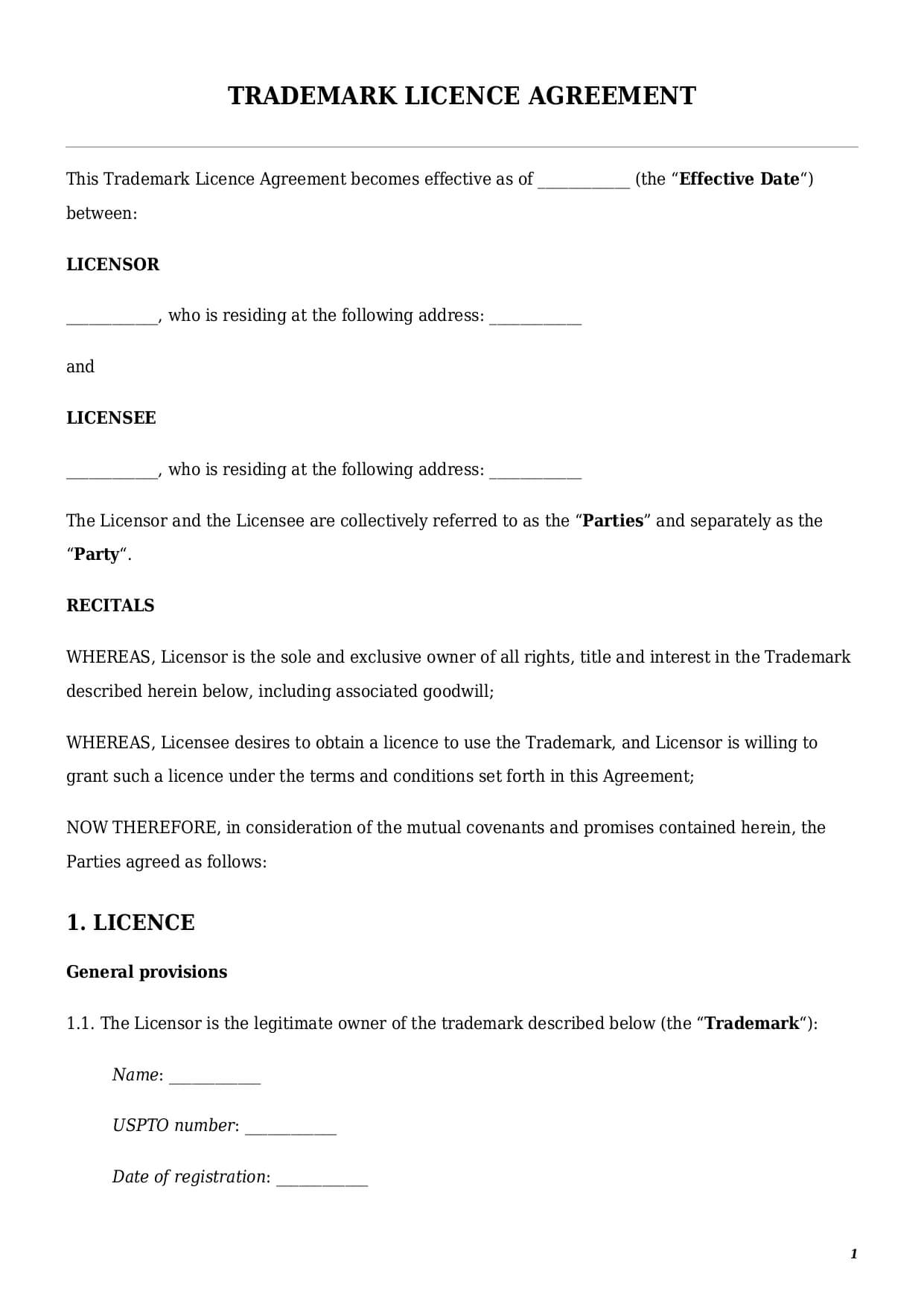
Why is this template right for your business?
This fully customisable template of a trademark licence agreement is suitable for:
- For trade mark owners. This template protects the value of your brand. It includes the quality-control mechanisms, approval rights, and termination triggers that prevent a licensing arrangement from quietly eroding your trademark’s reputation.
- For entrepreneurs willing to scale their business with a recognisable trademark. This template gives you clarity and security. It defines exactly what you’re permitted to do, for how long, and on what terms – reducing the risk of a licensor unilaterally changing the arrangement or terminating it without proper notice.
- For businesses willing to save legal costs. This template gives you a professionally structured starting point — covering scope, quality control, royalties, registration, infringement, and termination — at a fraction of that solicitor’s legal cost, with the flexibility to adapt every clause to your specific commercial arrangement.
What is a trademark licence agreement?
A trademark licence agreement is a contract in which the owner of a registered trademark (the licensor) grants another party (the licensee) permission to use that trademark without transferring ownership of it. The document outlines the details of the trademark, payment terms, scope of use, duration, territorial application and applicable warranties.
Under the trademark licence agreement, the licensor keeps the trademark, while the licensee gets a defined, contractual right to use it for specific goods or services, in a specific territory, for a specific period, and subject to whatever quality and usage controls the licensor requires.
This document template fully aligns with Sections 25 and 37-31 of the Trade Marks Act (TMA) 1994 and the Trade Marks Regulations (TMR) 2018.
What does this trademark licence agreement template include?
Our template includes all necessary legal clauses to ensure that the final document is fully enforceable across the UK and provides solid legal protection for both parties involved, including:
- Details of the Parties. Include the full name, registered business address, and contact information of the trademark owner (licensor) and the person willing to use the trademark (licensee).
- Grant of licence clause. This clause must define precisely the details of the trademark that is being licensed. This document template can be used for an already registered trademark or a trademark pending registration with the UK Intellectual Property Office (UKIPO) under Section 27 of the TMA 1994.
- Conditions of licence. This section of the document must define the type of the licence (exclusive, sole, or non-exclusive).
- Scope of use. In this section of the document parties must outline the list of goods, services or products which are being licenced; the territorial scope of the licence; and the permitted manner of use.
- Duration and renewal. This template also defines the duration of the licensing, including fixed term, renewal mechanics, and what happens on expiry.
- Quality control provisions. In this template, the licensor gets the right to approve how the mark is used and to inspect goods or materials bearing it, protecting the mark’s reputation and distinctiveness.
- Royalty and payment terms. The document template allows parties to customise the preferred payment model for their licensing arrangement, including a fixed fee, a royalty percentage, or both.
- Sub-licensing rights. The parties must clearly outline if further sublicensing is allowed.
- UKIPO registration clause. It is important to outline in the text of the agreement who shall be responsible for submitting this agreement for registration, including the allocation of registration costs between the parties.
- Conditions for termination. The parties must agree on the exact list of termination triggers, including breach of quality standards, non-payment, insolvency, and change of control.
- Post-termination obligations. This section outlines post-termination obligations of the licensee, including to stop using the trade mark and remove it from stock, marketing, and signage within a defined period.
- Governing law and jurisdiction. The parties should be able to select the laws of England and Wales, Scotland or Northern Ireland to be the applicable law for this agreement.
Trademark licence vs trademark assignment — key differences
This is one of the most important distinctions to get right before you start drafting, because the two documents do fundamentally different things. These two agreements differ as follows:
- Scope. Under the trademark assignment agreement, the licensor transfers all existing rights to the trade mark, while under the licence agreement the licensee gets only a portion of such rights.
- Duration. The transfer of the trade mark under the assignment agreement is permanent. On the other hand, a transfer under the licence agreement is temporary and fixed in time.
- Right to sue for infringement. The new owner under the assignment agreement receives the whole scope of rights to sue for any infringement of a trademark without limitation. To sue for infringement, the licensee requires getting prior written approval from the licensor.
If you want to keep the trade mark and let someone else use it under your control, you may need a trade mark licence agreement template. If you’re permanently transferring ownership – selling the brand outright or transferring it as part of a business sale – you need an assignment agreement instead.
Types of trademark licence in the UK
The most common types of licensing available for a trade mark in the UK are the following:
Exclusive licence
This type of licence is fully regulated by Section 29 of the TMA 1994. Only the licensee can use the mark within the licensed scope — not even the licensor. This gives the licensee the strongest position and typically commands the highest royalty or fee since the licensor is giving up its own right to use (or further license) the mark for that scope. However, there is one interesting pitfall in being involved in this type of licence. An exclusive licensee also has the same rights against a successor in title (someone the licensor later sells the mark to) as they had against the original licensor, provided that successor is bound by the licence. An exclusive licensee gets essentially the same rights and remedies as the trademark’s actual owner would have – including the ability to bring infringement proceedings in their own name independently.
Non-exclusive licence
The licensor can grant the same rights to multiple licensees simultaneously and can continue using the mark itself. Common for franchising and broad merchandising arrangements where the licensor wants multiple partners operating in parallel.
A non-exclusive licensee doesn’t automatically have the right to sue an infringer directly — instead, they can call on the trademark’s proprietor to take action. If the proprietor refuses or fails to do so within two months, the licensee can bring proceedings in their own name as though they were the proprietor. Since amendments were made by the TMR 2018, Section 30(1A) also makes clear that, unless the licence says otherwise, a licensee can only bring infringement proceedings with the proprietor’s consent – so this needs to be addressed explicitly in your agreement, not left ambiguous.
What are the risks of not having a proper licence agreement?
Licensing of IP rights is a very sensitive legal matter, which should be approached carefully. Using free or AI-generated templates is risky and may have serious negative legal consequences.
By customising this template with FasterDraft, you get a fully customisable and bespoke legal document that protects your business from the following risks:
Risk 1: Losing control over your brand’s reputation
Without clear quality control provisions, you have no contractual mechanism to stop a licensee producing substandard goods under your mark — and consumers won’t distinguish between your own products and a poorly made licensed product bearing your name.
Our template includes a strong legal clause ensuring the licensor’s right to regular quarterly monitoring of produced licensed goods. On top of that, the parties can also align the production of licensed products in compliance with the licensor’s brand specification, style and identity.
Risk 2: Disputes about scope
Without a clearly defined scope of use, there are disagreements about what the licensee is actually permitted to do. Our template prevents this legal risk by allowing parties to clearly define the following:
- Which products are allowed to be produced under the licensed trademark?
- Which territories are covered by the licence?
- Which marketing channels are being used to supply, sell or distribute licensed products?
Risk 3: No clean exit
Without termination and post-termination provisions, ending a licensing relationship — even where the licensee has clearly breached the agreement — becomes far harder to enforce, and a former licensee continuing to use your trade mark after the relationship has ended is a genuine, ongoing infringement risk you created for yourself by not documenting the exit terms upfront.
This template ensures that the parties are able to outline a clear exit strategy, including the following:
- notice period for termination of the contract in a no-breach scenario;
- notice period for termination of the contract in case of either party’s breach;
- insolvency of either party;
- non-renewal of the ongoing trademark registration.
Risk 4: Competition law exposure for restrictive terms
Exclusive and territorially restricted licences can, in some circumstances, raise issues under the Competition Act 1998 — particularly where a licence includes restrictions that go beyond what’s reasonably necessary to protect the trademark itself (such as broader market-carving arrangements between competitors). This is a specialist area, and licences involving significant market power or cross-border restrictions should be reviewed with competition law advice in mind.
Most common mistakes to avoid with trademark licence agreements in the UK
Once the parties sign and execute the trademark licence agreement, they may think this is the end of all formalities. However, this is where the parties to the newly signed agreement should be especially cautious and aware of the following:
Mistake 1: Assignment vs Licence
Sometimes parties rush into signing an agreement without properly clarifying each party’s contractual intent. The main legal trick with intellectual property rights is that not all businesses and individuals may understand the legal difference between assignment and licensing. As a result, either party may end up with the enforceable agreement that they never wanted to sign in the first place.
An assignment agreement is aimed at transferring the title for the trademark and all ancillary rights from one party to another. Under the assignment agreement, one party ceases to be the owner of the trademark by transferring their ownership to the other party. A trademark licence agreement allows the party to transfer only certain rights to use the trademark in a specific way without losing the title.
Mistake 2: Confidentiality Terms
The second step, once the licence agreement is signed, is to proceed with signing a separate non-disclosure agreement, also known as an NDA. A non-disclosure agreement restricts both parties of the agreement from disclosing any terms and conditions they have agreed upon. Having a separately signed NDA is especially recommended in a situation where the licensor issues a non-exclusive licence. For example, imagine party A issues the licence to use their trademark to party B for one price and the same licence to party C for a significantly lower price. Once the licence agreement between party A and party B expires, party B may request to negotiate terms the same as party C currently has. To prevent this, a solid confidentiality agreement should prevent party B and party C from exchanging information about the conditions of the licence between each other.
Mistake 3: Never registering the licence
Registration of the trademark licence agreement in the UK is addressed in Section 25 of the TMA 1994. Registering a trademark licence with the UKIPO is not mandatory for the licence itself to be valid between the parties — but Section 25(3)(b) is unambiguous: until an application has been made to register a licence, the licensee doesn’t have the protection of Sections 30 or 31 at all.
The safest, simplest position remains straightforward: register your licence with the UKIPO, and don’t leave your enforcement rights depending on a contested point of law.
The registration of the contract should be performed at any time.
Mistake 4: Leaving quality control vague or absent entirely
Many trademark licence agreements do not include a quality control clause, or the included clause has vague wording. That means that once the conditions of the licence are compromised by the licensee or the quality of products/services does not correspond with the trademark standards, the licensor may have no efficient legal tool to stop the violation.
Our template prevents this risk by including the following licensee’s obligations related to the quality and marketing control for licensed products and services:
- Licensed products must meet standards and requirements set out in brand specifications.
- Licensed products shall not be of a quality lower than the minimum standards applicable for the industry.
- Distribution, sales and supply of licensed products should be made in full compliance with applicable legal, regulatory and industry-specific standards.
- The licensor should have the right to monitor and inspect the licensee’s compliance with the licence, etc.
Mistake 5: Ignoring the difference between exclusive and non-exclusive licences
The difference between ‘exclusive’, ‘sole’, and ‘non-exclusive’ has real commercial and legal consequences — don’t leave this ambiguous, and make sure the agreement uses the correct statutory language if you intend a genuinely exclusive licence under Section 29 of the TMA 1994.
Why choose this template for licensing trademarks in the UK?
By customising this document template with FasterDraft, you get the document with the following benefits:
- a template that fully aligns with the Trade Mark Act 1994, Trade Mark Regulations 2018 and the Competition Act 1998;
- a document that is created by qualified UK solicitors and never by AI;
- a document that is fully customisable for the needs of your business;
- a real legal document, not a generic one or a multijurisdictional template;
- a document available for instant digital download and use right after the purchase.
How to use this template?
To get a fully customisable trademark licence agreement template, follow a few easy steps below:
- Click the “Create Document” button.
- Answer simple questions in the form to fully customise the document for your business needs.
- Select a template’s format – Word or PDF.
- Make a payment.
- Download in Word or PDF format.
Both parties sign and register the licence with the UKIPO promptly after signing.
Try FasterDraft Today
We offer bespoke solicitor-drafted and fully customisable legal document templates for the UK at the range of £ 6 to 50, depending on the document.
No hidden fees. No “free” subscriptions that turn out to be paid subscriptions. Only life-time free licence to use the document.
This article is reviewed by Daria Turanska, a lawyer with 15 years’ contract drafting experience. Fact checked by Sarah Collins.
Table of content
Frequently Asked Questions (FAQ)
-
1. Do I have to register a trademark licence in the UK?
No, registration isn’t mandatory for the licence to be valid between the parties. But under Section 25(3)(b) of the Trade Marks Act 1994, the licensee doesn’t get the enforcement protections under Sections 30 and 31 until an application to register the licence has been made — so while technically optional, registering promptly is strongly advisable in almost every case.
-
2. Can a trademark licence be exclusive?
Yes. An exclusive licence, as defined in Section 29 of the Trade Marks Act 1994, gives the licensee sole use of the mark within the licensed scope, excluding even the licensor itself. This must be drafted clearly to match the statutory definition if genuine exclusivity is intended.
-
3. How long can a trademark licence last?
There’s no statutory maximum. It depends on what the parties agree, provided it doesn’t exceed the term of the underlying trademark registration itself (which is renewable indefinitely, in 10-year periods).

Looking for something Different?
Start typing to find out our collection of legal documents and contract templates