

.svg) USA
USA.svg) Australia
Australia

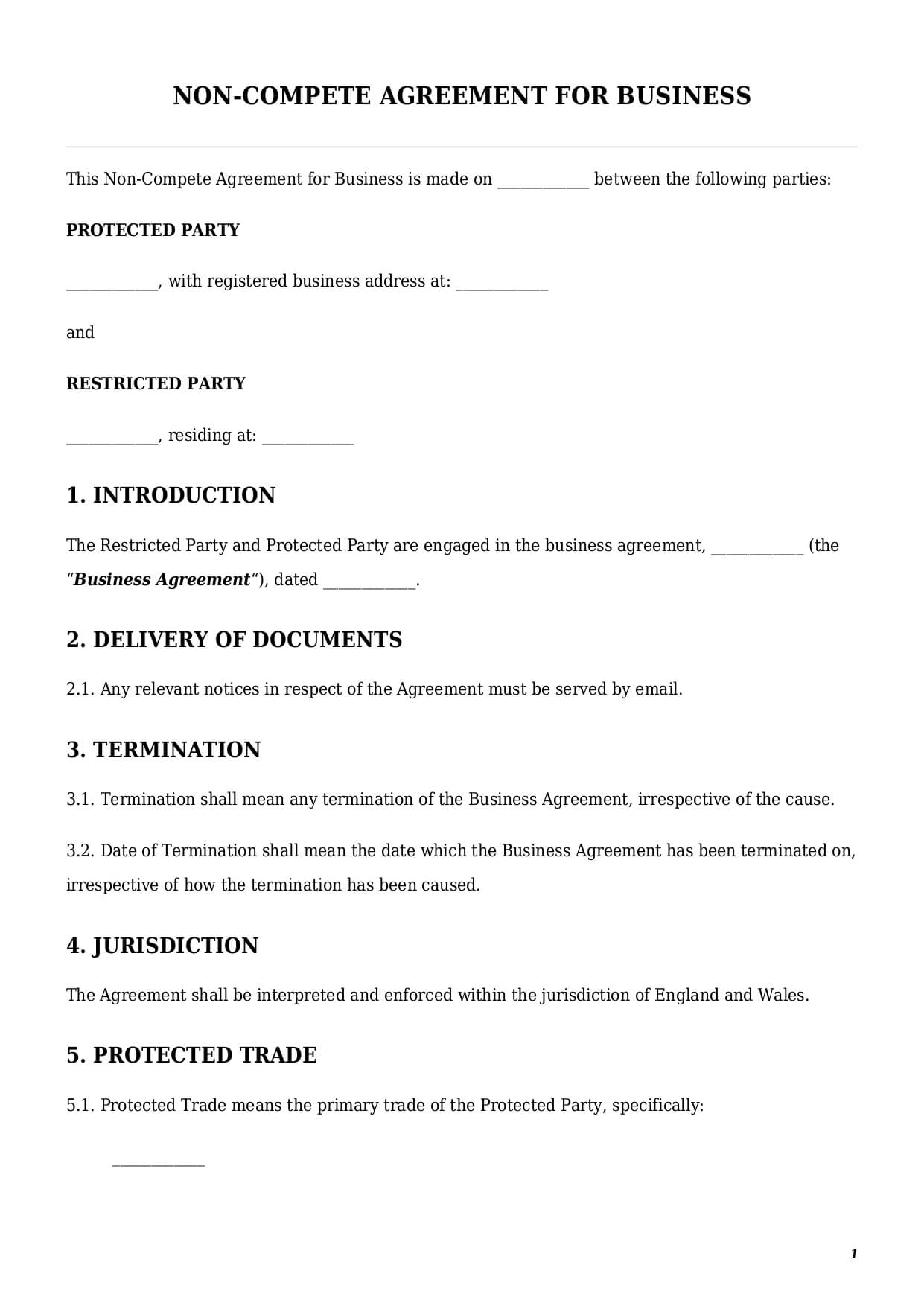
What is a non-compete agreement for business?
A B2B non-compete agreement is a non-compete agreement for business: a commercial contract used between businesses to restrict one company from competing with another for a defined period and within a defined territory after a specific commercial transaction or business arrangement. UK businesses use it to protect legitimate commercial interests such as goodwill, client relationships, market position, key staff connections, and supply arrangements from immediate competition that could undermine the value of the deal.
It is typically used after a sale of business, at the end of a joint venture, when signing a services agreement, or on exiting a general or limited liability partnership. This page is aimed at UK small business owners, entrepreneurs, freelancers, founders, and companies that need a business-to-business restraint tailored to those situations.
You will find what a B2B non-compete is for, the key clauses usually included, how to draft and customise the terms so they are more likely to be enforceable under UK law, the difference between a business non-compete and an employee non-compete, and the main legal risks to watch before using the template.
This template is not intended to restrict a former employee from competing with a former employer. In such a case, a separate employee non-compete agreement should be used instead.
Why choose this non-compete agreement template?
By customising this template with FasterDraft, you get the document with the following benefits:
- UK-focused. Every clause is written with reference to the English law doctrine of restraint of trade. The document can be used throughout England and Wales by different types of businesses.
- Fully customisable. This document can be used to customise for various purposes to protect the legitimate interest in a sale-purchase transaction, joint venture collaboration, provisions of services or goods arrangement, etc.
- Real document. This template is created by qualified UK solicitors. We do not offer AI-generated documents to ensure high-quality templates for our users.
- Various restrictive covenants. Parties to this non-compete agreement can choose which restriction should or should not be added to the final document.
- Professional layout. The final document is available for instant digital download in both PDF and Word. The document has a professional layout and is written in plain English.
Core non-compete clauses to protect legitimate business interests in a B2B non-compete agreement
A solid and well-drafted non-compete agreement for a UK business should include a number of important conditions. These conditions include:
Details of the Parties
A non-compete agreement for a business in the UK shall include detailed information about the protected and restricted party. A protected party is a business or corporate entity that wants to limit the trading of the other party in the future. A restricted party is the other party to the ongoing business transaction or contract, which is being restricted from doing certain trading actions in the future.
A confidential information clause
It is not typical for a non-compete agreement to include a confidentiality clause. Usually, parties prefer to have a standalone document to prevent competition and protect confidential information from disclosure. It is also common for a confidentiality clause to be included in the original business agreement between the parties.
A clause defining legitimate business interests
The well-drafted template should clearly identify which business interest of a protected party is aimed to be protected. For example, this can be goodwill, client connections transferred, investment made, etc. This is a particularly important clause during the enforceability test in the UK courts. To rule out the case, the courts in England and Wales are trying to figure out what the initial purpose of the non-compete agreement is and what parties aim to protect in the first place. A clear wording of the document can significantly facilitate the enforceability test in favour of the protected party.
A duration field for post-completion restriction
Unlike with a non-disclosure agreement, a business no-compete clause in the UK can become effective only upon termination of business relations between the parties. The document should outline:
- the start date – a clearly defined restriction period tied to a specific event (e.g., completion of sale, end of the JV term); and
- specific duration, indicated in weeks or months.
A geographical scope
The document must clearly define the territory within which the competition should be restricted. Usually, there is a geographic area in which a protected party normally does their business, including a specific county or city. Court of England and Wales rarely enforces worldwide or throughout the UK geography scope, unless in a specific number of cases. For example, when the protected party can genuinely prove operation worldwide through the subsidiary and real clients.
A list of restrictive activities
The last important element of every B2B non-compete clause in the UK is to list all the actions that the restricted party shall refrain from doing. For example:
- Soliciting current supplies. If the restricted party has access to the list of the protected party’s current suppliers of goods and services, the present solicitation clause may help. By inserting the present clause, the restricted party is being prohibited from directly approaching or soliciting in any other way specifically named suppliers. It is important to ensure that the list of suppliers must only include businesses and individuals with whom the restricted party have had direct connections during the business relations with the protected party. All in all, the non-compete clause cannot protect all suppliers in general.
- Soliciting current employees. The parties can also limit the restricted party’s ability to hire, offer employment or seek any direct professional contact with the current employees of the protected party. Same as with the suppliers, it is not possible to apply a non-solicitation clause towards all employees and future hires. The present clause can only be enforced regarding the specific list of employees directly defined in the non-compete agreement.
Drafting tips for enforceability under UK law
English law treats every restraint of trade as prima facie unenforceable unless the party relying on it proves it goes no further than necessary to protect a legitimate interest. Because legal standards for enforcing non-compete agreements vary by jurisdiction, the drafting points below are specific to England and Wales. This principle traces back to the House of Lords’ foundational reasoning in Nordenfelt v Maxim Nordenfelt Guns and Ammunition Co [1894], and it still governs how a court reviews a commercial restrictive covenant in the UK today. Practical drafting points that follow from this, bearing in mind that UK courts interpret non-compete clauses narrowly and, in employee cases especially, tend to resolve ambiguity in favour of employees:
- Link the restriction expressly to a business interest. State plainly what interest is being protected — goodwill paid for, confidential information shared, customer relationships transferred — and tie the scope of the restriction directly to that interest.
- Narrow the scope to necessary activities. A restriction covering the restricted party’s entire business, when only one product line or client segment is genuinely at risk, invites a court to strike the whole clause down rather than rewrite it for you.
- Align duration with commercial necessity. Ask what the restriction is actually buying: time for goodwill to transfer to new ownership, time for a new market entrant to establish itself, or the length of a joint venture term. A restriction that runs longer than that commercial justification is a weak point, not a safety margin.
- Watch for overbroad territorial restrictions. A worldwide or UK-wide restriction is difficult to justify where the business genuinely trades in one region or sector. Match the territory or geographical area field to where real competitive harm could actually occur.
- Document the investment or goodwill being protected. Keep a clear record — in the agreement itself and in supporting deal documents — of what was paid, transferred, or disclosed that justifies the restriction. This evidence is often decisive if enforceability is ever challenged.
Distinguish between employee non-compete vs business non-compete clauses
The present template can be used for commercial purposes to protect the legitimate business interests of UK businesses. It is not suitable for restricting competition with former employees, such as directors, consultants, and managers. In such a case, a separate employee non-compete agreement should be used instead.
A B2B non-compete clause in the UK shall apply between:
- two corporate entities;
- two businesses, including sole traders operating in the UK;
- businesses and freelancers operating by virtue of service contracts, freelance contracts;
- businesses and contractors are being engaged on grounds other than an employment contract.
From the court’s perspective, restraints on employees are scrutinised far more strictly, on the basis that an individual has less bargaining power and a stronger public interest in being able to earn a living. However, this is not always the case when dealing with court cases between two businesses or contractors.
Legal compliance notes and risk warnings for restrictive covenants
To ensure full legal compliance of a non-compete agreement template before signing it with your counterparty, the following legal considerations should be taken into account:
Seek Legal Advice
Most B2B transactions in the UK may involve significant financial consequences for both parties involved. Therefore, before entering into this business non-compete agreement, seek professional legal advice first. The list of solicitors can be found on the Law Society web page. Seek further guidance where the deal could affect business operations or raise risks specific to your industry.
No automatic remedies
Many businesses wrongly assume that, after a breach, the protected party can immediately take legal action and recover compensation for loss or damage. However, remedies are not automatic, and injunctions can be issued to prevent further breaches only where the court considers them justified. That means that in each specific case, the protected party should be able to prove the violation. Parties also often start by sending cease and desist letters before court proceedings. Successful enforcement may also involve additional costs, and legal costs may be awarded to the successful party.
Avoid broad restrictions
If you want to be able to effectively enforce the non-compete clause in the future, broad drafting can create ambiguity, so the clause should be precise to avoid ambiguity. A non-compete clause that is wider than necessary in scope, duration, or territory is not simply “unlikely to be enforced” — a court may strike it down entirely rather than rewrite it to something reasonable, leaving the protected business with no restriction at all. To support enforceability, such clauses should match a specific purpose, such as protecting competitive advantage by helping protect sensitive information, proprietary information, trade secrets, confidential knowledge, customers, and existing relationships from misuse by a competitor.
In the recent case Literacy Capital Plc v Webb [2024] EWHC 2026, the court refused to maintain the non-compete restrictions by considering them too “long, geographically too wide, and restricted to too broad a range of business activity”. The initial duration of the non-compete clause of 10 years was not maintained by the court, same as “worldwide restriction” when the nationwide geographic scope wasn’t justified by evidence that the company traded outside two counties.
How to customise this non-compete agreement for a business in the UK?
To get a fully customisable document template, follow a few easy steps below:
- Click the “Create Document” button.
- Answer simple questions in the form.
- Select a template’s format – PDF or Word.
- E-sign the document online (for a protected party only).
- Make a payment.
The document is ready for instant digital download immediately after the purchase.