

.svg)
.svg)
Advance Decision to Refuse Treatment
 PDF and
 Word
Word
Legally binding under the Mental Capacity Act 2005 when correctly made. This template gives you an editable Advance Decision, plain-English guidance notes, and the exact wording the Act requires if you're refusing life-sustaining treatment.
Reviews

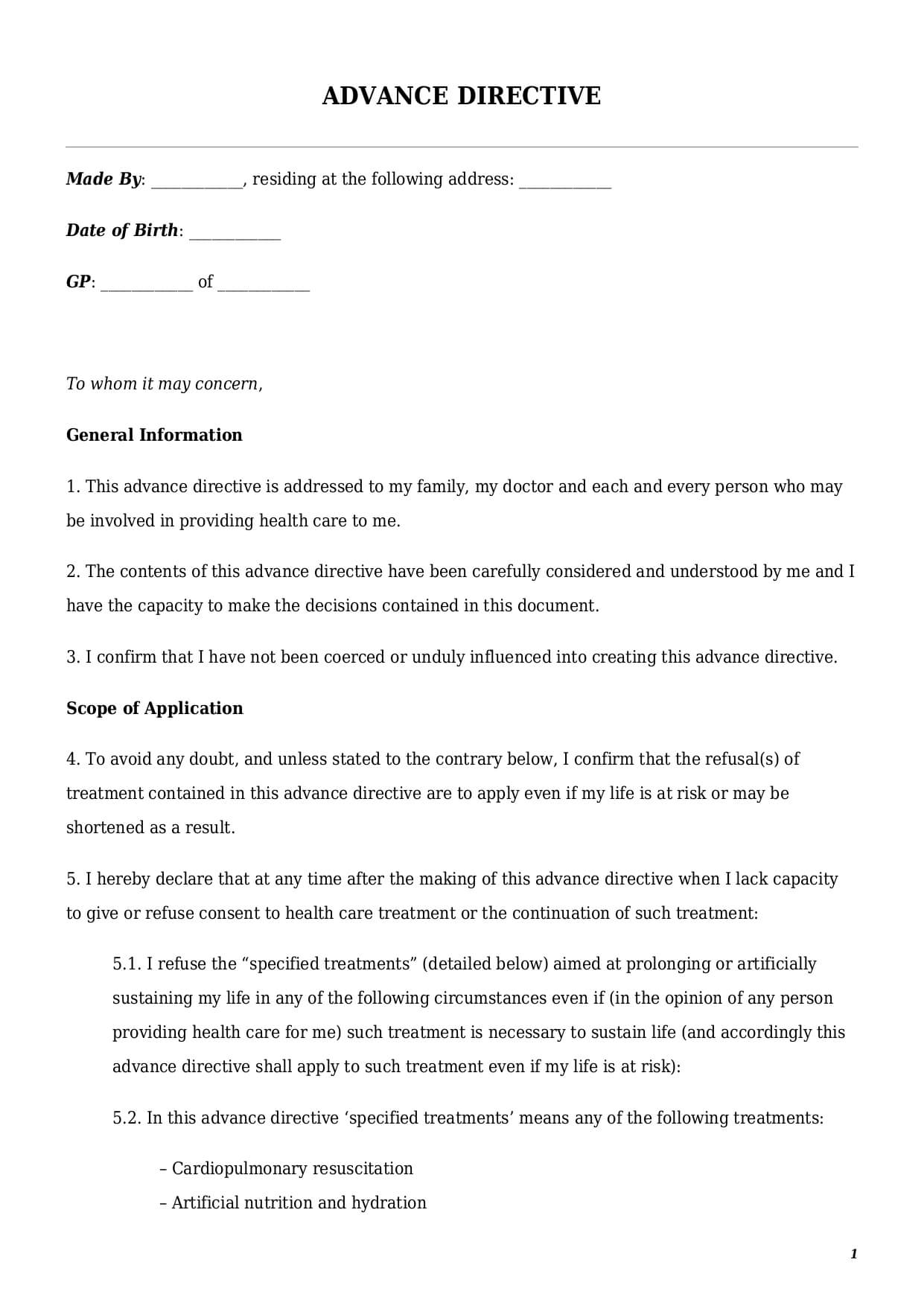
What is an advance directive/advance decision to refuse treatment?
An advance directive (Scotland) or advance decision (England & Wales and Northern Ireland) is a written decision of a person to refuse specified medical treatments in the future when a person may no longer have capacity to make such a decision. The legal enforceability of this document largely depends on the jurisdiction where the person currently resides:
- England & Wales: legally binding under the Mental Capacity Act 2005.
- Northern Ireland: legally binding under the Mental Capacity Act (Northern Ireland) 2016, Part 14.
- Scotland: not legally binding, but clinicians must take it into account under the Adults with Incapacity (Scotland) Act 2000.
Top 4 reasons to have an advance decision
Hesitation regarding having or not having an advance decision to refuse treatment is common, especially if things go normally. However, an advance decision to refuse treatment is made for circumstances that may arise in the future when you may no longer be able to decide.
It does not leave room for “guess”.
Without a properly written decision about your treatment, decisions about the possible medical treatment are being made by default in the “best interests” of the patient in line with Section 4 of the Mental Capacity Act (MCA) 2005.
It clearly defines the scope of “refusal”.
In this text of the advance decision, you can specifically outline medical treatments you want to refuse, including CPR, mechanical ventilation, artificial nutrition and hydration, dialysis, etc. Apart from that, you can also define the list of circumstances in which the directive or decision should apply.
It offers additional protection to pregnant women.
Even when you may generally consent to any of the medical treatments which are done in your best interests, in a situation of a pregnancy or delivery, many patients are willing to explicitly clarify which treatments may or may not apply in these particular circumstances.
It has a legally binding status in England and Northern Ireland.
Advance decisions signed by a patient residing in England, Wales or Northern Ireland become legally binding on clinics and medical professionals. That’s a materially stronger legal status than an informal note, a conversation with your GP, or a verbal wish shared with family.
What treatments or medical decisions cannot be included in an Advance Decision?
While a patient may list specific medical treatment they are willing to refuse, inclusion of the following provisions is not permitted:
- clauses demanding provision of certain medical treatment (an advance decision is a refusal-only instrument);
- clauses authorising a third party to make medical decisions on your behalf (this is covered by a special lasting power of attorney for health & welfare (MCA 2005, ss. 9–14));
- clauses excluding basic or essential care (for example, warmth, hygiene, and pain relief remain in place regardless of what the document says);
- clauses authorising or requesting assisted dying (this is outlawed in England & Wales under Section 2 of the Suicide Act 1961).
Advance Decision vs. Medical Consent — Which document should I use?
An advance decision is commonly confused with ordinary medical consent. Indeed, both documents include a person’s wishes regarding medical treatments or procedures; however, their legal nature remains different.
| Ordinary consent | Advance Decision | |
|---|---|---|
| Form | Can be verbal, written or implied | Must be in writing, signed, witnessed, and include an express statement that it applies even if life is at risk (MCA 2005, s.25(5)–(6)) |
| Purpose | To consent to specified treatments or medication | To refuse specified treatments or medication |
| Takes effect | At the moment of signing | Once the capacity has already been lost |
Is it possible to have a will and an advance decision at the same time?
A will and an advance decision are two separate legal instruments which are being used by individuals to plan their life and death. Since both documents may exist at the same time before a person loses their capacity or dies, it is typical to confuse them. However, these documents are different in legal nature and purposes for which they are being drafted:
| Last Will and Testament | Advance Directive (Advance Decision to Refuse Treatment) | |
|---|---|---|
| Purpose | Sets out how a person’s estate should be distributed after their death and appoints executors and guardians. | Allows a person to refuse specified medical treatments if they lose mental capacity in the future. |
| Legal basis | Wills Act 1837; Administration of Estates Act 1925; Inheritance (Provision for Family and Dependents) Act 1975. | Mental Capacity Act 2005. |
| Main purpose | Estate planning and succession. No authority regarding medical decisions | Healthcare and end-of-life decision-making. |
| Execution requirements | Must be signed by the person in the presence of two witnesses. | Must be signed by the person in the presence of one witness. |
| Can it be changed? | Yes. A person may sign in the presence of two witnesses a codicil or a new Will. | Yes. Can be changed or revoked at any time. |
| Legal effect | Becomes effective once the person dies. | Becomes effective once the person loses their capacity. Ends on the person’s death. |
What should be included in the template of an advance decision to refuse treatment?
A solid template for an advance decision to refuse treatment should include clear wording and a built-in signature and witness block, as well as include the following essential components:
- full name, date of birth and address of a person signing the advance decision;
- information about the NHS number (if registered), full name and registered address of the general practitioner;
- list of exact circumstances in which the directive shall apply – for example, full unconsciousness, vegetative conditions;
- list of medical treatments from which the person wants to refuse;
- legal reference to the applicable legislative act;
- signature and date of signing;
- full name and signature of a witness.
Why does a properly drafted template matter?
By customising this template of advance decision to refuse medical treatment with FasterDraft, you prevent the following risks:
- Too vague to be “applicable”. An unprofessionally drafted document may cause lots of disputes and guesses regarding the person’s initial intentions. Our template aligns with Section 25(4) of the MCA and contains clear and precise wording.
- Invalid on formalities. Missing the witnessed signature or the express life-sustaining treatment statement required by Sections 25(5)–(6) of the MCA can make an otherwise clear refusal legally unenforceable for exactly the treatment it was written to address.
- Unsuitable for the UK legal framework. Advance decisions or advance directives generated using AI or taken from the Internet are usually multijurisdictional templates that are not being properly tailored to the UK reality. Our template is created specifically for the UK legal context.
Common mistakes when creating an Advance Decision
To make sure your advance decision works properly at the moment you need it, make sure you do not make the following mistakes:
Mistake 1: Using a multijurisdictional template
There is no unified format of advance directive to refuse medical treatment throughout the UK. England, Wales and Northern Ireland have an advance decision which is legally binding, while in Scotland an advance directive does not have similar mandatory power over medical personnel and hospitals.
Mistake 2: Refusing to provide medical treatment in the will
The document takes legal effect and becomes publicly available once you are dead. It has no legal power and cannot be enforced when you leave. Once you include your advance decision to refuse medical treatment in the text of the will, no one will know and will be able to enforce it until you die.
Mistake 3: Creating a Health & Welfare LPA
If you have an existing advance decision, this is where things can get complicated once the Health & Welfare LPA is being issued. The authority for any medical decision sits with an attorney under a Health & Welfare LPA. In case of any contradiction and discrepancy in terms of which medical treatment to take, the attorney’s decision under the Health & Wealth LPA shall prevail over the wishes (MCA 2005, Section 25(2)(b)). This is because the most recent document shall usually prevail.
Mistake 4: Forgetting about formalities
An advance decision and advance directive are important legal documents; therefore, their execution requires additional formalities:
- signature of the person in the presence of at least one witness; and
- a witness’s full name and signature.
How to use this template?
To get a fully customisable and practically useful advance-decision template, follow the instructions below:
- Click the orange “Create Document” button to start the customisation process.
- Answer simple questions in the form.
- E-sign the document online (optional).
- Select a template’s format.
- Make a payment.
- Download the document in PDF or Word format.
- Print it out.
- Make the witness sign and date the document.
- Tell your GP and friends about the existence of this document.
- Review and update the document, if necessary, at any time.
Table of content
Frequently Asked Questions (FAQ)
-
1. Is an advance directive legally binding in the UK?
It depends on where you are. It’s legally binding in England & Wales under the Mental Capacity Act 2005 and in Northern Ireland under the Mental Capacity Act (Northern Ireland) 2016. In Scotland, it isn’t legally binding, though it must be taken into account.
-
2. What's the difference between a living will, an advance directive and an advance decision?
“Living will” and “advance directive” are the informal, everyday terms. “Advance Decision to Refuse Treatment” is the correct legal term in England & Wales law.
-
3. Can I write my own advance decision without a solicitor?
Yes — there’s no legal requirement to use a solicitor. The formalities in s.25(5)–(6) still have to be met if you’re refusing life-sustaining treatment, which is exactly what this template is built to ensure.
-
4. Does an advance decision expire?
No fixed expiry date is set by law, but it must still be valid and applicable when it’s needed — reviewing and updating it periodically, especially after a significant health change, helps keep it that way.
-
5. Can I change or cancel my advance decision later?
Yes, at any time while you still have capacity to do so.
-
6. Does my family have the final say if I have an advance decision?
No. A valid and applicable advance decision is legally binding on clinicians, doctors and hospitals under Section 26 of the MCA 2005, regardless of what family members would prefer at the time.
-
7. Do I need an advance decision if I already have a Health and Welfare LPA?
Not necessarily, but many people have both because they cover different circumstances, and it’s worth understanding how one takes precedence over the other for a given treatment.

Looking for something Different?
Start typing to find out our collection of legal documents and contract templates