

.svg) USA
USA.svg) Australia
Australia

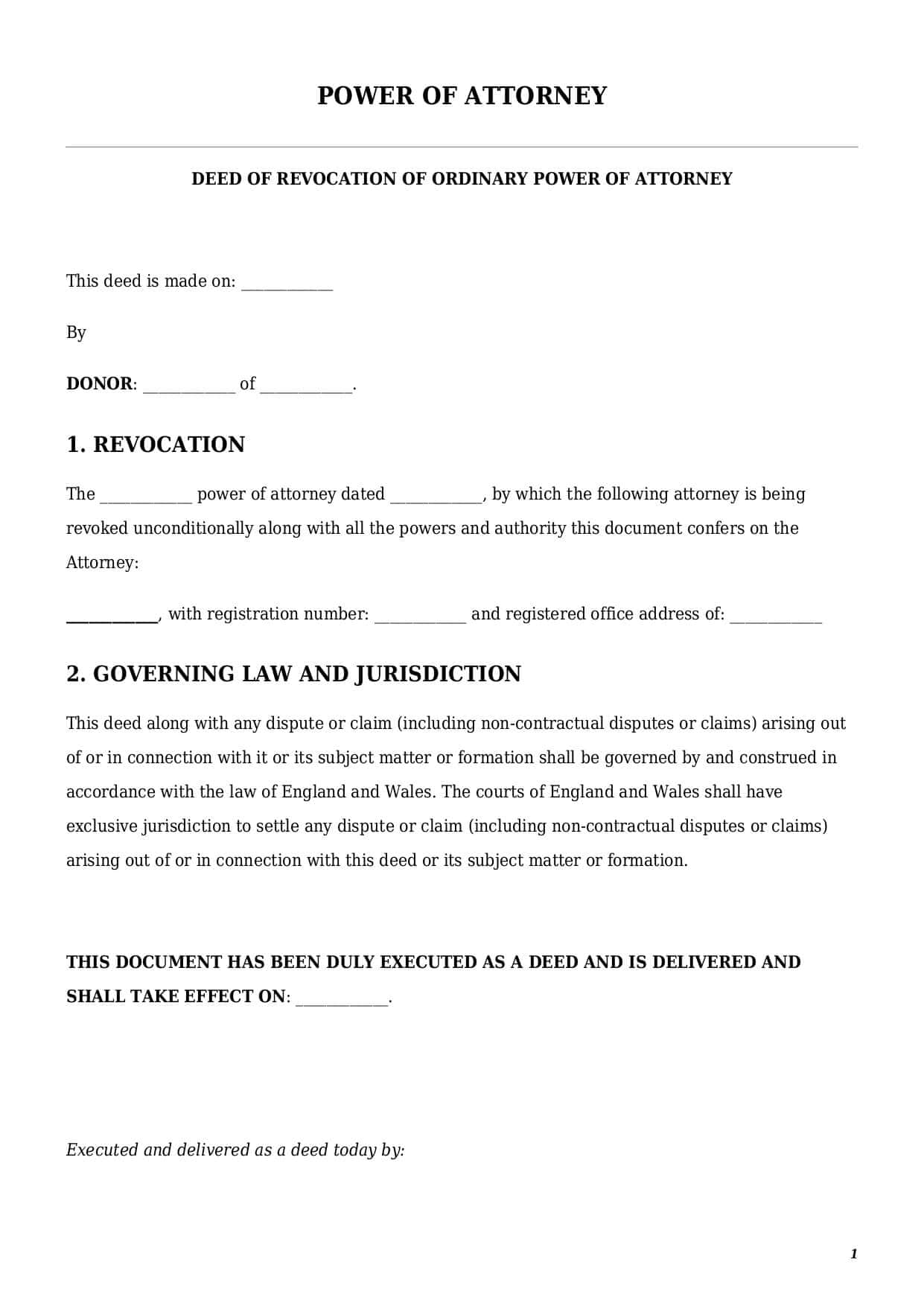
What is a deed of revocation?
A deed of revocation is a formal legal document that ends an existing ordinary or lasting power of attorney that was previously granted to an attorney to act on behalf of a donor. In England and Wales the revocation could be of two main types:
- full revocation, when the power of attorney is being cancelled entirely; or
- partial revocation, when the past of the document is being revoked, while the rest of the document remains intact.
This deed of revocation of power of attorney can be used for ordinary and all types of lasting power of attorneys issued in England and Wales.
In which cases do you need a deed of revocation?
There are many reasons someone might want to revoke a power of attorney, including:
- Breakdown of trust. The donor may no longer have trust or feel confident in the appointed attorney.
- Change in relationship. Sometimes the appointed attorney may have a close relationship with the donor, including husbands, wives, partners or friends. Once the relations change, the revocation of the original power of attorney becomes unavoidable.
- Attorney circumstances have changed. In some situations an appointed attorney may no longer be a good fit for the performance of their duties under the power of attorney. For example, an attorney may lose mental capacity, get sick or move abroad.
- The power of attorney is no longer needed. In most of the cases a power of attorney is needed once a person needs help in managing certain affairs, travels abroad or experiences health issues. Once one of the circumstances no longer exists, a document can be revoked.
- Wishes have changed. This is especially the case with a lasting power of attorney. Once your family circumstances, financial situation, or preferences have evolved, you may wish to change certain arrangements.
It is also possible to revoke a power of attorney for any other reasons. What is more important is that English law does not limit a donor’s right to revocation of a power of attorney in certain circumstances only.
What should be included in a deed of revocation form?
A standard deed of revocation of power of attorney UK template must include the following mandatory elements:
- Donor’s Details. The document must outline in full the donor’s full legal name, address and the date on which the original power of attorney was issued.
- Scope of revocation. The deed should also define if this is a full or partial revocation. In case of a partial revocation, the list of powers that are being revoked should be listed directly.
- Ratification. For a deed of revocation of LPA (lasting power of attorney) that should also include the ratification clause. This is a clause in which the donor confirms everything that has been done by the attorney in good faith is fully accepted by the donor.
- Execution block. This is a section of the document in which the donor’s signature, date of signing and a witness’s full name and signature should be inserted.
Full revocation vs partial revocation: which do you need?
This is one of the most important decisions to get right before completing the document.
Full Revocation you may need when:
- willing to end the power of attorney entirely;
- planning to replace one attorney with another;
- planning to create a brand new power of attorney.
Partial revocation is suitable when:
- removal of one of the appointed attorneys;
- removal of certain granted powers or authorities.
Common mistakes to avoid with a deed of revocation in the UK
When drafting your deed of revocation template from scratch, avoid making the common mistakes below:
Mistake 1: Assuming revocation is effective the moment the deed is signed
Many people believe that, having signed a deed of revocation, the matter is closed. However, the power of attorney’s final date may be different in either of the following circumstances:
- For a lasting power of attorney, a deed of revocation becomes effective once the deed is properly registered with the Office of the Public Guardian; or
- For an ordinary power of attorney, a deed of revocation can be delayed for any other date in the future.
Mistake 2: Using informal wording instead of the correct statutory language
A handwritten note or an informal email is not enough and legally sufficient to revoke an ongoing power of attorney. For a deed of revocation template UK to be legally binding, the following conditions should be met:
- a deed of revocation must incorporate statutory wording.
- a deed of revocation must be signed by the donor in the presence of a witness; and
- a deed of revocation must be registered (applies only for a lasting power of attorney).
Mistake 3: Partial revocation does not allow a change of an attorney
A deed of partial revocation of a power of attorney in the UK means that one or several of the powers granted to the attorney under the power of attorney are being revoked. That means that the original power of attorney remains in force, but the attorney keeps a reduced number of powers.
In a situation when the donor wants to replace the current attorney with another one, the original power of attorney should be revoked and the new attorney should be added. It is also not possible to both partially revoke the ongoing power of attorney and replace the attorney in the same document.
Why use FasterDraft for your deed of revocation template UK?
By customising this document template with FasterDraft, you get the following benefits:
- a template that fully aligns with the Powers of Attorney Act 1971;
- a document that is suitable for the revocation of both ordinary and lasting powers of attorneys issued in England and Wales;
- a document that is created by qualified UK solicitors;
- a template with professional statutory wordings;
- a document that is fully customisable for your particular needs;
- a template that reduces legal mistakes and errors by 99% compared to drafting a document from scratch.
How to use this template?
To create a fully customisable document template, follow a few easy steps below:
- Click the “Create Document” button.
- Answer simple questions in the questionnaire to help customise your future document.
- E-sign the document online.
- Make a payment.
The document is ready for instant digital download on your computer right after the purchase.