

.svg)
.svg)
Codicil to Will (England and Wales)
 PDF and
 Word
Word
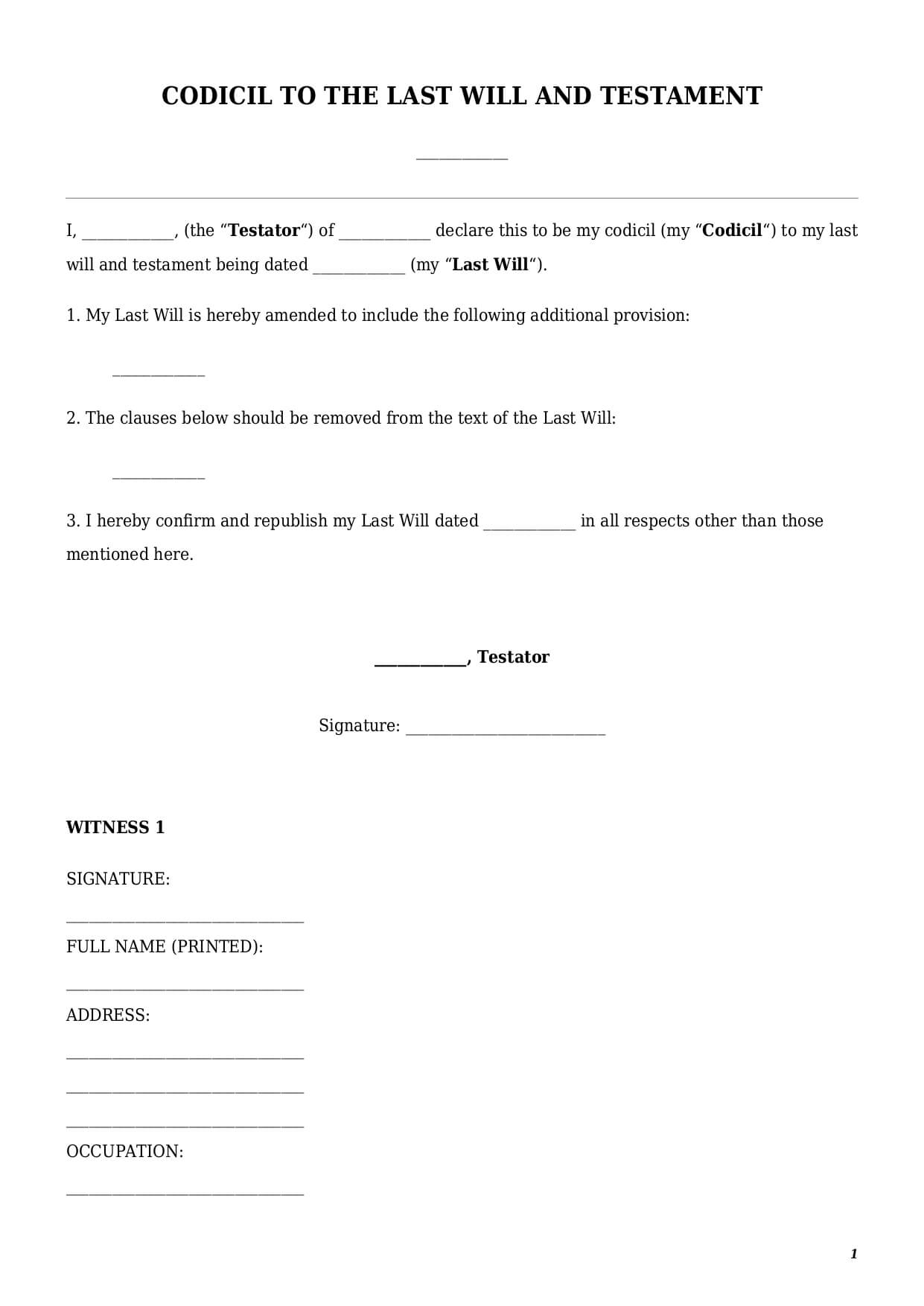
This codicil template lets you make minor changes to the original text of the will without its revocation and in full compliance with the Wills Act 1837.
Reviews

What is a codicil to a will?
A codicil is a formal legal document that amends, adds to, or partially revokes an existing will and, in certain circumstances, can also revive an already revoked will without replacing it entirely. Once the codicil is signed, it sits alongside the original will, and it must be executed with exactly the same formalities as a will itself under Section 9 of the Wills Act 1837.
Codicil vs. New Will — Which Do You Actually Need?
If you already have a will and are planning to introduce certain amendments to it, you may be wondering if you need to proceed with a codicil or the creation of the new will. The table below helps you to answer this question:
| Codicil | New Will | |
|---|---|---|
| Best for | Small changes. For example, new beneficiary, new child, new gift, correction of identification details | Significant changes. Change in family status (getting divorced, married) or multiple amendments at once |
| Original will | Remains in force, read alongside the codicil | Fully revoked and replaced with the new will |
| Execution formalities | Section 9 of the WA 1837 | Section 9 of the WA 1837 |
| Risk of inconsistency | Increases with every codicil added — multiple documents must be reconciled at probate | Low — a single, self-contained document |
As a practical rule of thumb, for one clear, straightforward amendment, a codicil to a will template is a faster and cheaper option compared to drafting the new will from scratch.
However, for more complex amendments, like disinheritance of certain beneficiaries or adding new provisions, signing a separate new will should be a smarter and more practical choice.
Why choose FasterDraft’s template for a codicil to a will?
By customising this document template with FasterDraft you prevent the following risks:
- It is built to satisfy the exact same legal scrutiny as a full will. The present template fully aligns with the requirements of the Wills Act (WA) 1837 and the Mental Capacity Act (MCA) 2005.
- It is cheaper and faster than a solicitor’s drafted document. You get a fully customisable and bespoke legal document at the fraction of the solicitor’s legal costs.
- Suitable for either one or several amendments. This template allows you to introduce one or more amendments and changes to the existing will document.
- Aligned with UK legal context.
- Includes all essential elements. The template covers everything you need for a complete document, along with the attestation field for witnesses’s signatures.
What should a typical codicil to a will template in the UK include?
A standard codicil template must cover a number of the following sections:
- Full identification of the testator;
- Clear identification of the original will — its date and place of signing;
- A precise statement of what’s being changed — clause by clause, rather than a vague, general amendment;
- Confirmation that all other provisions remain in force — expressly preserving everything not touched by the codicil;
- A capacity and voluntariness declaration — confirming the testator understands the amendment and isn’t acting under duress or undue influence;
- Date of execution;
- Testator’s signature;
- Attestation part (identification detail and signatures of two witnesses).
Do not make these common mistakes when creating and signing a codicil to a will in England & Wales
A template for a codicil to a will in the UK should meet the same execution formalities as defined in the Wills Act 1987, as well as the Mental Capacity Act 2005, to ensure it is not being disputed or revoked in the future. The common legal mistakes include the following:
Mental Capacity of the Testator
The testators must undergo the same mental capacity test to meet the criteria of the Mental Capacity Act 2005 (supplemented by Banks v. Goodfellow common law test) again while making the codicil. All in all, it is not enough for the testator to be mentally capable on the date of signing the original will but also on the date of signing each codicil.
In particular, the testator should be able to understand the nature of the act, the extent of the estate, and the claims of those who might reasonably expect to benefit, without any disorder of mind distorting that judgement. If the testator believes that his general mental capacity can be challenged, it is better to attach an appropriate medical assessment performed by a medical professional prior to the date of execution of the codicil. While this is not a legal requirement, it is a sound practical tip that ensures your peace of mind.
Avoid gifting witnesses
Under section 15 of the WA 1837, any gift made in favour of an attesting witness, including their spouse or civil partner, becomes void. However, such limitation does not apply to the witness’s right to inherit any residuary estate under the will or codicil.
Codicil does not revive the revoked will
Even if the testator creates the codicil by amending the will which has been previously revoked, such a codicil does not revive the will unless a codicil includes specific wording with an intention to revive it (Section 22 of the WA 1837).
Doctrine of republication
A validly executed codicil is treated, for most legal purposes, as republishing the will as of the codicil’s date — a well-established common law principle operating alongside Section 22 of the WA 1837. All in all, the will, along with the codicil, will be interpreted in line with the laws which have existed starting from the date of signing the codicil, rather than the will. For example, it can affect the interpretation date for certain gifts or limitations on conditions for giving a gift.
Lasting Power of Attorney
If a testator has any existing lasting power of attorney to deal with property or financial affairs on his/her behalf, such a power of attorney should be additionally revised each time the amendment to the will is being introduced to ensure consistency in the estate planning.
Multiple codicils
While there is no statutory limit on how many codicils you can add. However, from the practical point of view, the more codicils you make, the following risks may arise:
- Provisions become genuinely inconsistent, and it may not be clear how they interact with an earlier one, which can create real ambiguity about which version governs
- A codicil goes missing, which means losing even one can mean a change you intended never actually takes legal effect.
- Executors face unnecessary complexity when dealing with multiple codicils;
- Difficulties in understanding the genuine will of the testator which serve as a ground for court disputes in the future.
How to use this codicil to a will template in the UK?
To get a fully customisable document template, follow the steps below:
- Click “Create Document” to open the questionnaire.
- Fill in the questionnaire.
- E-sign online.
- Make a payment.
- Digitally download the final document in Word or PDF format.
- Check the document for any inconsistency with the original will document.
- Print the codicil out and sign it in the presence of two independent witnesses, present together.
- Make witnesses put their signatures in the attestation form attached to this template.
- Store the codicil with your original will.
- Inform your appointed executors about both documents’ existence.
Table of content
Frequently Asked Questions (FAQ)
-
1. Do I need a solicitor to make a valid codicil?
No. Section 9 of the Wills Act 1837 does not require a solicitor to witness or validate your will or codicil to it. However, other execution formalities, such as being in a state of full legal capacity and two witnesses being present while signing, should be met.
-
2. Can the same two people witness both my will and my codicil?
Yes, this is legally allowed. However, this is your choice as a testator, rather than a mandatory rule. The codicil should not necessarily be witnessed by the same individuals as the main will.
-
3. How many codicils can I make to one will?
There is no statutory legal limit. From the practical point of view the maximum recommended limit is two codicils. After that, it is better to issue the will document template to ensure consistency and avoid any potential risks with administering multiple codicils.
-
4. Does a codicil need to be stored with the original will?
Yes, it is better to store both documents together so executors and trustees can easily locate and produce both documents together.
-
5. What happens if my codicil and will contradict each other?
There are two potential negative legal consequences for that – first, the codicil will revoke the will in the part in which such a will contradicts the codicil (a legal principle under which the latest document has the greatest legal power); second, it may potentially create a solid foundation for legal disputes between successors.
-
6. Should I use a codicil or write a new will after getting divorced?
Under Section 18A of the Wills Act 1837, if you divorce or your civil partnership is dissolved after making your will, the will itself survives, but any gift to your former spouse and any appointment of them as executor or trustee is treated as if they had died on the date of the decree absolute or final order.
Anything you left to them typically falls into the residue instead, which may or may not be what you actually want. To change such an allocation, you may proceed either with the issuance of the new will or simply attaching a codicil.

Looking for something Different?
Start typing to find out our collection of legal documents and contract templates