

.svg)
.svg)
Letter of Wishes (England and Wales)
 PDF and
 Word
Word
This template helps testators to set out which kind of funeral they want, how children should be raised, and which grandchild gets the sentimental jewellery without ever touching legal formalities of the will.
Reviews

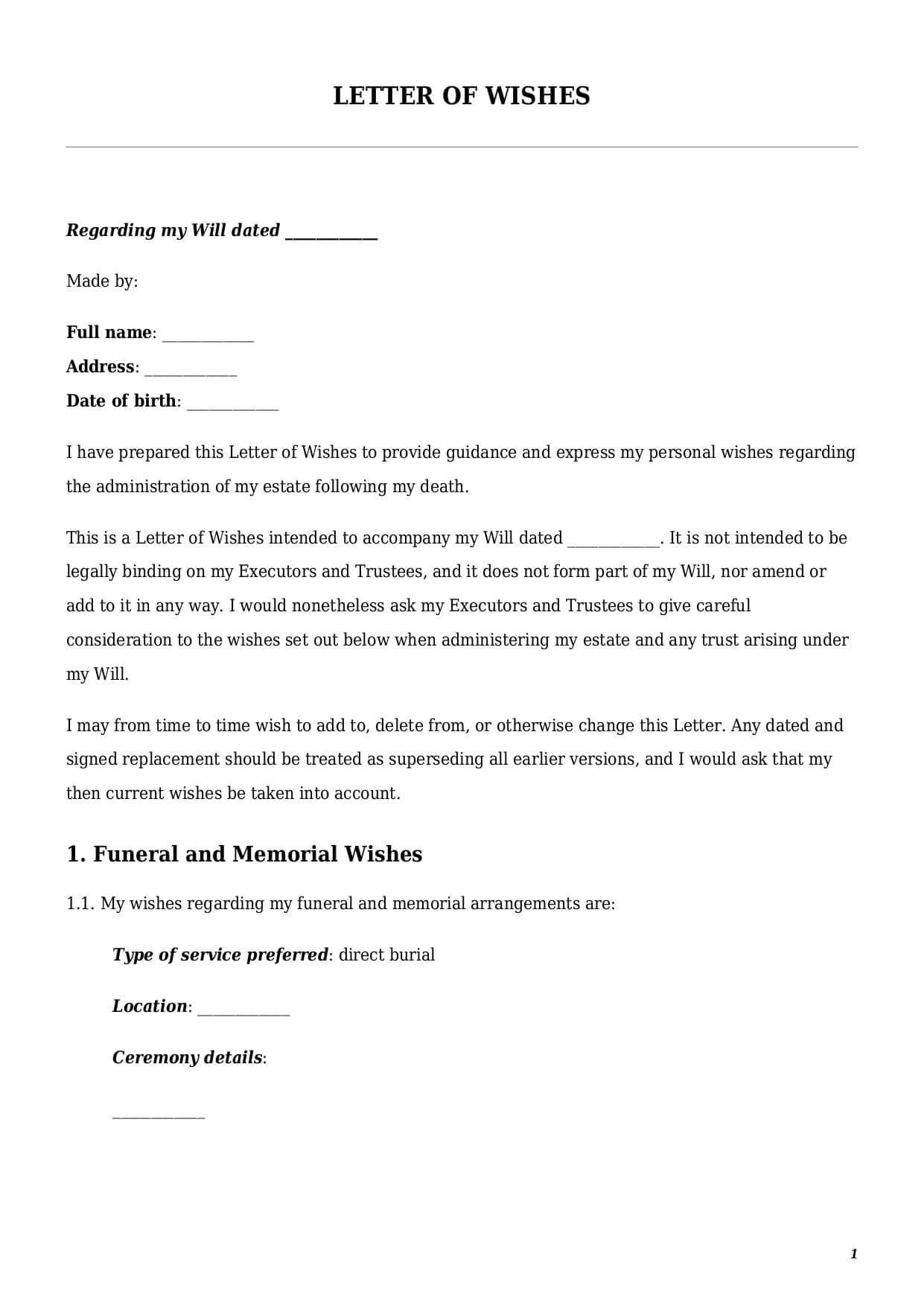
What is a Letter of Wishes?
A letter of wishes is a non-binding, informal written document that is issued by a testator to accompany their will and to give executors certain guidance and instructions regarding the execution of the will. The document gives a testator complete freedom to update or change it at any time, without the complex execution formalities required for a will or codicil.
The present document can be used for a will signed in England and Wales.
Codicil vs. Letter of Wishes vs. last will — A Practical Comparison.
This is the comparison that matters most before you decide what you actually need.
| Last Will and Testament | Codicil | Letter of Wishes | |
|---|---|---|---|
| Legally binding | Yes | Yes | No |
| Execution formalities | Section 9, Wills Act 1837 — signed by the testator and two witnesses | Section 9, Wills Act 1837 — signed by the testator and two witnesses | Signed by the testator only |
| Used for | Binding dispositions of your estate, appointing executors, appointing guardians, allocation of residuary | Formal amendments to an existing will | Guidance on personal possessions, funeral wishes, guardianship approach, reasoning behind decisions |
| Informal Update | No. Require signing a new codicil or will | No. Require signing a new codicil or will | Yes — freely, at any time, with no formalities |
| Part of the public probate record | Yes, once probate is granted | Yes, once probate is granted | No, unless deliberately incorporated or disclosed in the court |
| Legal basis | Wills Act 1837 | Wills Act 1837 | None. |
All in all, a last will allows you to make legally binding decisions regarding your estate, the appointment of a guardian, or the allocation of chattels. While a letter of wishes is a set of informal guidance which can be used to interpret the wording of the will or codicil (in case of any ambiguity) or to better understand the wishes and intentions of the testator.
How can this template from FasterDraft help?
By customising the letter of wishes with FasterDraft, you get to prevent risks and gain the following benefits:
- Aligns with the UK legal framework. This template incorporates limitations set out for the letter of wishes by the Wills Act 1837, the Children Act 1989, and the Organ Donation (Deemed Consent) Act 2019.
- Has a clear structure and professional wording. The letter template is written in a concise and clear manner to prevent any doubts.
- Fast customisation process. You get a bespoke fully customisable document in minutes.
- Saves legal costs. Get a template of a letter of wishes as a small fraction of a solicitor’s legal costs.
What does a standard template of a letter of wishes cover?
Due to the informal and non-binding nature of the document, there is no specific format or structure for this document. Typically, the letter should cover:
- full name, address and date of birth of the testator;
- direct reference to the will and its date of signing;
- funeral wishes (ceremony, location, timing);
- allocation of digital assets (type, amount, access details and instructions);
- guardianship instructions (wishes regarding the children’s education, religion, and upbringing);
- allocation of personal chattels in case it is not possible to allocate as per the will;
- confirmation of informal nature and non-binding legal status;
- testator’s signature and date of signing.
How do Will and Letter of Wishes interact together?
When both documents are drafted properly, they can play together to ensure that the testator’s will and wishes are well executed and implemented, including:
- Ambiguous wording. In a situation where a will’s wording is genuinely ambiguous, and there is an ongoing dispute between successor, the court or executor can use this letter for further interpretation (Section 21 of the Administration of Justice Act 1982).
- Explanatory support in case of disinheritance. In a situation where a will’s distribution could reasonably be seen as leaving a spouse, child, former spouse, or dependant without reasonable financial provision, a letter of wishes can act as an explanatory foundation. In such a case the present document gives your executors and, if necessary, the court genuine insight into a decision that might otherwise look arbitrary or unexplained.
- Legal gap for digital assets. There’s currently no dedicated UK statute governing what happens to digital accounts after death. Therefore, a testator’s guidelines regarding who, when and how can use and access the account can be helpful.
Common mistakes with a letter of wishes you can prevent
A letter of wishes should never be mistakenly taken for a will, codicil or any other binding document. While expression of thoughts or wishes is totally acceptable, inclusion of certain instructions may be void or unenforceable. Since the price of such a legal mistake is very high, it is better to be aware of the following common legal mistakes:
Mistake 1: Trying to make a binding gift
A specific, valuable item you want a named person to legally receive needs to be in the will or a codicil attached to it. A letter of wishes cannot bind the executor; therefore, any of your requests regarding the allocation of chattels or gifts may remain unattended.
Mistake 2: Recording organ donation
The present template of a letter of wishes should never be used for organ donation. According to the Organ Donation (Deemed Consent) Act 2019, it requires registering the decision about the organ donation wishes directly in the NHS Organ Donor Register. Since an organ donation is a time-sensitive issue, it does not permit any delay in identifying the testator’s actual wishes or locating the original will or any codicil to it.
Mistake 3: Include too much sensitive data
While the letter of wishes permits the testator to transfer the various digital assets and digital accesses, all that information should be provided cautiously. It is better not to specify directly in the document the exact passwords or credentials allowing the reader of the document to immediately access the testator’s Facebook account or crypto wallets. Instead, it is better to record where to find access instructions (a password manager, for example).
Mistake 4: Private document vs. public one
The legal nature of the letter of wishes implies its complete privacy. However, using the wrong wording in the text of the document may turn a simple informal document into a legally binding document that will be available to the public once probate is opened. To prevent this, check the following:
- A letter of wishes should explicitly state that it “is not intended to be legally binding“.
- A will should not contain a direct reference to a letter, and the letter shall not exist before the date of signing the will (doctrine of incorporation by reference established in the Goods of Smart [1902] P 238 case).
How to use this template from FasterDraft?
To get a fully customisable document template, follow instructions below:
- Click “Create Document” to open the questionnaire.
- Answer questions in the form.
- Add a digital signature.
- Download in Word or PDF format.
- Print it out.
- Store it with your will.
- Tell your executors and trustees that such a letter exists.
- Revisit and update it whenever your circumstances change.
Table of content
Frequently Asked Questions (FAQ)
-
1. Is a letter of wishes legally binding in England and Wales?
No. Executors and trustees are not legally obliged to follow or obey instructions and recommendations contained in the letter of wishes. However, the present document is written evidence of the testator’s actual intentions. For example, if the will disinherits any of the beneficiaries, the letter of wishes may explain the reasoning behind such a testator’s decision.
-
2. Can I use a letter of wishes to leave a specific item to a specific person?
No. Any gift or personal chattel shall be distributed according to the text of the will. Any distribution of gifts or chattels in the letter of wishes is not legally enforceable. However, the testator may still advise executors and trustees on what to do with unallocated personal chattels.
-
3. Does a letter of wishes need to be witnessed?
No. This letter of wishes is an informal document and does not require any further notarisation or witnessing.
-
4. Will my letter of wishes become public when my will goes through probate?
A letter of wishes is usually addressed to the executors and shall remain private in most of the cases. However, in case of a dispute, the part of the letter may be disclosed in the court during the legal proceeding. Therefore, the document should be worded with that possibility in mind.
-
5. Can I update my letter of wishes without redoing my will?
Yes. The process of amending, changing and updating the letter of wishes is much more flexible and straightforward compared to the will. It does not require any major formalities, including witnesses.
-
6. Should I record my organ donation wishes in my letter of wishes?
No. To record an organ donation, complete formalities, join the NHS Organ Donor Register, and tell your family directly, since a will or letter of wishes is typically read too late for organ donation timing.
-
7. Can a letter of wishes guide how my children are raised?
Yes. While it is not possible to appoint a guardian under the letter of wishes (Section 5 of the Children Act 1989), a letter of wishes is the right document where the testator can determine their wishes regarding religion, maintenance and upbringing.

Looking for something Different?
Start typing to find out our collection of legal documents and contract templates