

.svg)
.svg)
Last Will and Testament (England and Wales)
 PDF and
 Word
Word
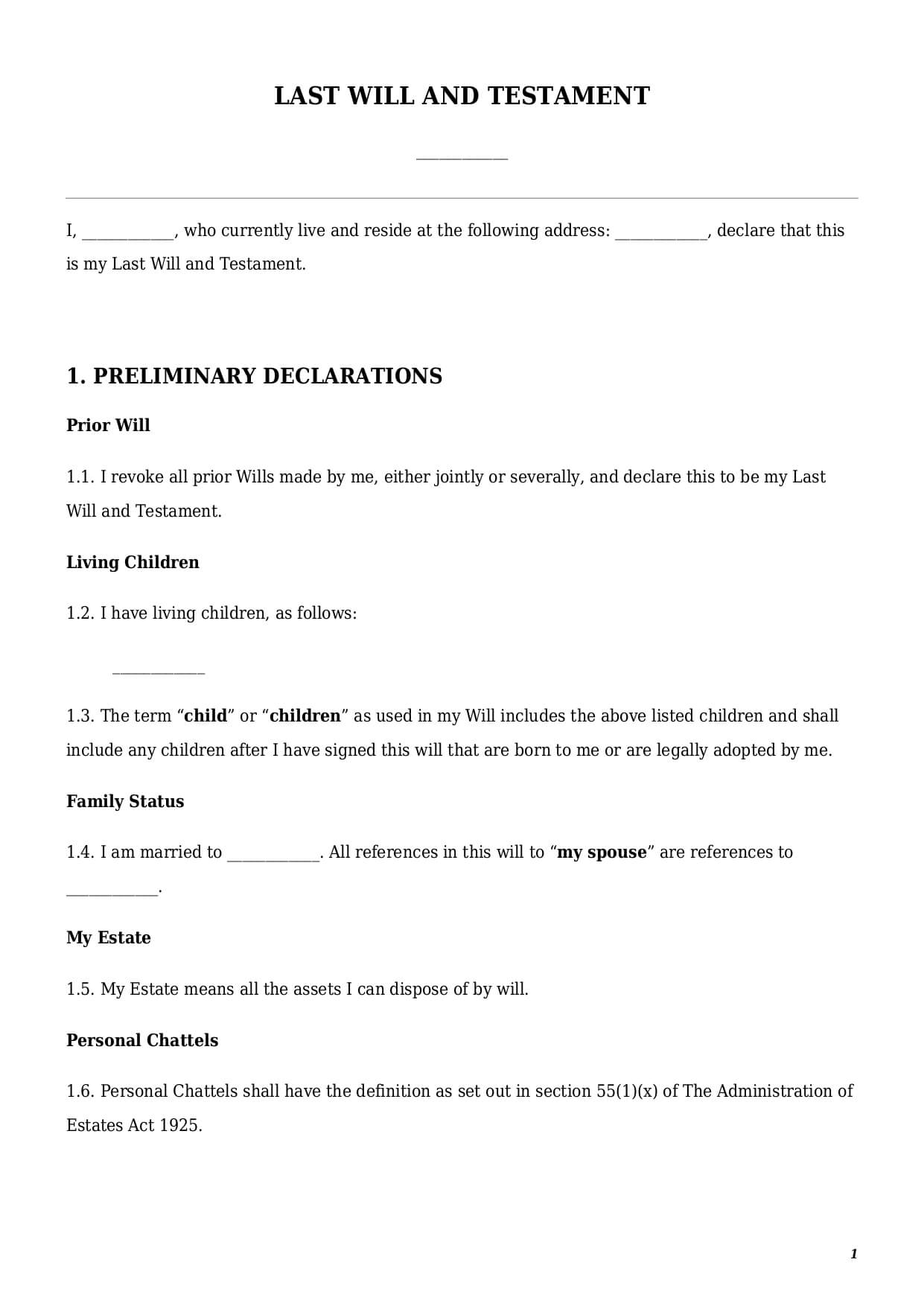
This template gives you freedom to decide how and to whom your personal chattels and estate shall be transferred after your death and ensures full compliance with the actual legal framework.
Reviews

What is a last will and testament in the UK?
A last will and testament is a legal document in which a person (the testator) sets out how their property should be distributed after death, who should administer their estate (the executor), and who should care for their minor children.
For a last will and testament to be legally valid in England and Wales, the document must meet strict execution requirements set out in Section 9 of the Wills Act (WA) 1837. This template ensures 100% compliance with WA 1837, as well as provisions of the Administration of Estates Act 1925 (as substantially reformed by the Inheritance and Trustees’ Powers Act (ITPA) 2014) and guidelines defined by STEP Standard Provisions and Special Provisions (3rd Edition).
Why choose a will — and never rely on statutory inheritance laws in England and Wales?
Dying without a valid will means your estate is distributed under the intestacy rules under the effective provisions of the ITPA 2014. This is a fixed set of rules that never take into account your personal wishes or personal relations and real-life circumstances.
The intestacy rules in the UK can produce results most people would never choose:
- Your lifetime partner can get nothing. If you are not legally married or are not in a registered civil partnership, your lifetime partner may not have a legal right to inherit, no matter how long you have been living together.
- A surviving spouse doesn’t automatically inherit everything. If after your death there are other surviving beneficiaries apart from your spouse or civil partner, such as living children, your residuary estate will be split up between the surviving spouse and children.
- Step-children have no automatic entitlement at all. If the stepchildren were not legally adopted on the date of the testator’s death, they have no inheritance rights.
- Close friends. The entire testator’s estate under the intestacy rules is being distributed only between blood relatives and spouses/civil partners. Intestacy rules do not cover close friends.
- No guardianship. If you leave behind minor children and have no written will, the guardian will be appointed by the court, rather than it being a decision you made in advance.
- Exclusion of beneficiaries. Personal relationships with certain members of the family may go wrong sometimes; therefore, a testator may wish to exclude some of them from the will completely. However, this is not possible if you do not have a written will at the moment of your death.
A written last will and testament document is a set of legal wishes and instructions a person is willing to make regarding the appointment of a guardian, making special gifts, and providing financially for the people about whom they care a lot and love.
Why choose a last will and testament template from FasterDraft?
By customising this template with FasterDraft, you get the following benefits and increase protection from the legal risks below:
- The template is meant to survive scrutiny. The document is built not only to comply with Section 16 of the WA 1837 to meet minimal structural requirements for the will but also with execution formalities, including details of the witnesses and place for signatures in line with Section 9 of the WA 1837.
- Cheaper than that solicitor’s drafting from scratch. A typical solicitor in England and Wales will charge between £150 and £300, while a professionally drafted template from FasterDraft can be customised in minutes at a small fraction of a solicitor’s legal costs.
- Covers all – guardianship, chattels, gifts and funeral arrangements. This template can be customised not only to cover distribution of the residuary estate between beneficiaries but also additional wishes such as funeral location, distribution of personal gifts, etc.
- Risk of DIY. A well-structured template gets you the correct legal framework compared to DIY wills, which almost always contain execution errors and wrong legal wording.
What should be included in the standard last will template for England and Wales?
This document template covers all essential clauses to ensure the document is complete and legally valid:
- Testator’s Identification Details – full name, address and date of signing; current family status (married, single, in a civil partnership or in a long-term relationship);
- Revocation clause – all the previous wills should be revoked;
- Mutual will clause (if the testator has any previous mirror wills with their partner or spouse);
- Legacies – named items or sums left to particular people or organisations;
- Guardianship clause – if one or several trustees’ children are under the age of 18, a guardian should be appointed;
- Funeral wishes – if the testator has any specific wishes regarding the funeral ceremony, this could be included in the document;
- Testator’s signature;
- Attestation space. This section must include the names, signatures, and occupations of two witnesses.
In which cases can my will be cancelled — and how do you prevent this?
Once the will is ready, it does not mean that now your residuary estate will be distributed according to the guidelines defined in the document. Unfortunately, there are lots of mistakes testators in the UK do not take into consideration while drafting and signing their will. Unfortunately, the cost of such a mistake is high – the will can be cancelled. The typical legal pitfalls are the following:
Change of your family status
Under Section 18 of the WA 1837, getting married or entering a civil partnership revokes any existing will in full — unless the will was expressly made “in contemplation of” that specific marriage. Therefore, once your family status has changed, you must urgently proceed with drafting the new will. Failure to do that will result the application of UK inheritance laws by default in the event inheritance laws by default in case of your sudden death. This legal caveat is exceptionally important for a situation when a testator created a will while single and is currently getting married or entering a civil partnership. This, however, does not affect a situation in which a testator remains single but is currently in a relationship that does not constitute marriage or a registered civil partnership.
Later will affect
If you are introducing amendments to the current will by making a codicil or other formal written amendment to it, make sure that the clauses that are changing do not affect provisions of the existing will that you do not want to change. Under Section 20 of WA 1837, any contradiction or discrepancy between the previous will and its codicil should be interpreted in favour of the latest version.
The witness is visually impaired. In the leading case Re Gibson (also reported as In the Estate of Gibson) [1949] P 434, Pearce and the court confirmed that a witness cannot be blind or have an eye disability that prevents him or her from actually seeing the testator’s putting his or her signature and making the will.
The witness is a beneficiary under the will
Under Section 15 of the WA 1837, a witness can also be a beneficiary under the will; however, in such a case, any gift made to such a person under the will is automatically considered void. All in all, the beneficiary still is capable of inheriting the residuary estate under the will, though no longer has access to any gift that is being separately gifted to them under the will.
Legal challenge in the court
Even if you have successfully avoided all the mistakes above, third parties, including your former spouse, someone treated as a child of the family, a cohabitant of two years or more or another interested third party, can try to challenge your will on the following grounds:
- lack of due execution means that the process of drafting and signing the will was not in line with Section 9 of the WA.
- lack of testamentary capacity (the long-established test from Banks v Goodfellow (1870) LR 5 QB 549 — understanding the nature of making a will, the extent of one’s property, and the claims of those who might expect to benefit, without any disorder of mind distorting that judgement);
- undue influence or fraud (for example, a testator has been threatened to sign the will in favour of a third party or was in a strong financial dependency).
Preventing Tips
To make sure you will survive after the death and the trustee will be able to distribute all the gifts and residuary estate in line with your wishes, follow the simple rules below:
- Rule No. 1: Check your will after any major event in your life – marriage, divorce, birth of a new child, or change in personal relations.
- Rule No. 2: Avoid witnessing by the parties who are benefiting from the will.
- Rule No. 3: Once the will is signed, inform your trustee (future executor) of where it is being stored.
- Rule No. 4: Create a letter of explanation that shall accompany the will and explain the reasoning behind the distribution of the residuary in the text of the will. Although this doesn’t bind the court in case there is a dispute, it can materially strengthen your executors’ position in defending an ITPA 1975 claim.
How to get a fully customisable last will and testament form?
To get a personalised last will document template, follow the steps below:
- Click the “Create Document” button to open the questionnaire.
- Answer simple and user-friendly questions in the form – the more answers you provide, the better the document will be at the end.
- E-sign the document online.
- Make a payment.
- The last will and testament template is ready for instant digital download in PDF and Word.
- The document is ready for immediate use after its download.
- If you do not sign the will online, you must sign the document in the presence of two witnesses. If the document is being signed online as part of the questionnaire, make sure two witnesses are present while you are putting your digital signature in the questionnaire.
- Keep the document in a safe place – your home, your friend’s house, your solicitor’s office, etc.
How much does it cost?
FasterDraft offers fully customisable and professionally drafted templates of legal documents for UK users at a range of £4.99 to £50, depending on the document’s complexity and size.
Table of content
Frequently Asked Questions (FAQ)
-
1. Do I need a solicitor to make a valid will in England and Wales?
No. Under Section 9 of the Wills Act 1837 dealing with execution formalities, there’s no legal requirement to use a solicitor. What matters is that the will meets the Section 9 Wills Act 1837 formalities and genuinely reflects your intentions.
-
2. What happens if I don't have a will when I die?
In such a case, your residuary estate will be distributed in accordance with the intestacy rules defined by the Administration of Estates Act 1925, following a fixed statutory order that doesn’t provide for unmarried partners, stepchildren, friends, or charities and gives you no say over who becomes your children’s guardian.
-
3. Can I write my own will without witnesses?
No. Section 9 of the Wills Act 1837 explicitly requires two witnesses present at the same time, properly attesting your signature. The will signed without witnesses’ attestation is not legally valid.
-
4. Does getting divorced automatically cancel my will?
No. Under Section 18A of the Wills Act 1837, if you divorce or your civil partnership is dissolved after making your will, the will itself survives, but any gift to your former spouse and any appointment of them as executor or trustee is treated as if they had died on the date of the decree absolute or final order. Anything you left to them typically falls into the residue instead, which may or may not be what you actually want.
-
5. Can someone challenge my will after I die?
Yes. The will can be challenged and either changed or revoked completely after you die in a number of limited circumstances defined by the Inheritance (Provision for Family and Dependants) Act 1975, including lack of due execution, lack of testamentary capacity, etc.
-
6. Who can be a witness to a will?
Anyone, including your friend, colleague, neighbour, or any other third party of your choice. Be careful about making your spouse or any other beneficiary under the will a witness because, under Section 15 of the Wills Act 1837, such a witness automatically loses their right to any gift or personal chattel given under the will.
-
7. Can my partner inherit if we are not married?
If you have a registered civil partnership, in such a case your civil partner has a default right of inheritance under the UK intestacy laws. If, however, this is an unregistered partnership, in such a case he or she can only inherit if there is a will made in their name.

Looking for something Different?
Start typing to find out our collection of legal documents and contract templates