
.svg)
 United Kingdom
.svg) USA
USA

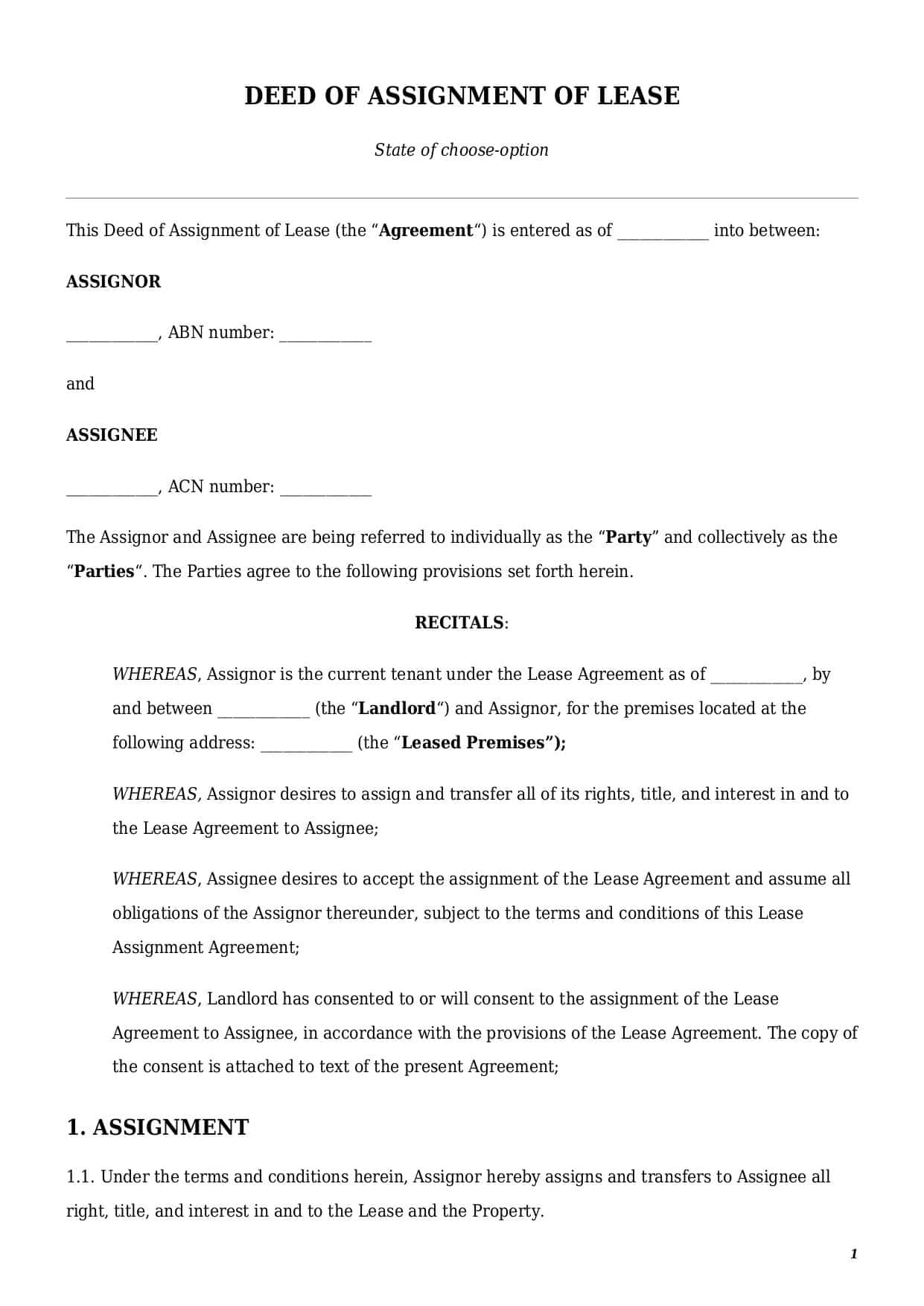
What is a deed of assignment of lease?
A deed of assignment of lease is a legally binding document that transfers rights and obligations under the existing lease agreement from the former tenant to the new tenant. This deed does not alter the original lease terms, including its duration or rental payments, but simply replaces the tenant under the agreement.
Who should use this deed of assignment of lease template?
This deed of assignment of lease is a professionally drafted document that can be helpful for:
- small businesses that no longer require their retail premises and wish to assign the lease to a third party;
- established business reducing operations and seeking a new tenant to take over the premises;
- landlords looking for the replacement of existing tenants;
- individual tenants entering into a lease assignment for the first time.
This document does not replace or amend existing terms of the lease or rights and obligations of the parties under commercial or residential tenancy agreements.
What should be included in the deed of assignment of lease template?
A standard deed of assignment of a lease in Australia must include:
- Parties’ Details. The document shall outline identification information of a landlord, assignor (current tenant) and assignee. This includes the full legal name, mailing address, and ACN/ABN numbers if either party is a company or business registered in Australia.
- Lease Details. The text of the deed should also include reference to the original lease agreement under which the assignment takes place. This includes the name and date of a signed contract, the full address of a leased property, and the state or territory where the property is located.
- Assignor’s Covenants. This clause confirms that there is no delay or breach of the lease on the date of signing this deed. In simple words, it means that there are no outstanding lease payments, property damage or other violations of the existing lease.
- Assignment of Liability. Inclusion of this clause in the text of the deed allows us to handle how liabilities are distributed between the outgoing and incoming tenants. It means that the new tenant is not responsible for past breaches, and the outgoing tenant cannot be responsible for future violations.
Checklist of Assignment of Lease in Australia
Read the Original Contract
The process of assignment of lease in Australia depends on its type (residential or commercial), as well as the state or territory where the leased property is located. The text of the existing lease contract between the parties can also shed light regarding how the assignment should be made. For example, some contracts may specifically outline any assignment, while others impose a long notice period.
All in all, it is important to first check the existing tenancy agreement to know more about the next steps.
Get the Landlord’s Consent
As a general rule provided in local retail tenancy acts, landlords cannot reasonably withhold their consent for the assignment. Once the consent is issued, it cannot be revoked. To get a consent, a current tenant shall submit a prior written request to the landlord to request the same. The notice period usually varies between 30 and 90 days depending.
A landlord’s deed of consent to assignment of lease shall be issued in writing and attached to the deed of assignment.
Sign the Deed
Once the consent is obtained and the deed of assignment of lease sample is ready, parties must date and sign it. The parties involved in signing are:
- a landlord;
- a current tenant (assignor); and
- a future tenant (assignee).
Since the document is executed as a deed, each party’s signature must be witnessed by a witness. Australian law does not impose any specific requirements regarding the identity of a witness, who shall be at least 18 years old, of sound mind and not be either party to this deed.
Last but not least, the parties must execute this deed in three copies, one copy for each party.
Register the Deed
In certain cases when the original lease is registered with the state’s land registry, then the deed of assignment of lease sample should also be registered. In other cases registration of the assignment is not legally required.
How to customise this deed of assignment of lease template with FasterDraft?
To get a fully customisable document template, follow a few easy steps below:
- Click the “Create Document” button.
- Answer simple questions in the form.
- Select a template’s format – deed of assignment of lease PDF or Word.
- Make a payment.
The document is ready for instant download immediately after the purchase.