

.svg)
.svg)
Room Rental Agreement
 PDF and
 Word
Word
This Room Rental Agreement Template helps Australian landlords and tenants clearly set out the terms for renting a room in a shared property.
Reviews

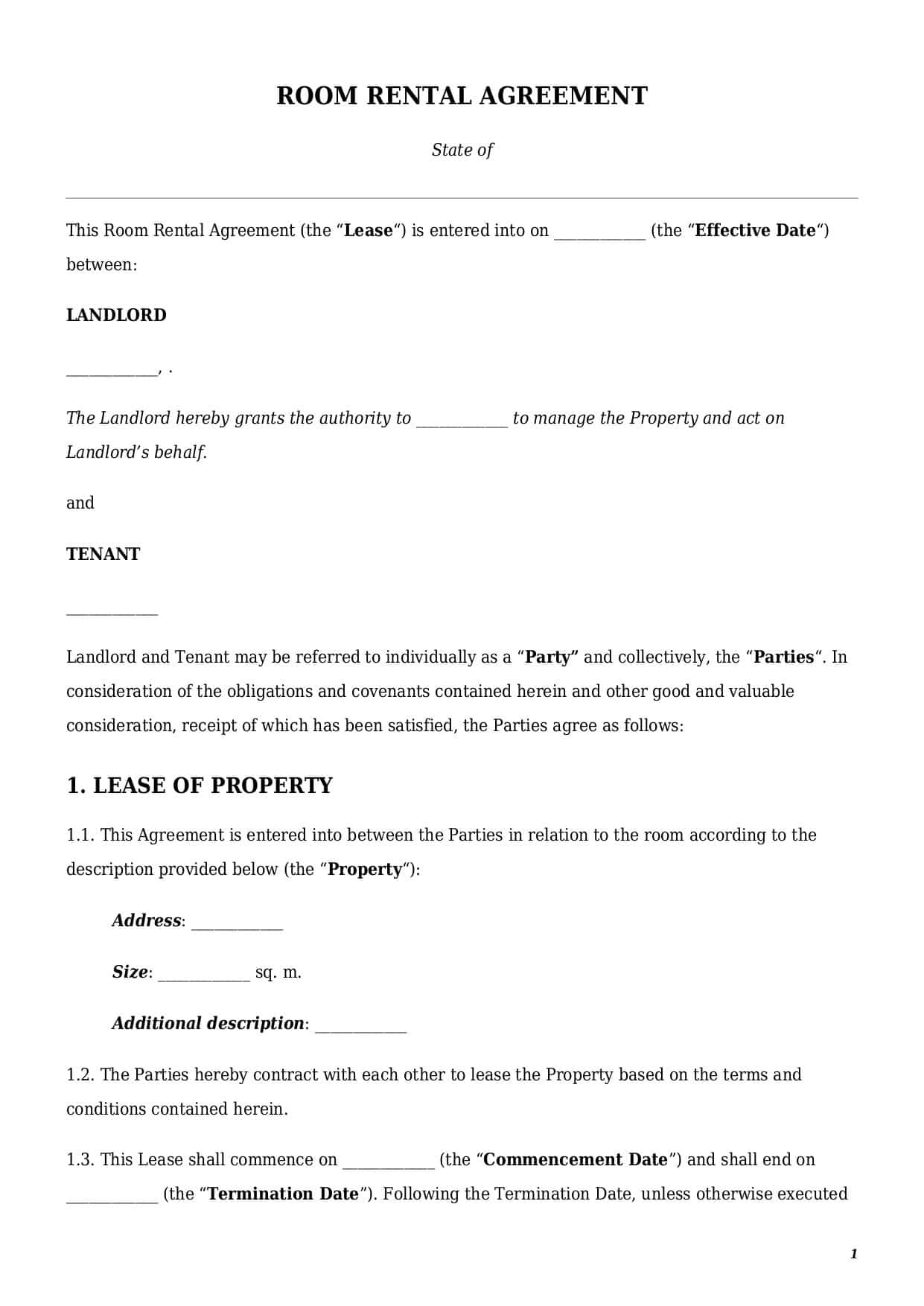
What is a room rental agreement?
A room rental agreement, also referred to as a room rental lease agreement, is a legally binding contract that sets out the terms and conditions under which one person rents a room in a property that is shared with others. The document clearly defines the mutual parties’ responsibilities and the main conditions of the lease, including rent, payment schedule, property maintenance and repair, termination, etc.
The parties involved in a room rental agreement are a landlord and a tenant. A landlord is a property owner, while a tenant is an individual who is willing to rent out a separate room inside an apartment or house.
Who should use this room rental agreement?
This professionally drafted room rental agreement template can be helpful for:
- private property owners willing to rent out one of the rooms in their house or apartment;
- property management companies looking for a template to use in their daily work;
- property investors willing to rent out a room for extra income;
- students and single individuals looking to split accommodation with others.
What should be included in this room rental agreement sample?
A standard room rental agreement sample must include the important elements below:
- Details of the Parties. The text of a contract should outline the full legal name, the landlord’s ACN or ABN number if applicable, the contact mailing address and the phone number.
- Property Description. The document must define a property’s address, the size of the room and any additional features (for example, an en suite bathroom).
- Rental Payment. In Australia it is common to specify weekly rental payments. Apart from that, the contract should also outline the frequency of payments, acceptable payment method, amount of a security bond, and late fees.
- Utilities. The parties must agree on how to split electricity and gas bills, water usage and water supply charges, internet bills and so on.
- Obligations of the Parties. Every room rental agreement template should provide a detailed list of duties and obligations of each party, including urgent repairs, maintenance, abandonment, allowed property usage, subletting and more.
- Termination. The contract must establish a notice period each party should comply with to be able to terminate the contract earlier.
What are the benefits of using a room rental agreement?
In Australia, state and territory tenancy laws allow the conclusion of verbal room rental agreements. In that case your tenancy is governed by the general provisions of relevant tenancy laws. However, most property owners and management companies prefer to choose a written room rental lease agreement for many reasons.
First, the document clarifies all essential provisions of the tenancy. This, in its turn, helps to prevent any ambiguity in how both parties understand the conditions of the lease.
Second, a written document allows for including as many rights, obligations and guarantees as the parties wish and which applicable laws cannot provide.
Second, a solid room rental lease agreement plays the role of a road map for both a landlord and a tenant, ensuring that everyone knows their rights and obligations.
Thirdly, a written contract significantly reduces disputes that may arise between parties later along the road. This is especially important for long-term tenancy agreements.
Finally, in case of a dispute, a written room-for-rent rental agreement serves as legal proof of the initial contractual arrangement between both parties. It allows tribunals or courts across Australia to quickly find out which of the parties is a wrongdoer.
Which specific rules apply to room rental agreements across Australia?
In Australia there is no unified federal residential tenancy law, therefore each state and territory has adopted their own legislation to address it.
New South Wales (NSW)
In the case of a room rental agreement NSW, the Residential Tenancy Act 2010 defines a number of very specific landlord’s obligations. For example, a landlord may not be allowed to take photos of the property, even if for the purpose of showing it to prospective tenants or for the sale. Moreover, if at some point a leased property becomes listed as a property with loose-fill asbestos insulation, a landlord has 7 days to inform a tenant about such a change.
Queensland
In this state a typical room rental lease agreement template shall address separately how charges for water supply and usage should be split between the parties. It is typical for a tenant to cover in full water usage, water supply or both expenses at the same time.
Victoria
If the room is located in a house or unit of apartments with access to a swimming pool, the Residential Tenancies Act 1977 provides a list of strict requirements regarding the protective barriers. A landlord has to obtain a safety pool certificate prior to renting out the room with the access to the swimming pool. In that case a landlord remains fully responsible for the pool safety for the whole duration of the lease.
Tasmania
When creating a room rental lease agreement in Tasmania, a landlord must ensure that their room is able to meet minimum requirements, provided in the Residential Tenancy Act 1997. For example, a room should have either an en suite bathroom or provide such access inside the property where a room is located. Apart from that, a room should have access to the kitchen, smoke detectors should be workable, etc.
South Australia (SA)
In South Australia the requirements for the tenancy agreement are similar to those in Tasmania and Queensland. The text of a contract must confirm that the room fits the minimum required standards provided by the local law. On top of that, payments for the water usage and water supply should be outlined separately in the contract apart from other utilities.
Western Australia (WA)
If a tenant can live with pets, in that case a room rental agreement A should provide a tenant’s obligation to pay an additional pet bond in the amount of AUD 260. A pet bond is being used to thoroughly clean the rented property after the lease ends.
Australian Capital Territory (ACT)
Same as in the rest of the states and territories, a landlord must provide a tenant with a detailed property condition report. Such a report should be provided to a tenant not later than on the date of signing the original lease contract.
Northern Territory (NT)
In the Northern Territory, the creation of a tenancy agreement form template is not subject to any additional criteria that differ from general rules applicable to residential tenancy in Australia.
How to customise a room rental agreement template with FasterDraft?
To get a fully customisable document template, follow a few easy steps below:
- Click the “Create Document” button.
- Answer simple questions in the form.
- Select a format – room rental agreement template PDF or Word.
- E-sign document.
- Make a payment.
The document is available for instant download immediately after the purchase.
Table of content
Frequently Asked Questions (FAQ)
-
1. What is the difference between a room rental agreement and a flatmate agreement?
A room rental agreement governs the conditions and duration of the lease of a room between a property owner and a tenant, usually within a large house or apartment. A flatmate agreement regulates relationships between roommates and not with a landlord. A typical flatmate agreement may define quiet hours, guest policy, cleaning chores, usage of the kitchen, etc.
It is important to note that a room rental lease agreement always prevails over a flatmate agreement. Landlords are not bound by a flatmate agreement, while tenants must comply with both a general rental lease and any signed flatmate agreement.
-
2. Is a room rental agreement legally binding in Australia?
Yes, a room for rent rental agreement is a legally binding document once signed by a tenant and a landlord. Signing this agreement is a party’s right rather than obligation, as Australian law allows a room rental agreement to be concluded in both written and verbal forms.
-
3. What is the difference between this room rental agreement and a residential tenancy agreement?
A present room rental agreement is being used specifically to rent out a part of the property, i.e., a separate room, in a house or apartment to a tenant. On the other hand, a residential tenancy agreement is being used for renting out the whole property, such as a house, villa, houseboat or apartment.