

.svg)
.svg)
Short Term Residential Rental Agreement
 PDF and
 Word
Word
This short-term rental agreement template is ideal for Australian hosts, Airbnb owners and holiday rental providers renting out residential properties on a short-term basis.
Reviews

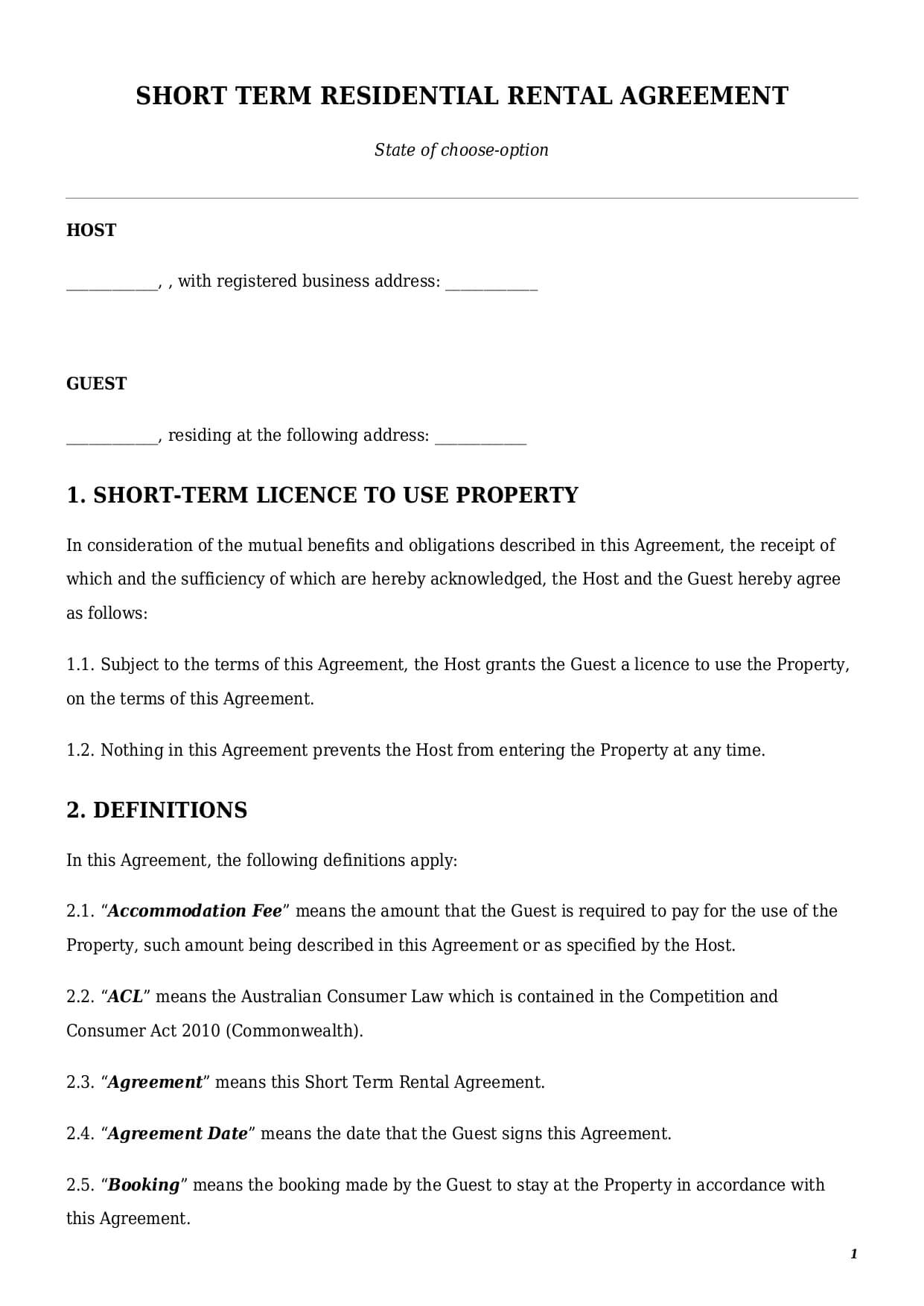
What is a short-term residential rental agreement?
A short-term residential rental agreement, sometimes referred to as a periodic tenancy agreement in Australia, is a legally binding contract between a property owner and a guest that sets out the terms and conditions governing the temporary rental of a property. This document defines key terms and conditions of the periodic tenancy, including:
- identification details of the parties;
- booking details (such as the licence period, check-in and check-out)
- security bond and refund conditions;
- property use rules and restrictions;
- cancellation and termination policies.
The parties involved in a residential lease rental agreement for a short term are the host and the guest. The host is a property owner, investor or property manager who has the right to rent out the property. A guest or a tenant is an individual, a family or a group of individuals who want to rent the property for a short period of time, including a few days, a few weeks or a few months.
A short-term residential rental agreement is an important legal tool for a number of reasons, including:
- helps minimise legal risks.
- ensures compliance with applicable Australian state and territory laws; and
- clearly defines both parties’ rights and obligations.
Who is this short-term residential rental agreement suitable for?
A solid and compliant template of a short-term residential rental agreement shall be suitable for:
- Airbnb hosts seeking a reliable sample residential rental agreement for short-term rentals;
- property owners renting out holiday homes and secondary residences;
- real estate investors generating income from short-term accommodation to secure extra income;
- property managers and real estate agents seeking a solid rental agreement for daily usage.
What’s included in this short-term residential rental agreement template?
This template includes all essential legal clauses, including:
Details of the Property
Every sample residential rental agreement shall define the detailed characteristics of the rental property. This information must include the full property address, the number of bedrooms and bathrooms, and information about any other additional spaces, such as gardens, balconies and bathrooms. The key feature of a periodic tenancy agreement is that the rented property is fully or partially equipped. Therefore, it is crucial to make sure that the list of furniture and all equipment is listed somewhere in the text of a contract or in another separate document attached to the main agreement.
Parties Details
Another crucial element for a short term residential rental agreement template is to include identification details of the parties involved, including:
- full name of the host;
- ACN or ABN number, if the host is a registered business or company;
- mailing address of both parties;
- contact details, including phone number and email address.
Licence to Use the Property
Under the periodic tenancy agreement sample, a tenant or guest is given a legal right to use and occupy the property for the defined period of time. Such a right is also known as a licence. Every licensee must define the following important details:
- purpose of the stay (for example, studies at a university or college, family vacation, business trip);
- permitted and prohibited uses (such as no parties, no guests, and no business in the rented property);
- duration of the stay (also known as the check-in and check-out dates).
Payment Terms
One of the key elements for every sample residential rental agreement is the inclusion of payment terms. Common payment structures for a short-term rental tenancy in Australia include high daily rates or a total fee for the entire stay.
Usually the text of the contract must define the acceptable payment methods that can be used by a guest to pay for the accommodation as well as the schedule for payment. Some Airbnb properties may require you to pay 100% of the sum in full before the date of check-in, while others may require only half of the sum, with the rest to be paid upon arrival or on the date of check-out.
Additional charges can also be included in this section. The list of additional charges largely depends on the property itself. For example, some properties may offer additional cleaning services or cooking facilities for tenants, while others may provide barbeque stations on demand. If this is the case, every periodic tenancy agreement sample shall reflect all those fees in advance.
Security Bond
The provisions regarding the placement and return of the security bond are usually governed by the relevant legislation of a state or territory where the rental property is located. For example, in a residential rental agreement NSW, rental bonds should be placed by tenants online and are further held securely via Rental Bonds Online until the tenancy expires. Therefore, tenants and guests must check in advance the rules applicable for the placement of a deposit in the state or territory where the property is located.
Once a periodic tenancy ends, the property manager or owner must return the security bond back to the guests, provided the property is returned in the same condition as it was when it was rented out in the first place.
Guest Obligations
Even though a short-term residential lease rental agreement can last for a few days, guests and tenants have a list of duties and obligations they must follow with regard to the usage of the property. These obligations include using the property in accordance with its purpose, following curfew or quiet time requirements, not damaging property, not caring for pets if initially prohibited, etc.
Liability
This periodic tenancy agreement sample defines liability for both the tenant and property owner regarding the usage of the property. As a rule of thumb, guests use the property at their own risk. The property owner may not be liable for any loss, injury, or loss and damage of the property caused by the guest’s usage of such a property.
While the host’s liability is subject to the provisions of Australian consumer law, the host’s liability is limited to either of the following:
- the supply of the booking again; or
- the payment of the cost of having the booking supplied again.
What is the difference between a short-term and long-term rental agreement?
Residential tenancies in Australia could be of two most commonly used types – short-term rental tenancy and long-term rental tenancy agreement. Despite their similarity, these two documents differ significantly from each other.
- Applicable Legal Regulation. The set of regulations that apply to short-term and long-term rental agreements in Australia also differ. Every state and territory usually has a separate residential tenancy act defining the most important rules and principles governing the long-term rental arrangements. However, in the case of a periodic tenancy agreement template, there is no specific applicable act. As a result, the parties should be governed by the main provisions of contract common law and basic principles of Australian consumer law.
- Required format. Most Australian states and territories provide a mandatory document template parties must use for a long-term rental agreement. For example, a residential rental agreement Victoria can be found on the official website of Consumer Affairs in the state of Victoria. Failure to use the prescribed template may result in a document not being legally valid and enforceable. However, this is not the case for a periodic tenancy agreement template, as there are no mandatory state or territory templates parties must use. Therefore, parties are free to create their own contracts to reflect the desired terms and conditions of the short-term rental.
- Types of Property. The long-term rental agreement is used mostly for private or detached houses or apartments suitable for a long-term rental. This is usually the type of property that a landlord does not plan to use for personal reasons in the nearest future. Another situation is with properties that are being rented on a short-term basis. These are usually second homes, holiday homes or other types of seasonal properties whose main purpose is to generate seasonal or additional income for the property owners.
Why is this residential rental agreement suitable for the Australian real estate market?
This short-term residential rental agreement template is ideal for periodic tenancy of property located in Australia for the following reasons:
- Compliance with Australian tenant laws. This residential rental agreement template is fully compliant with applicable state or territory tenancy rental acts, as well as general contract principles of common law.
- Compliance with Australian Consumer Law. If the host of the property is a company or business registered in Australia, the provisions of this document shall automatically comply with basic requirements for consumer protection defined by Australian Consumer Law. For example, the advertising about the holiday rentals shall not be misleading and shall provide accurate photos of the actual property’s size, appearance and appliances.
- Compliance with best industry practices. The present template is a good periodic tenancy example for those seeking a solid legal template for short-term rental in Australia. The document is written in plain English and complies with the most recent developments and practices of the Australian real estate market, including guidelines related to the return of security rental bonds.
Short-term Residential Rental Agreement Checklist
Below you can find a free legal checklist to follow when completing your short term residential rental agreement.
Customise your document
To make sure this template of a residential lease rental agreement is suitable for your individual case and circumstance, the first step is to customise this legal template with FasterDraft. Get started now by pressing the orange button “Create Document” anywhere on this page.
Check the final document
Once the document is ready, make sure you properly read it and, what’s important’ understand every clause included in the document. It is important you take enough time to do that. If you are unsure about any clause included in this periodic tenancy agreement template, it is always better to ask your lawyer for further clarifications.
Sign the final document
All parties involved in this periodic tenancy agreement must sign it. If a third party is acting on behalf of a landlord, such as a property management company, make sure such a representative has proper legal authorisation to sign the document on behalf of a landlord. Usually, such an authorisation is known as power of authority and is fully recognised across Australia. Both the tenant and the landlord must sign this document. If several tenants enter this agreement, make sure all of them put their signature.
What’s next?
Every person signing this residential rental agreement must get a document’s copy. The copy must be kept in a secure place for the whole duration of the short-term rental. A signed document is solid legal proof that the short-term rental tenancy actually exists.
How does it work to customise a legal template with Faster Draft?
To get a fully customisable residential rental agreement template, follow the 5 steps below:
- Click the “Create Document” button.
- Answer simple questions in the form.
- Select a template’s format – short-term residential rental agreement PDF or Word.
- Make a payment.
The ready-made document is available for instant download. You can edit and amend the received template an unlimited number of times.
Table of content
Frequently Asked Questions (FAQ)
-
1. Do I need a short-term rental agreement in Australia?
Yes, a residential lease rental agreement is an essential legal document when you plan to rent out the property for a short period, such as a few days, weeks or months. A well-drafted lease agreement defines the key terms of the rental, including the duration of the stay and the rights and obligations.
-
2. Is this template suitable for Airbnb?
Yes. In most cases a residential rental agreement is commonly used for properties listed on Airbnb and other holiday rental platforms in Australia.
-
3. Is the template legally valid in Australia?
Yes. This residential rental agreement is compliant with the main provisions of Australian consumer law, as well as relevant state and territory residential tenancy laws. The templates reflect the most important clauses, including rental bond, cancellation policy, and amount and frequency of rental payments.
-
4. Can I customise the agreement?
Yes, this sample residential rental agreement is fully customisable and can be tailored to your specific circumstances. To do that, you have to answer all the questions in the questionnaire provided to generate a fully customisable legal document template.
-
5. Does this template cover security bonds?
Yes, inclusion of a security bond clause in a residential rental agreement is mandatory for most long-term rental agreements. Although security bonds are not always legally required for short-term rentals in Australia, property owners tend to include them for a number of reasons. First, it makes tenants comply with their rental obligations. Second, it secures the property against potential damage.