

.svg)
.svg)
Notice of Will Revocation
 PDF and
 Word
Word
A notice of will revocation is a formal, written declaration by a testator that they intend to revoke an existing will.
Reviews

What is a notice of will revocation?
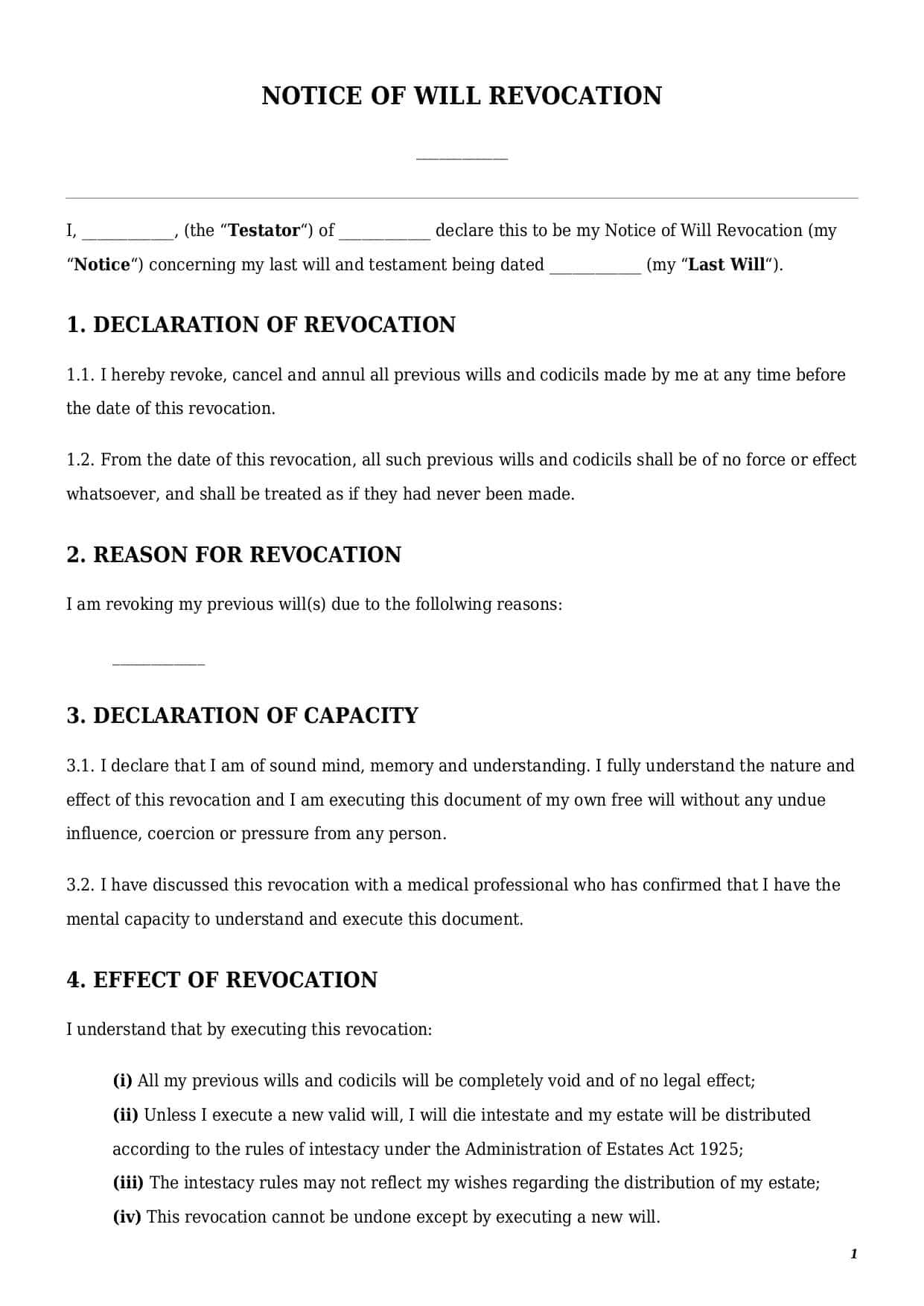
A notice of will revocation is a formal written legal document by which a testator in England and Wales revokes in its entirety an existing (ongoing) last will and testament or life interest trust will. Issuing a notice of will revocation is one of the three legally recognised ways of cancelling the last will under English law, the other two being physical destruction of the original will or issuing the new one.
If you are looking to simply amend or change the will, you do not necessarily need to revoke it. In such a case a codicil to a will template should be used instead.
This is a genuinely narrower use case than most people assume. Most people who want to change their will simply make a new one, which typically includes its own revocation clause and deals with the estate going forward in a single document. A standalone notice of revocation is the right tool specifically when someone wants the existing will gone now and is either still deciding on new arrangements or is content, at least for the time being, for their estate to pass under the statutory intestacy rules instead.
Is a will revocation legally enforceable in England and Wales?
A notice of will revocation is legally allowed in England and Wales, provided the following conditions are met:
- A notice of revocation must be in writing (Section 20 of the Wills Act (WA) 1837).
- A notice should clearly state the wording declaring an intention to revoke (Section 20 of the WA 1837).
- Signed by a testator in the presence of two witnesses, who then also sign the document (Section 9 of the WA 1837);
- Witnesses should be at least 18 years old and of sound mind.
Failure to meet these necessary requirements means the original remains valid and will still be admitted to probate.
How to choose the estate planning document wisely: a codicil, a will, and a notice of revocation?
Understanding the legal nature of a codicil, last will and notice of revocation helps to shape your legal decisions with the right documents.
- Amendment of executor details, beneficiary list, adding specific gifts or chattels and similar minor changes. In a situation like that, you do not need to revoke the will and start the whole process all over again. Use a codicil to a will to amend or add the missing or inaccurate information.
- New life partner, new marriage or new kids. If your family or life circumstances change drastically, it may cause you to rethink how the estate must be distributed after your death. For these types of changes, a codicil may not be a good fit. Therefore, most testators will proceed with the new will and testament. In such a case, you do not need a separate notice of revocation, as the new will and testament document may incorporate a standard default clause invalidating all the previous wills and codicils.
- Cancellation of the will, putting nothing in its place. Sometimes a testator no longer needs a will and is ready for their estate to be dealt with under the statutory intestacy rules. If this is the case, a notice of revocation is the single document you need. There is one important legal consideration to keep in mind: under Section 22 of the WA 1837, a revoked will can be revived by re-executing it or by a codicil that shows an intention to revive it.
What should be included in the standard notice of will revocation?
A standard notice of will revocation must cover:
- a testator’s full name, date of birth and residential address (the same information as provided in the original text of the will);
- an express declaration of intention to revoke the will, including its date;
- a statement confirming the testator’s understanding of legal consequences of such a revocation along with confirmation that their estate will be distributed under the intestacy rules;
- a testator’s signature and date of signing;
- execution block for witnesses, including their full name, occupation and signatures.
Important legal considerations before drafting a notice of will revocation
Before signing a notice of will revocation, consider the following:
Risk of intestacy
This is the first and most important legal risk. If you intend to replace your will with a new one, it is almost always better to make the new will directly. A properly drafted will revokes all previous wills through its own revocation clause, so there’s no window during which you have no valid will in place. Revoking first and redrafting later leaves a gap in which, should you die, your estate would pass under the intestacy rules rather than your wishes.
Lack of formalities
As stated above, failure to comply with all necessary execution formalities listed in Section 9 of the WA 1837 serves as a ground for the notice being legally ineffective.
Physical destruction of the will
According to Section 20 of the WA 1837, a will can also be revoked simply by burning, tearing, or otherwise destroying it with the intention to revoke. But this route depends entirely on provable intention, the presence of witnesses and many other combining factors. Revocation of a will by the means of physical destruction is a disputable way of will revocation that remains a common ground for court disputes. A formal written notice of revocation, properly executed and safely stored, avoids this evidential uncertainty entirely.
Proper storage
If the will is being cancelled, it is a good practice to immediately inform its executors about the will revocation. Failure to do so in a timely manner may prevent executors in the future from finding out that there was a fact of the will revocation. Alternative ways of storage of the copy of the present notice could be a testator’s solicitor or a deposition with the HM Courts & Tribunals Service Probate Service.
How to customise this notice of will revocation for England and Wales?
To get a fully customisable notice template, follow a few easy steps below:
- Click the “Create Document” button.
- Answer simple questions in the form.
- Select a template’s format – PDF or Word.
- Make a payment.
- The document template is ready for instant digital download immediately after the purchase.
- Once the document is ready, a testator must print it out and read it carefully.
- The document must be signed by a testator in the presence of two witnesses.
- Witnesses must also put their signatures and full names on the text of the document.
This article is reviewed by Daria Turanska, a lawyer with 15 years’ contract drafting experience. Fact-checked by Sarah Collins.
Table of content
Frequently Asked Questions (FAQ)
-
1. How do I legally revoke a will in the UK?
Under section 20 of the Wills Act 1837 (England and Wales), there are three ways:
- making a new will that explicitly states revocation of all previous wills;
- physically destroying the will; or
- issuance of the present notice of will revocation.
-
2. Do I need a notice of will revocation if I am making a new will?
No, not usually. A properly drafted new will should include its own express revocation clause, which revokes the old will and sets out the new arrangements in one document. Therefore, in such a case, having a standalone notice of revocation is generally not required.
-
3. Does a Notice of Will Revocation need to be witnessed?
Yes. To be legally effective, it must be witnessed by at least two witnesses at the same time when the testator signs the document. Without this, the notice has no legal effect, and the original will remain valid.
-
4. Can I use a notice of will revocation to cancel a life interest trust will?
Yes, but only when the testator is still alive. A will creating a life interest trust has no legal effect until the testator dies, and the trust itself doesn’t come into existence until then. Up to that point, it can be revoked using this notice like any other will. Once the testator has died and the will has taken effect, it can no longer be revoked. If beneficiaries then wish to change how the trust operates, the appropriate document is a Deed of Variation, signed by the beneficiaries within two years of the death.

Looking for something Different?
Start typing to find out our collection of legal documents and contract templates