

.svg)
.svg)
Equal Opportunities and Diversity Policy
 PDF and
 Word
Word
This equal opportunities policy UK template helps employers to address discrimination, harassment and bullying in the workplace, as well as deal with submitted concerns in a professional manner.
Reviews

What is an equal opportunities policy?
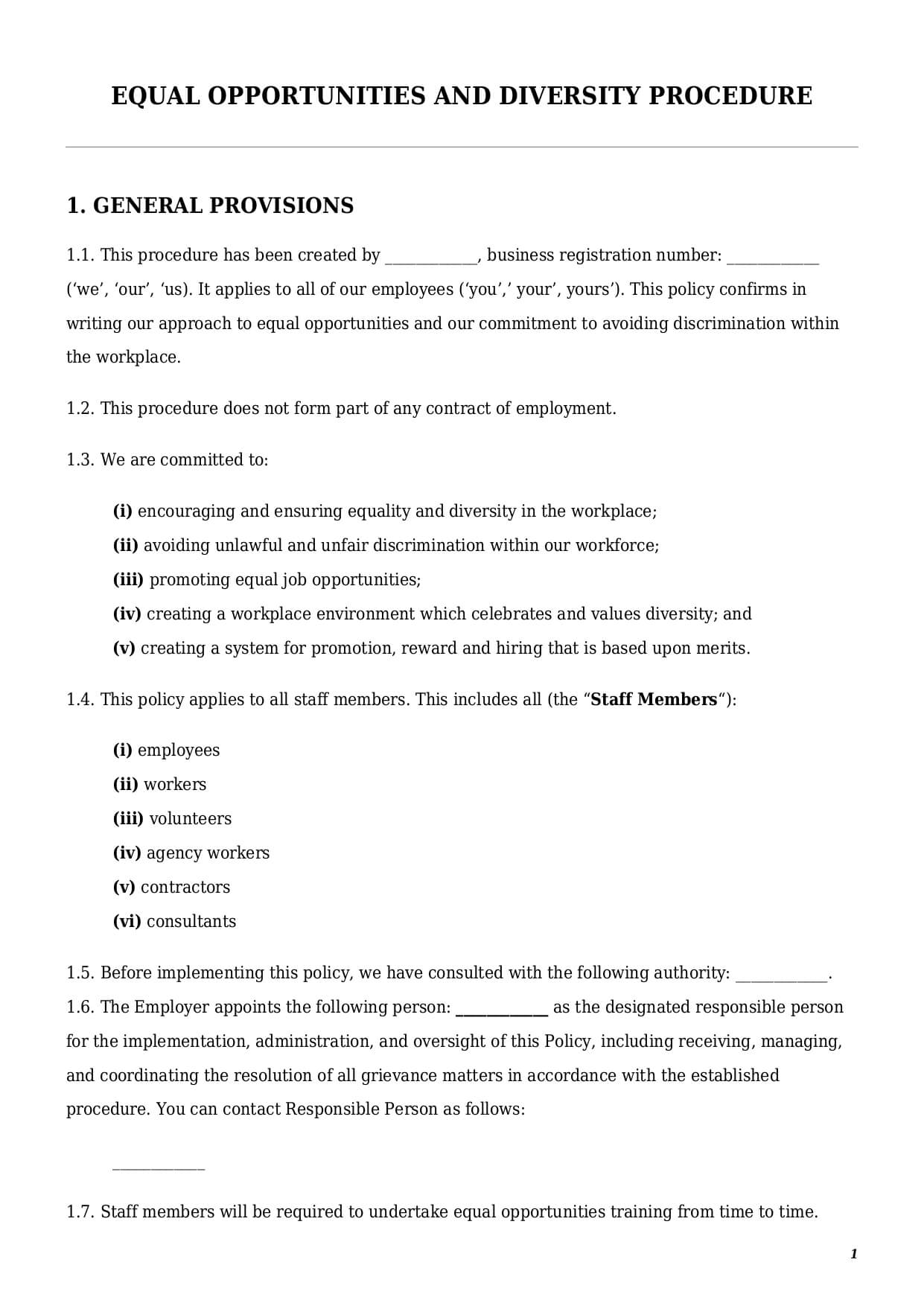
An equal opportunity policy template is the company’s internal procedure that establishes rules and policies to encourage, ensure, promote and create a workplace that celebrates and values diversity and equality. The document sets out the list of mutual rights and obligations that prevents discrimination and promotes diversity at any level, including recruitment, promotion, allocation of benefits, redundancy or dismissal of employees.
An equal employment opportunity policy template confirms the employee’s commitment to equal opportunities and avoidance of discrimination within the workplace. This document can be customised for various types of UK employers, including charities, SMEs, startups, companies with remote employees, companies with employees coming from different ethnic backgrounds, etc.
Why do UK employers need an equal opportunities policy template?
Many companies and organisations operating within the UK choose to implement this policy for a number of reasons:
- compliance with the UK Equality Act 2010 that mandates UK employers to prevent discrimination at the workplace;
- implementation of best employment practices, including provided by ACAS guidance on discrimination and bullying;
- introduction of a safe working environment for all employees;
- prevention of harassment, bullying and discrimination at the workplace;
- resolution of discrimination practices in an efficient and professional manner;
- establishment of solid disciplinary measures for those violating the policy.
It is common for an equal opportunities policy template UK to be used together with other policies, including:
- workplace code of conduct that defines general obligations of all employees to behave in a compliant and professional manner;
- Disciplinary policy that establishes procedures for internal investigations related to discrimination, bullying and harassment;
- Grievance policy that allows employees who suffer from discrimination or other forms of inequality to report this.
Forms of Discrimination in the Workplace
The present equality of opportunity policy template covers the following types of discriminatory practices at the workplace, including:
Direct discrimination
This is a type of discrimination when one person treats the other person less favourably because of one or several protected characteristics. These characteristics include age, gender, sex, ethnicity, religion, political beliefs, and so on.
For example, John has been refused in a job interview because his religious belief does not match the religious beliefs of his potential employer.
Indirect discrimination
This is a type of discrimination when the application of the same rules to all employees puts a certain group of employees in a less favourable or disadvantageous position.
For example, new company rules make Sunday a working day, which puts Mark, one of the company’s employees, in a less favourable position because he is a father of three kids and on Sunday the day care is closed.
Harassment
This is one of the forms of discrimination where one person engages in unwanted conduct relating to a protected characteristic of another person with the sole purpose of affecting or violating that other person’s dignity or creating an intimidating, hostile or offensive environment.
One of the special forms of harassment is sexual harassment, which is specifically aggressive sexual behaviour in the form of inappropriate touches, comments, jokes, messages and even looks.
Victimisation
Another discriminatory practice that can arise in the workplace is victimisation. In such a situation the employee is being discriminated against because of exercising their rights not to be discriminated against.
For example, John has recently filed a harassment complaint against his immediate supervisor Mark. As a result of that, Mark started victimising John for the fact of making such a complaint.
Disability discrimination
This is a special type of discrimination that includes direct or indirect unfavourable treatment of a disabled person in the workplace.
For example, Rachel has a walking disability, which makes her daily commute to the office quite long and uncomfortable. Rachel has been refused on multiple occasions getting a remote working arrangement.
What should be included in an equal employment opportunity policy template?
There is no mandatory list of clauses a standard policy should have. The policy’s final content largely depends on the type of employer and internal organisation in the company, as well as some factors.
Scope of Application
An equal opportunity policy has a universal application. It means that it applies to a vast category of the staff, including the following:
- part-time and full-time employees;
- employees working remotely and in the office;
- employees working on a fixed-term or long-term employment contract;
- casual workers or agency workers;
- self-employed contractors.
Implementation of Policy
A standard equal opportunities and diversity policy template should appoint specifically designated employees for application and implementation of this policy, including
- full name and job title;
- working hours;
- list of duties and obligations; and
- contact details.
Obligations of Employer
An equality and diversity policy template should outline the list of the employer’s obligations related to the implementation of this policy, including:
- dealing with addressed concerns in a timely manner;
- investigating each employee’s concerns in a timely and efficient manner;
- applying disciplinary measures to employees violating this policy;
- performing regular training for staff;
- appointing responsible staff for implementation and supervision of this policy.
How do I customise this equal opportunity policy template?
To get a fully customisable policy template, follow a few easy steps below.
- Click the “Create Document” button.
- Answer simple questions in the form.
- Select a template’s format – an equal opportunity template PDF or Word.
- Make a payment.
The document is ready for instant download and implementation right after the purchase.
Table of content
Frequently Asked Questions (FAQ)
-
1. Can I get an equal opportunities policy template free from FasterDraft?
At FasterDraft you can fully customise your policy template at an affordable price. We do not sell free generic documents, documents generated by AI or documents suitable for multijurisdictional usage. The templates they offer are created by qualified UK solicitors.
-
2. Can this policy be added to an employee handbook?
Yes, you can incorporate this policy template inside the employee’s handbook.
However, the most common option is to implement a separate policy dealing with addressing and preventing discrimination, harassment, bullying and other forms of inequality in the workplace.

Looking for something Different?
Start typing to find out our collection of legal documents and contract templates