

.svg)
.svg)
Warning Letter to Employee
 PDF and
 Word
Word
This employee warning letter template helps UK employers issue professional, ACAS-aligned disciplinary warnings for poor performance, misconduct, attendance issues, and other workplace breaches.
Reviews

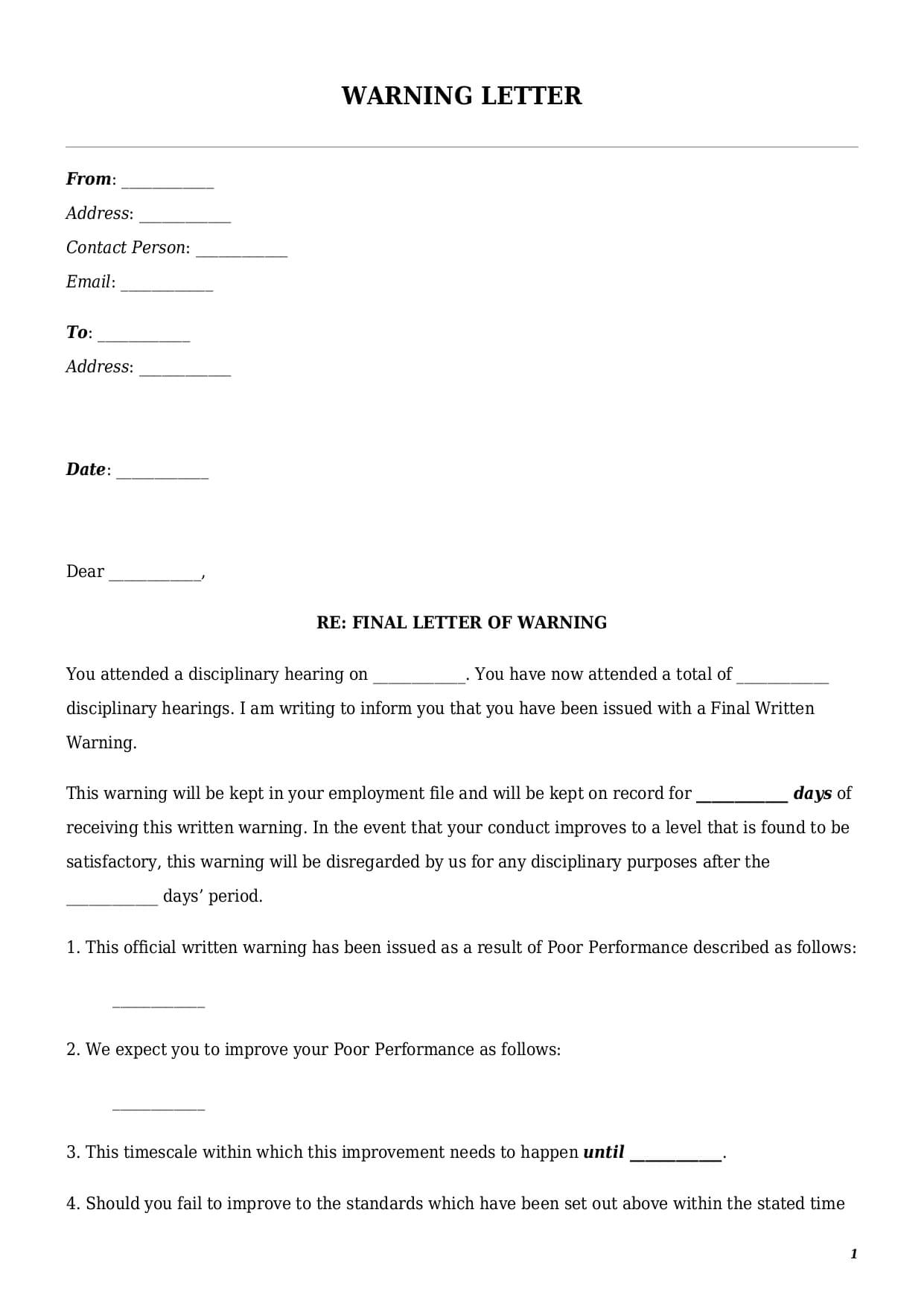
What is an employee warning letter?
A warning letter to an employee is a formal written document that is being issued by the employer to notify the employee about poor performance or poor conduct at the workplace, as well as ways of its improvement. This template is a standard document that is being used by UK employers and HR departments to issue warnings in a compliant and professional way.
This template is specifically designed for ACAS-aligned disciplinary procedures and can be used for part-time and full-time employees or casual workers.
This document cannot be used to issue warnings to freelancers, self-employed people or contractors engaged on the basis of service agreements.
When should employers use a warning letter to employee?
This sample warning letter to an employee can be used for various types of disciplinary offences committed by the employee at the workplace, including:
- poor performance that is below an average standard typically required for this type of a job;
- constant misconduct that interferes with the employer’s policies;
- attendance issues that involve constant lateness, leaving earlier, and missing deadlines;
- insubordination and other workplace-related conflicts with peers, line managers or supervisors;
- usage of drugs, alcohol or other substances at the workplace;
- harassment, bullying or victimisation of the employees, suppliers, workers or other staff, etc.
This document template is being widely used by UK employers in conjunction with the Workplace Code of Conduct and Employer Disciplinary Procedure.
What should be included in this template of warning letter to employee?
UK employment law does not prescribe a defined warning letter format for employees. A standard document usually includes the following:
- Employee Details. Full name, residential address, job title and contact email address should be included in the letter.
- Type of Letter. The text of the letter should clearly outline if this is a first, second or final warning.
- Nature of Misconduct. In this section of the letter, the employer should clearly outline the reason for the issuance of such a warning. For example, in case of the issuance of the attendance warning letter to the employee, the employer should state the hours on which the work starts and the hours when the employee arrives to work. Or, in case of the employee absenteeism warning letter, the employer should state days and/or hours on which the employee has been absent from the workplace.
- Required Improvements & Deadline. Here the employer should state how exactly the employee is supposed to make improvements, as well as the deadline.
- Appeal Process. A warning letter should outline the full name of a person to whom the employee can file their appeal, as well as the timeline during which such an appeal can be submitted.
- Record Retention Period. The employer should also state the period of time within which the record of the present warning shall be kept on the employer’s files.
- Subsequent Steps. Depending on the type of warning letter to be issued, the employer should inform the employee what will happen if improvements are not made. For example, the second warning letter can be issued, or the employee can be suspended from work.
- Sign & Date. Once the letter is ready, it should be signed and dated by the employer. The head of the HR department or other authorised person shall sign this letter on behalf of the employer.
Is this warning letter template suitable for UK employment law?
At FasterDraft you can customise a sample warning letter to an employee that is
- fully compliant with the ACAS Code of Practice on disciplinary and grievance procedures;
- in line with the Employment Act 2002 and Employment Rights Act 1996;
- drafted by qualified solicitors, and never generated by AI;
- compliant with standard disciplinary procedures used by UK employers;
- ready for use in England, Wales, Scotland and Northern Ireland.
Difference Between Informal, First, Second and Final Written Warnings
An employee’s poor performance or unprofessional behaviour at the workplace may instantly trigger the issuance of an employee poor performance warning letter. There are different types of warning letters HR departments may use depending on the severity of a disciplinary offence.
Informal warning
This is usually a verbal warning when a line manager, supervisor or someone from the HR department addresses their concern in a private, unofficial setting. This allows to communicate to the employee in a gentle way that there are certain issues that require improvement. This is the first informal step many UK employers prefer to start with.
First written warning
A 1st warning letter to employee template is being used when a line manager, supervisor or HR department wants to fix an issue with the performance or behaviour at the workplace. The text of the letter should state:
- reasons for its issuance;
- type of the letter (i.e., 1st warning); and
- subsequent steps in case of non-improvement (e.g., issuance of a second or final warning).
Second written warning
A 2nd written warning letter is being issued to those employees who have failed to improve issues addressed in the 1st warning or improvements have not been enough. However, if the employee commits a different disciplinary offence, the disciplinary process should normally restart with a first written warning relating to that separate issue. Each distinct disciplinary matter should therefore have its own record of warnings and related documentation.
The text of a second warning letter to an employee should state the following:
- reasons for its issuance;
- type of the letter (i.e., 2nd warning); and
- subsequent steps in case of non-improvement (e.g., final warning or dismissal).
Final warning
If the employer has already used all available means to help the employee to improve their work performance, in that case the employer may issue the final warning. For the final ACAS-compliant warning letter, the document should specifically mention that the next step should be a dismissal.
How to customise this warning letter to employee template?
To get a fully customisable ACAS-compliant warning letter, follow a few easy steps below:
- Click the “Create Document” button.
- Answer simple questions in the form.
- Select a template’s format – a warning letter in PDF or Word.
- E-sign the document online (for FREE);
- Make the payment.
The document is ready for immediate use instantly after its download.
Table of content
Frequently Asked Questions (FAQ)
-
1. Is a written warning legally required in the UK?
UK employment laws do not directly require having written warnings. However, ACAS in their recent guidelines related to dismissal emphasise the issuance of a written warning letter:
- adds clarity;
- records the fact of violation by the employee;
- confirms the fact that the employee is properly informed.
Therefore, many UK employers choose to have a written ACAS-compliant warning letter that can be sent by post or by email.
-
2. How many warnings should an employee receive before dismissal?
There is not a specified number of minimum warnings employees should issue before dismissing employees.
The type of misconduct, severity of violation, and the peculiarities of each particular disciplinary procedure affect the number of warnings to be issued. In some situations an employer may terminate employment immediately should the fact of gross misconduct, like a criminal offence or theft, be spotted in the workplace.
-
3. How long does a written warning stay active?
According to the best HR practices, a typical warning letter is kept on the record for the period between 3 and 12 months. The exact duration should always be specified in the text of the original disciplinary policy adopted by the employer. Upon expiration of the set period of time, the record of warnings is being destroyed, and the employee is being considered as the one who has no recent or ongoing warnings.
-
4. Can employees appeal a warning letter?
Yes. Either it is a first or employee final warning letter, or the employee should be given an opportunity to appeal this decision to the company’s head management. This is good practice that is being widely supported in ACAS guidelines.

Looking for something Different?
Start typing to find out our collection of legal documents and contract templates