

.svg) USA
USA.svg) Australia
Australia

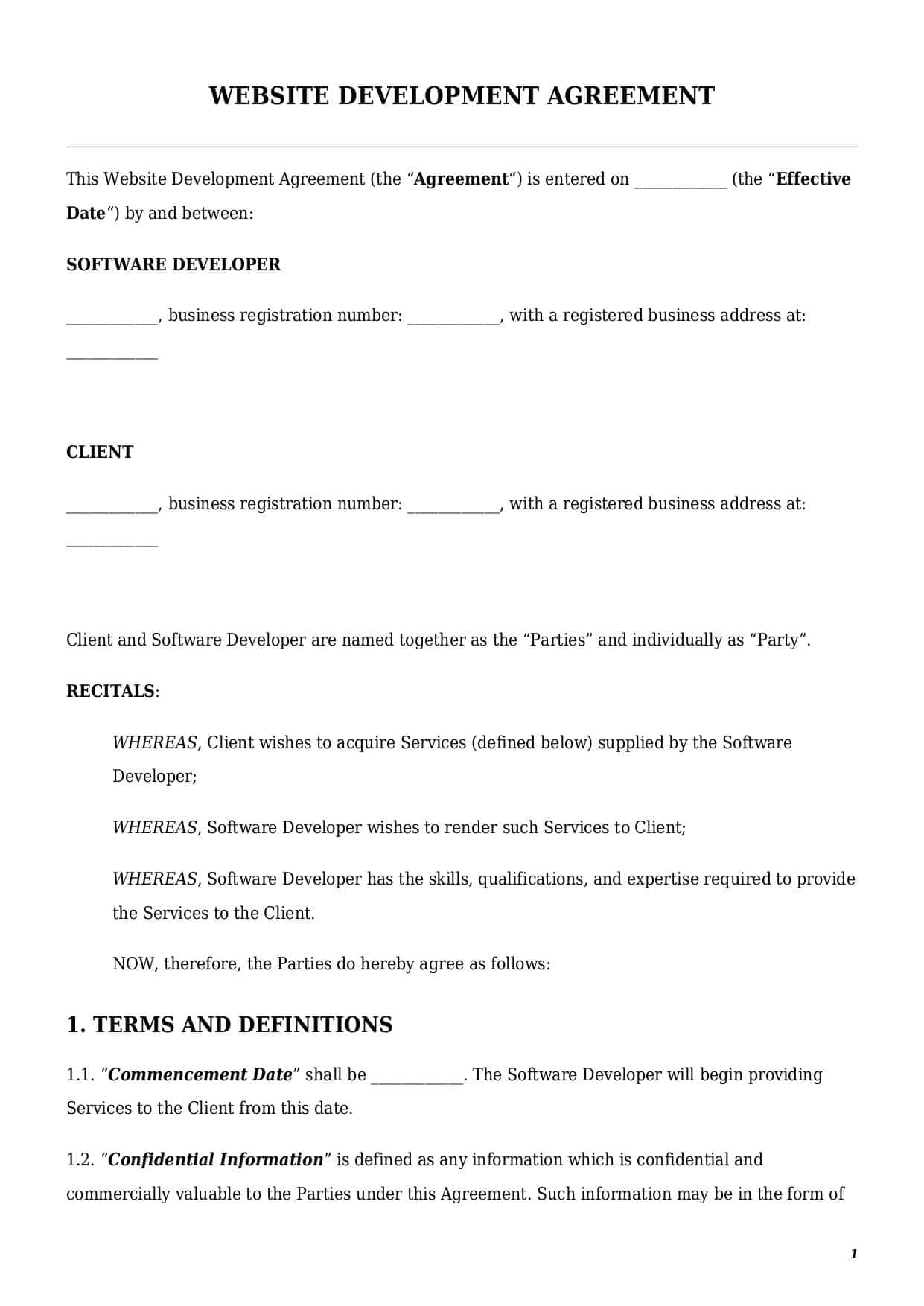
What does this UK website development agreement template typically cover?
Each website development agreement typically includes the following set of clauses:
- Project scope. This section defines in detail which exact services are being ordered and how the final deliverable (i.e., a website) should look. This template can be used by UK businesses for development or for both design and development of the website.
- Content creation. If the website is built from scratch, the parties must discuss who shall be responsible for the content creation. In most cases, the content creator is a website owner. However, in the UK there are lots of agencies that can provide various types of services under a master services agreement, including design, website development and content creation. In a situation of a website’s redesign, the parties must discuss who shall be responsible for migrating existing content (text, images, blog posts, and product listings) to the new site and to what standard.
- Payment milestones. A payment structure largely depends on the project phase. For example, for a design milestone the full fee should be paid on approval of the agreed design/mockups; for a development milestone the fee in full could be paid for each specific milestone. All the fees must be stated in pounds exclusive of VAT. The document must also outline acceptable payment methods the client can use for making payments under this agreement.
- Testing stage. The parties must discuss in the web development contract template how the testing should be made, including types of devices, types of browsers, screen sizes, how defects should be fixed, etc.
- Warranty and Support. It is common for website developers to provide additional post-launch or warranty support for the websites deployed live. Usually this period lasts between 30 and 90 days and could be free of charge or for an additional fee depending on the initial arrangement between the parties. If there is a separate master service agreement between the parties, a warranty and post-launch support are typically discussed there. However, if there is only a website development agreement used for a one-time project, parties must address all necessary details in the present template.
- Termination. The template for a website design and development agreement must also outline how either party can end this agreement, including a minimum required notice period. Post-termination obligations, including payment obligations.
Website Development Agreement vs. Software Development Agreement: which document does your business need?
| Criteria | Website Development Agreement | Software Development Agreement |
|---|---|---|
| Purpose | Used specifically for the website development. | Used to build various types of software, such as an application, platform, mobile app etc. |
| Typical deliverable | Finished, publicly accessible website | Custom software with functionality beyond a typical website |
| Timeline | Usually the website is being developed as a one-milestone project. | Usually requires more extensive specification documents and a list of milestones. |
| Hosting & domain | Usually includes a hosting and domain relationship | This is not a standard by default clause. |
| Best suited for | Websites, including complex sites built on WordPress, Shopify, or similar platforms | Genuinely bespoke software which functionality going well beyond a standard website |
To sum up: If you are looking to build a website for your business or private purposes, the website development agreement is the right choice. If, however, you are looking to build a platform, application, or any other type of software or app, you should use a software development agreement. Any other type of software or app should use a software development agreement instead.
Who owns the website code, design and IP after development?
There is a default rule stipulated in Section 11(1) of the Copyright, Designs and Patents Act 1988, stating that the author of a copyright work is its first owner. It means that when the website is developed by a third party (a developer), all the copyright is vested in the developer, unless the other is being defined in the provisions of the website development contract.
This is a surprising legal norm that always comes as a surprise to many clients and businesses who order website development and design in the UK.
Therefore, a well-drafted website development agreement must:
- specify who the owner of the website is (i.e., a developer or a business);
- define the scope of the “website” (the wording of the contract must specifically outline that the code, design and content are being covered);
- define the moment on which the business becomes the owner of the website (e.g., upon making the payment in full).
Common mistakes when drafting a website development agreement in the UK
There are a number of popular misconceptions users typically have about how the website development contract is structured:
Automatic transfer of ownership
The most common misconception is that once you pay a developer for the website in full, the website is fully owned by you. However, under the UK legal framework, the payment for the website does not automatically transfer its ownership from the developer to the business. In fact, you need to incorporate a separate clause into the text of the website design and development agreement stating the moment from which the client becomes the owner of the website.
This could be a moment once the full payment is made, once the website is released live, once the website is properly tested and accepted by the client, etc.
No design clause
Not all software developers are designers. Therefore, when you order website development services, it does not automatically include any design by default. Therefore, defining who is responsible for the provision of the design blueprints is task number one.
Accessibility Compliance to WCAG 2.2 and the Equality Act 2010
If your website provides goods or services, it must make “reasonable adjustments” for disabled users under the Equality Act 2010. This is not a good practice but a mandatory legal standard online businesses in the UK must follow.
According to the Web Content Accessibility Guidelines, currently WCAG 2.2 Level AA, there is no recognised benchmark used to demonstrate that this duty has been met, meaning that website owners may apply various tools to ensure accessibility by disabled users. However, a website that’s inaccessible without good reason risks a discrimination claim, enforced through the Equality and Human Rights Commission or the courts.
This requirement is applicable towards public and private websites.
Three unexpected things you must do before signing a website development agreement in the UK
It is worth thinking in advance about these four things before you sign a web development contract template for your UK business:
Domain and Hosting Access
The website developer and the client may have different expectations of what should be delivered upon the completion of the works under this agreement. It is common for the parties to forget about who shall be responsible for domain and hosting access, without which no website can operate.
Even if your developer helps you to set up a hosting account, connect the website to the domain and do other similar jobs, you must specify directly in the draft contract template the following:
- Whether the domain is registered in the client’s name or the developer’s and, if the developer’s, a clear handover process and timeline?
- Who holds hosting account credentials during and after the build?
- What happens if the relationship ends before or shortly after launch?
- Ongoing hosting responsibility post-launch, if the developer is providing it, including cost, renewal terms, and notice period for either party to end that arrangement.
Failure to address all these components in the contract can cost your business much more than the development of the website itself.
Scope of Testing
Whether you order an e-commerce website development contract or a one-page landing-visit-card website, testing its final result is essential to prevent bugs and ensure a positive user experience.
In most of the cases, parties include a standard clause in the document template stating the following: “The website developer undertakes to perform proper testing of the final deliverable before completion of works to ensure full operation of the website in life.” However, this clause remains vague and does not specify the following:
- on which devices the testing should be done;
- in which browsers is the testing required?
- within which period of time after testing the website must be accepted;
- what is considered a “defect” and what is considered a “change request”?
Data Protection & Cookie Consent
If your website collects any type of user’s personal data, for example, using a contact form, in-built analytics tools, order forms, etc., the website by design must additionally comply with the UK GDPR obligations and, separately, cookie and tracking technology rules under PECR (the Privacy and Electronic Communications Regulations).
Since 5 February 2026, following the Data (Use and Access) Act 2025, PECR now includes new exemptions from the consent requirement for specific low-risk purposes:
- Statistical/analytics cookies, where the data is used only by the website operator and not shared for other purposes such as advertising;
- Appearance/functionality cookies, such as remembering display preferences, dark mode, or layout choices.
At the same time, both exemptions require the operator to provide clear information about the purpose of the tracking. However, advertising, retargeting, cross-site tracking, and any analytics setup that also feeds advertising or profiling still require full opt-in consent and are unaffected by this change.
For the website development agreement template, it means that the parties must decide who is responsible for implementing a compliant cookie consent mechanism, as well as who is in charge of processing personal data. In a situation where, after the website is complete, the developer will process personal data on the client’s behalf, a separate data processing agreement template should be signed between them.
Legal compliance
Once the website is ready and tested, the businesses may want to immediately deploy the website live without forgetting to properly draft a legal foundation for the website, including the following:
- website terms and conditions;
- privacy policy template;
- cookie policy; and
- terms and conditions of sale (for an e-commerce website).
It is better to draft and carefully review these documents months before the website goes live to ensure they are fully compliant with the most recent requirements of the UK legal framework and how your website actually operates.
Why use FasterDraft?
FasterDraft offers the largest collection of fully customisable and lawyer-drafted templates for England, Wales, Scotland and Northern Ireland. All our templates are created from scratch by qualified lawyers and never by AI.
To customise this web development contract template for the UK, follow the instructions below:
- Click the “Create Document” button.
- Answer simple questions in the form.
- Select a template’s format – PDF or Word.
- E-sign the document online for free.
- Complete a payment.
- The document is ready for instant digital download immediately after the purchase.
- Print the document and read it carefully.
- Have both parties to the document sign and date it in two copies.
- Each party must keep a signed copy of the document for the record.
This article is reviewed by Daria Turanska, a lawyer with 15 years’ contract drafting experience. Fact-checked by Sarah Collins.