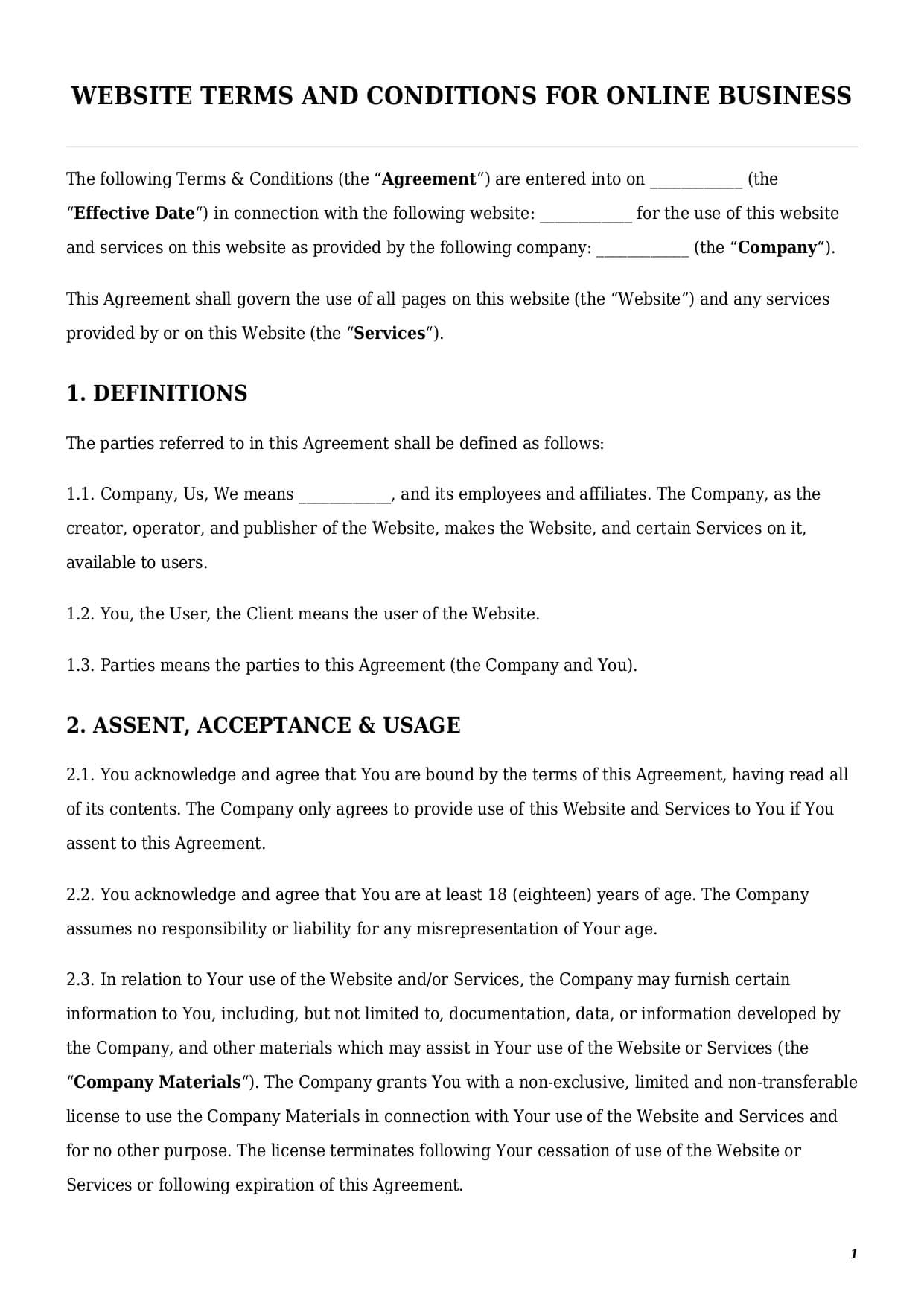
A properly structured UK website typically needs several distinct legal documents working together, each linked clearly from your footer:
- Website Terms and Conditions — This document governs the general use of your site, including what users can and cannot do on your site, a list of products, services, or goods offered, dispute resolution, and general contact information for the business.
- Terms and Conditions of Sale — this policy specifies how purchases on your website should take place, including cancellation policy, placement of order, confirmation of order, acceptable payment methods.
- Privacy Policy — this policy is a mandatory document to ensure your business fully aligns with the Data Protection Act 2018 and UK GDPR transparency obligations.
- Cookie Policy — this policy helps to ensure the Privacy and Electronic Communications Regulations (PECR)-compliant cookie disclosures.
- Returns and Refund Policy — This document defines conditions for returns and refunds for the e-commerce business which sells and delivers physical goods. This policy usually is not required for e-commerce businesses selling digital content.
- Complaints Policy – This policy addresses how a user of the website can submit a complaint regarding the use of the website or problems with goods, services, or items sold on the website. While many businesses choose to include these provisions in the text of the website terms and conditions, good business practice is to outline this information in a separate document.
Once all these policies are ready and published, the business must cross-reference each from the others rather than duplicating content between them — this keeps every document focused, easier to update independently, and clearer for users trying to find the specific information they actually need.
Why is having a professional template of the terms of use essential for your online business?
By customising this terms and conditions template for a UK website, you prevent the following risks:
- A generic website T&Cs document. On the internet, there are plenty of websites that offer AI-generated multijurisdictional or generic templates of terms and conditions that leave a genuine gap in defining who owns content users post, what happens if a comment on your site is defamatory, what you’re liable for if the site is unavailable, and what rights you have to remove a user who’s abusing the platform.
- Spending days or weeks to draft the document from scratch. Our professionally structured template gets you there in minutes rather than requiring you to track multiple regulators’ evolving guidance yourself.
- Spending a lot on legal costs. Hiring a solicitor in the UK for drafting the website terms and conditions can cost you between £200 and £500. By customising the template with FasterDraft, you pay a little fraction of a solicitor’s legal fees.
- Hidden subscriptions. We never trick our clients into subscribing or paying any extra charges when customising the document template on our website – one document means one-time payment and a lifetime licence to use it.
What should a complete website terms and conditions template cover?
The terms and conditions template for e-commerce typically should cover the following important sections:
- Site operator identity and contact details. This part is usually placed at the beginning of the document and is aimed at clarifying who is the owner of the website, including the business name, registration number, address and contact information. The present section is legally required under the ECR 2002 for any “information society service”.
- Intellectual property ownership. This section shall confirm the website operator’s ownership over the website’s content, design, trademark and branding, protected under the CDPA 1988. The document must also outline who shall own the content generated by users; otherwise, the default provisions of Section 11 of the CDPA 1988 shall apply.
- User account terms. Adding this section largely depends on how your website operates. If users can create their personal accounts, in such a case the terms of use must outline the registration requirements, account security responsibilities, and users’ rights to suspend or terminate access.
- Acceptable use policy. The document must also outline prohibited activities the users cannot do with or on the website, including unauthorised access attempts, hacking, or introducing malicious code. These actions constitute a criminal offence under the Computer Misuse Act 1990 and therefore must be outlined directly in the document.
- Third-party links disclaimer. If your website includes third-party links (for example, ad banners), it is important to include a by-default clause limiting your responsibility for external sites you link to, including the content contained on these websites.
- Limitation of liability. While limitation of liability cannot be done under UK consumer law when the goods are faulty, do not match the description or are not fit for purpose, the business can still limit its liability for site downtime, errors, or content accuracy.
- Governing law and jurisdiction. The website operator can select the laws of England and Wales, Scotland or Northern Ireland to apply to the provisions of these terms and conditions.
Common mistakes when drafting a terms and conditions template for an e-commerce business in the UK
The website terms and conditions are by far the most important document of your online business, which can be compared with an online constitution governing the presence of your website on the Internet. Therefore, before publishing this document online, make sure to learn the most common mistakes below:
Mistake 1: Using Terms of Sale
Most businesses are focused on selling their goods and services online, so they publish only terms of sale while forgetting to define the rules of using the website in general. This omission may significantly cost your business, especially when it comes to the protection of your IP ownership and the scope of your business liability as well as users’ rights.
Mistake 2: No user content licence
If your website lets people post reviews, comments, or images, you must include clear conditions regarding the licensing of such content in your T&Cs. If your business policies are silent on ownership, you may have no clear right to display, moderate, or reuse the content published by users. For example, imagine you are willing to share a user’s positive customer review left in comments but cannot do it without a user’s proper authorisation.
Our template addresses this gap by including standard legal wording by which users of the website issue a free, worldwide, unlimited licence to the business to use their content for further marketing or promotional purposes.
Mistake 3: Ignoring the Online Safety Act
It is a common misconception among many online businesses in the UK that the provisions of the OSA 2023 shall only apply to a website which is a social media platform or to a large social media platform. However, in fact, the requirements of the OSA 2023 apply to any website that has a comments section, forum or review feature. Therefore, all e-commerce stores operating in the UK shall exercise to the fullest extent their illegal content duties, requiring them to detect and remove content like fraud, harassment, threats, and other priority illegal content.
Non-compliance carries fines of up to £18 million or 10% of qualifying worldwide revenue, whichever is higher – a materially higher ceiling than most UK businesses realise applies to something as ordinary-sounding as a comments section.
Mistake 4: Defamation Claims Limitation
The website owner cannot be sued for defamation arising from the content they did not post themselves. For example, if user A posts a racist joke about user B in the comments, user B cannot sue the operator of the website for defamation. However, such an exception is only valid if the website terms and conditions align with Section 5 of the DOWR 2013. A solid and well-written terms of use must outline the detailed complaint process, including the following:
- How the defamatory notice shall be sent;
- What is the timeline for reviewing the notice (for example, 48 hours)?
- Ground for deletion of the defamatory content.
Mistake 5: No duplication
The terms and conditions of the website are not a universal document which must cover everything from privacy issues and data processing to the alternative dispute resolution schemes in case of complaints for faulty goods. Solid terms of use must provide interlinking to specific policies, tackling matters like personal data, cookies, pricing and other matters in separate documents.
How to use this terms and conditions template for an ecommerce business in the UK?
To get a fully customisable terms and conditions template for your online business, follow a few easy steps below:
- Click the “Create Document” button.
- Answer simple questions in the form.
- Select a template’s format – PDF or Word.
- E-sign the document online (optional).
- Make a payment.
- The document is ready for instant digital download immediately after the purchase.
- Publish these terms and conditions on your website.
- Link this document to other policies available on your website, for example, cookie policy, shipping policy, complaints policy, etc.
- Check contact details for their accuracy inside the text of this document to ensure users and customers can easily reach you should they have any questions.
- Update your policy regularly.
Try FasterDraft today
We offer bespoke, solicitor-drafted and fully customisable legal document templates for the UK at a range of £6 to £50, depending on the document.
No hidden fees. No “free” subscriptions that turn out to be paid subscriptions. Only a lifetime free licence to use the document is provided.


.svg)
.svg)
 PDF and
 Word
Word