

.svg)
.svg)
Terms and Conditions of Sale for Website
 PDF and
 Word
Word
Sell online with confidence — a Terms and Conditions document built specifically for UK websites, to govern how a contract is formed, what happens with pricing and payment, when risk and ownership pass to the customer, and what statutory rights the customer keeps regardless of what your own wording says.
Reviews

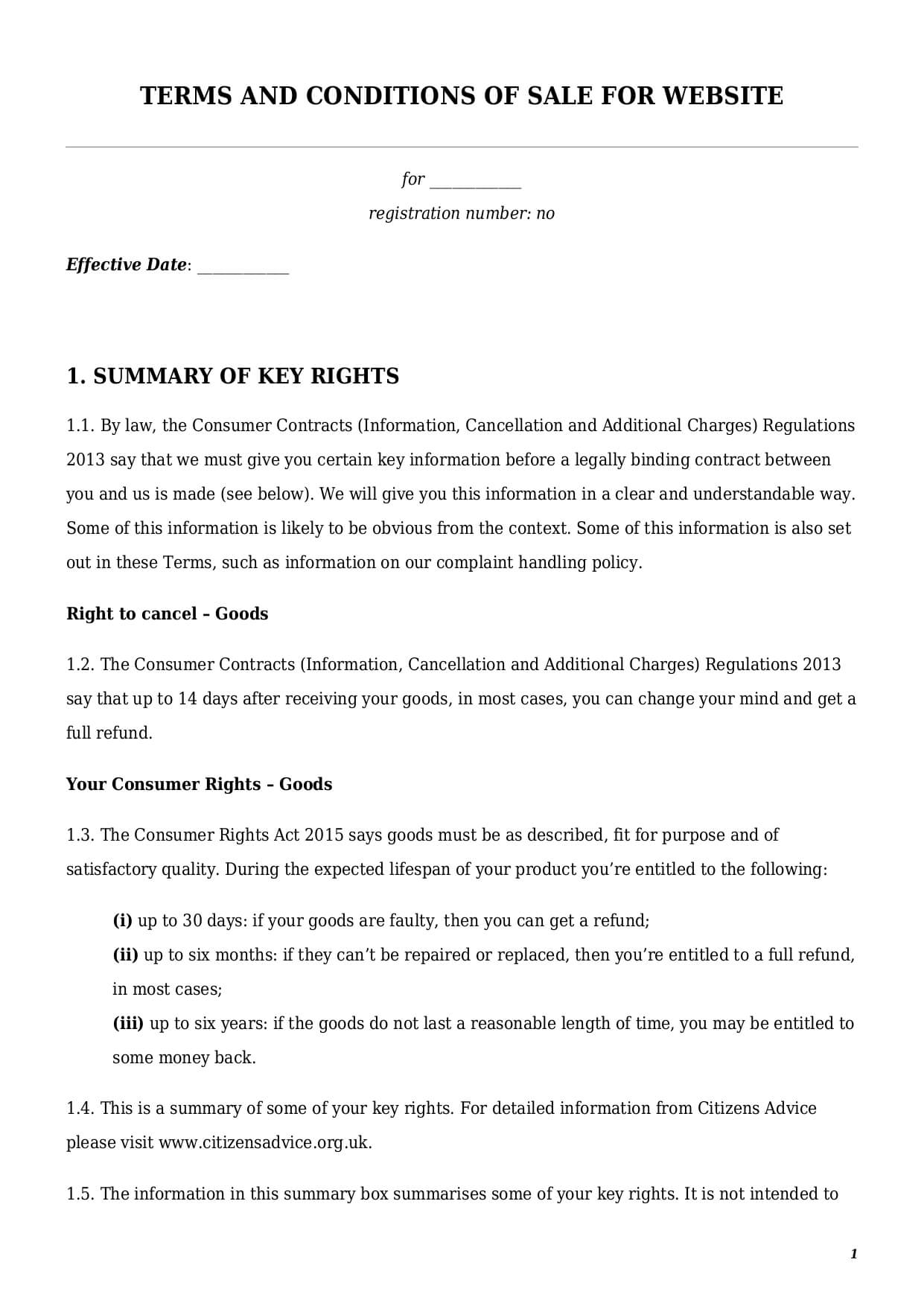
What is the website terms and conditions of sale?
A website’s terms and conditions of sale template is a public document placed on the website by online merchants to set up a legal framework for how the goods, digital content or services are being purchased, paid and delivered to the customers in the UK. The present template applies only to distance (remote) sales made online through the website or online marketplace. This document cannot be used for physical sales in the store or other physical points of sale.
This solid template of website terms and conditions of sale is built to help online businesses in the UK to outline the following:
- Order formation and confirmation. Clear steps setting out how an order is placed, what constitutes your acceptance of it, and when the contract actually comes into existence.
- Prices, taxes, and payment timing. What’s included in the displayed price, how VAT is shown, and when payment is taken relative to order and dispatch.
- Delivery, risk transfer, and title rules. When the goods legally become the customer’s responsibility, and — separately — when ownership actually transfers.
- Limitation of liability options. Configurable limitations for the online business’s liability.
- Termination and suspension triggers. The circumstances in which you can suspend or terminate a customer’s account or an order.
This document template is being frequently used by UK online businesses along with shipping policy, return and refund policy and privacy policy documents, which are also available on our website and can be customised at any time online.
Why does your online business in the UK need this professional template?
Having a professionally drafted terms and conditions policy for the website is not only about high business standards and respect towards your customers and users but also about complying with rapidly evolving consumer and data protection legislation in the UK. By customising this website terms and conditions for sale template with FasterDraft, your business will benefit as follows:
- All necessary clauses in one document. The template is built to handle physical goods, digital content, and services sold online – either individually or in combination, since many e-commerce businesses sell more than one type. Each category carries slightly different statutory obligations under the Consumer Rights Act (CRA) 2015, and the template’s structure lets you include only the sections relevant to what you actually sell.
- UK jurisdiction focus. This template is drafted under the law of England and Wales by default, reflecting the CRA 2015, the Consumer Contracts (Information, Cancellation and Additional Charges) Regulations (CCR) 2013, and the Electronic Commerce (EC Directive) Regulations (ECR) 2002 — the core legislative framework governing UK online sales.
- Fully customisable. The template can be customised to reflect the unique business model of your business to ensure that operations are run smoothly and in a fully compliant manner.
- No AI generation. Our templates are prepared by qualified solicitors with real expertise. We do not sell generic templates, multijurisdictional templates or templates generated partially or fully with AI.
- No hidden fees. For bespoke and fully customisable website terms and conditions of sale, you pay only a one-time fixed fee. No hidden subscription, charges or other marketing tricks. You get a free lifetime licence to use and modify the purchased document. We also offer a free E-sign online tool for our users, where you can e-sign the document while customising it.
What should be covered by the Website Terms and Conditions of Sale?
A standard website’s terms and conditions for e-commerce businesses must include the following important components:
Product Description
The document must outline which types of goods, services, digital content or both users can purchase via the website.
Acceptance and Formation
The document should also outline how the order is considered to be formed. According to the Digital Markets, Competition and Consumer Act 2024, the acceptance of the order by a customer should be subject to the following conditions:
- Clickwrap or explicit consent required. A customer must take a clear, affirmative action — checking a box, clicking “Place order” — to agree to your terms. Pre-ticked boxes or terms buried in a footer link with no active agreement step provide much weaker evidence of a binding contract, and under the Digital Markets, Competition and Consumers Act 2024’s broader push against practices that obscure genuine consumer choice, transparent, active consent is the standard to build to.
- Acknowledgement vs. acceptance of order. Under Regulation 11 of the ECR 2002, the business should issue two separate confirmation emails – confirmation of the receipt of the order and acceptance of the order, i.e., that the order will be processed. It is not acceptable to issue either of the emails. Many retailers deliberately structure their terms so the contract is only formed when the goods are dispatched, not when the order is placed — this gives you the flexibility to decline an order (for example, if an item is actually out of stock or mispriced) without being in breach of a contract that was never properly formed. The template includes this distinction as a clearly drafted, deliberate clause rather than leaving contract formation timing ambiguous.
- Checkout wording. Regulation 11 of the ECR 2002 also requires giving customers appropriate, effective, and accessible technical means to identify and correct input errors before finalising an order (a clear “review your order” step before final submission satisfies this).
Prices, Payment And Invoicing
It is not legally required to place the list of exact prices in the text of the policy. It is enough simply to state that the actual price usually should be stated along with the product, services or digital content being purchased.
Where you’re VAT-registered and selling to consumers, prices must be shown inclusive of VAT. Delivery costs must also be disclosed clearly before the customer commits to the purchase — under the Digital Markets, Competition and Consumers Act 2024’s ban on drip pricing, in force since 6 April 2025, any mandatory charge that only becomes visible late in the checkout journey is now a direct enforcement risk.
As a general rule, online businesses do not charge any late payment or interest since most of the goods or services are being provided upon the receipt of funds from the customer. However, those online businesses which plan to provide services or goods before collecting the payment still have the right to charge interest on overdue commercial invoices under the Late Payment of Commercial Debts (Interest) Act LPCDI 1998. In such a case information about the statutory interest rate must be indicated in the text of the policy.
Cancellation, Returns And Consumer Rights
The terms and conditions for a website usually briefly touch on the process of the cancellation of an order or return of goods because it is typically being outlined in a separate return and refund policy. However, if the business does not have such a separate policy, in such a case, provisions related to cancellation, return and refund must be stated in the present policy.
There are certain typical legal mistakes that e-commerce businesses in the UK usually make when drafting provisions on cancellation and return from scratch:
- Cancellation for digital products. A cancellation policy may not apply for digital goods that are immediately downloaded after the purchase. If this is the case, the user should be informed in advance about such an immediate download and inability to cancel the order upon payment at the checkout page.
- The 14-day cancellation right. Under the CCR 2013, consumers buying at a distance — which includes essentially all website sales — have an automatic right to cancel within 14 days, without giving a reason. This template includes the correctly scoped clause reflecting this right, cross-referenced to your Returns and Refund Policy for the practical mechanics.
- Exceptions to the cancellation right. Under Regulation 28, several categories are excluded — personalised or bespoke goods, goods that deteriorate quickly, sealed goods unsuitable for return once unsealed for hygiene reasons, digital content where the customer has given express consent and acknowledgement of losing their cancellation right, and services already fully performed with consent. The template includes this exceptions list as a configurable module, and which ones apply depend entirely on what you sell.
Data Protection Act UK
When the customer places an order on the website or contacts the business to cancel the order or asks for the refund, the business may process the customer’s personal information. Processing of personal information of customers should be performed in compliance with the UK GDPR and the Data Protection Act 2018. Customers’ personal information may include an email which is used for communication with the customer, card details used to return payment under the cancelled order, the full name of the customer, etc.
While terms and conditions of sale for a website do not address how personal information is being collected, processed, or retained by the business, the document must contain a direct reference to the existing privacy policy the business currently uses.
How to implement this template on your website?
Once the policy is ready and finalised, the business should follow a few additional steps to make this policy visible and accessible for the website users:
Steps: 1. Footer placement and checkout linking
Link your Terms and Conditions in your website footer (permanent and always accessible) and at the point of checkout, where the customer must actively agree before completing their order — one without the other leaves a gap either in accessibility or in evidenced agreement.
Step 2. Store dated copies of each version
Every time you update your terms, keep a dated, archived copy of the previous version — if a dispute arises about an order placed six months ago, you need to be able to show exactly what terms applied to that specific customer at that specific time, not just what your current terms say. The best way is to keep both the written version as a text file and the print screen of the web page of the policy before any updated or amended version has been made.
Step 3. Inform the public
The website operator should always make clear that the policy has been recently updated. The Information Commissioner Office’s recent guidelines emphasised the requirements and best practices on how website operators in the UK must inform the public about the introduced or upcoming updates:
- Publish a visible message on the website with an attached link to the updated policy.
- Send a personal email (only if the user has explicitly agreed to receive marketing and other materials and updates related to the website or its products);
- Send notifications in the app (for registered users only); or
- combination of either of the options above.
How to customise this policy with FasterDraft?
To get a fully customisable document template, follow a few easy steps below:
- Click the “Create Document” button.
- Answer simple questions in the form.
- Select a template’s format – PDF or Word.
- E-sign the document online for free (optional).
- Make a payment.
The document is ready for instant digital download immediately after the purchase.
Table of content
Frequently Asked Questions (FAQ)
-
1. Can I write my own terms and conditions?
Yes, there’s no legal requirement to use a solicitor, and a well-structured template like this one gives you the correct legal framework to build from. What matters is that the final document accurately reflects how your business actually operates and correctly incorporates the mandatory consumer protections under UK law — a document that looks professional but omits the statutory cancellation right, for example, offers you no real protection at all.
-
2. What are the terms and conditions of a sale?
They’re the contractual terms governing a transaction between seller and buyer—covering price, payment, delivery, risk, ownership, cancellation rights, warranties, and what happens if either party doesn’t perform as agreed. For a UK online sale, several of these terms aren’t fully optional — the Consumer Rights Act 2015 and the Consumer Contracts Regulations 2013 imply certain rights into the contract regardless of what your written terms say.
-
3. What should I include in my terms and conditions?
At minimum: your business identity and contact details, how orders are formed and accepted, pricing and payment terms (VAT-inclusive, with delivery costs disclosed), delivery and risk transfer provisions, the 14-day cancellation right and its exceptions, warranty and faulty goods remedies, intellectual property ownership, data protection provisions (or a link to your privacy policy), and your governing law and jurisdiction.
-
4. What terms and conditions should be on a website?
Beyond the sales contract itself, most UK websites also need a separate Privacy Policy (covering UK GDPR compliance), and — if you use cookies or similar tracking technologies — a Cookie Policy. This template focuses specifically on the sales contract; we’d recommend pairing it with dedicated privacy and cookie documentation rather than trying to combine everything into one document.
-
5. What are the terms and conditions of sale?
The specific contractual provisions governing how a sale takes place between your business and a customer — see the “Core Clauses” section above for the full breakdown this template covers.

Looking for something Different?
Start typing to find out our collection of legal documents and contract templates