

.svg) USA
USA.svg) Australia
Australia

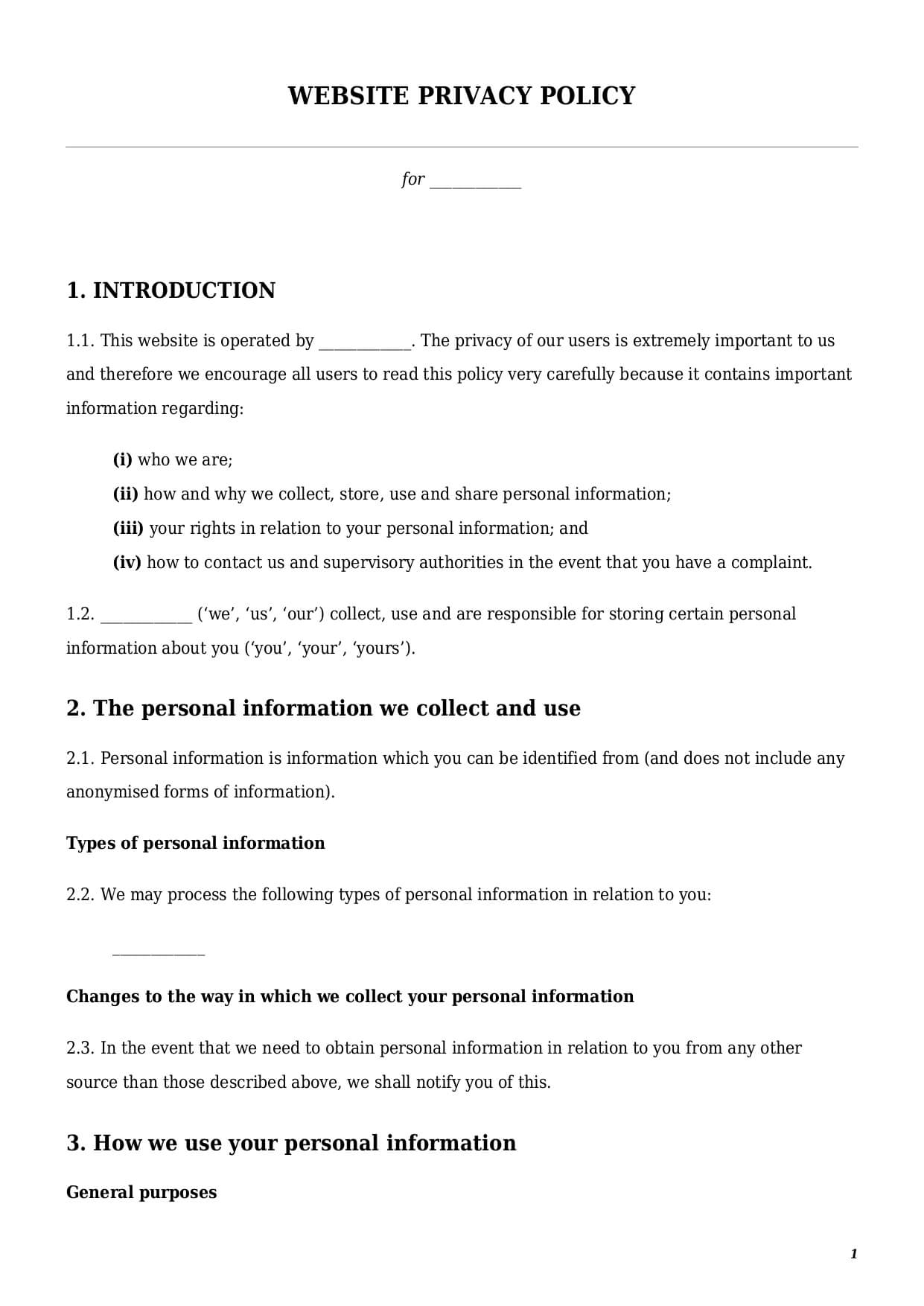
What is a website privacy policy?
A website privacy policy is an official document used by online businesses that tells your visitors and customers what personal data your site collects, how it’s collected (actively, through forms and purchases, or automatically, through cookies and analytics), why you use it, who you share it with, how long you keep it, and what rights they have over it.
Collecting and processing personal information in the UK is an important and sensitive topic, which requires all online businesses operating in the UK to comply with the set of legal acts, including UK GDPR, the Data Protection Act 2018 (DPA 2018) and the Data (Use and Access) Act 2025.
A solid and well-drafted website privacy policy defines the exact scope of personal, sensitive, or criminal data collected from users; the retention period of such data by businesses; the lawful grounds for processing such information; and communication between users and businesses.
This privacy policy for a website template establishes a solid legal framework when processing, collecting or transferring users’ personal information. This document is, however, different from a workplace privacy policy covering processing, collection and transfer of employees’ and workers’ data by the employer due to ongoing employment relations between the parties. For a workplace privacy policy, another document template should be used instead.
Why do you need a professional template of a website privacy policy for your UK business?
By customising this policy template with FasterDraft, you will receive a professionally drafted document with the following benefits:
- Bespoke solicitor-drafted template. At FasterDraft, we do not offer generic templates. The problem with generic templates is that they create real, specific gaps. Free templates found online are often drafted for the US, referencing the CCPA rather than the UK GDPR. Most of the online templates are suitable for multiple jurisdictions or are AI-generated. Our templates are created by qualified UK solicitors.
- Compliance with UK laws. This document is fully aligned with the DPA 2018 and the DTA (Use and Access) Act 2025, with substantial changes affecting websites in the UK.
- Purpose-built UK template. Using this document template is faster and more reliable than starting from scratch.
- Protect your online UK business from mistakes. The cost of getting this wrong is real. An inaccurate or outdated privacy policy doesn’t just risk an ICO complaint — it undermines customer trust at exactly the point (checkout, signup) where trust matters most for conversion. On top of that, it prevents your online business from making the most common mistakes that lead to violations of UK data protection laws.
- Avoid fines. The Information Commissioner’s Office (ICO) is the UK’s independent supervisory authority, with fining powers of up to £17.5 million or 4% of global annual turnover, whichever is greater. The price for a mistake of non-compliance with the basic requirements of UK data protection law is very high. By customising this privacy policy template for your business, you significantly increase protection against fines and litigation in the future.
What should be included in this privacy policy template for a website?
A solid and well-drafted privacy policy template should include the following information:
Business Details
The policy must outline all identification information of the website operator, including full business name, registration number (if applicable), registration address and contact information. The contact details of the business must include working hours, contact telephone and email address.
Types of information to be collected
The policy must outline the types of information to be collected from users, which are being classified into three groups – personal information, sensitive information and criminal information. For each of these groups, the policy must outline the following:
- purposes for processing such information (for example, to process delivery of the placed order on the website);
- list of types of information to be processed (for example, criminal record, religious beliefs, email address);
- ground for processing of such information (for example, to fulfil a legal obligation or to perform a contract).
The list of lawful bases for processing the personal information is limited to Article 6 of the UK GDPR — typically contract necessity for purchases, legitimate interests for basic analytics, and consent for marketing.
Retention periods
This clause must outline how long different categories of data are kept by the business. There are two important caveats one should take into consideration when deciding on the relevant retention period:
- First, the retention period cannot be unlimited in time;
- Second, the retention period should be reasonable and necessary only for the fulfilment of the purposes for which such information is being corrected.
Users’ Rights
In full compliance with the UK GDPR, website privacy policies must include rights of users in relation to the processing or transferring of their personal data, for example:
- fair processing of information and transparency over how we use your personal information;
- access to your personal information and to certain other supplementary information that this Privacy Statement is already designed to address;
- require us to correct any mistakes in your information which we hold;
- require the erasure of personal information concerning you in certain situations;
- receive the personal information concerning you which you have provided to us in a structured, commonly used and machine-readable format and have the right to transmit this information to a third party in certain situations;
- object at any time to the processing of personal information concerning you for direct marketing, etc.
International transfers
For the UK website privacy policy template, it is important to include a separate section informing users if their personal data or any part of it is being transferred outside the United Kingdom. If your online business uses Google, Meta or any other US-based SaaS platforms, for example, it means that the data is technically being transferred outside the UK. That means that users must be informed about the same in the text of the policy.
Where that’s the case, your policy needs to reference the transfer mechanism relied on (an adequacy arrangement, the UK extension to the EU-US Data Privacy Framework, or UK Standard Contractual Clauses / an International Data Transfer Agreement), not simply omit the issue.
Automated Decision-Making and Profiling
If your site uses automated tools to make decisions with real consequences, including any AI automation, in such a case, the policy must incorporate Article 22 of the UK GDPR. The cited article gives individuals specific rights around solely automated decision-making, including the right to opt out of the automated decision-making process, as well as the right to appeal any automated decision made.
Automation and AI decision-making are being employed by businesses for various purposes, for example, credit or affordability checks, automated fraud screening, algorithm-driven pricing, etc.
The DUAA 2025 made notable reforms to how this area operates, so if your business relies on automated decision-making in any meaningful way, this is worth flagging specifically in your policy rather than leaving it unaddressed – and worth a closer compliance check, given how recently the underlying rules changed.
Common mistakes UK online businesses make with their privacy policies
A solid website policy is an effective legal tool that protects your business against legal disputes and claims coming from users or government bodies, including the ICO. Below is a short list of the most typical mistakes businesses make when it comes to the protection of users’ personal information:
Outdate Policy
Once the policy is published, it does not guarantee unlimited protection for your online business. The UK legislation is evolving all the time, which means that the policy should be reviewed frequently. There is no specific timeline that businesses in the UK must follow to review their ongoing privacy policy; however, such a revision must be done with “reasonable” frequency. We would recommend reviewing and updating the policy when necessary, but not less than every 6 to 10 months.
For example, the Data (Use and Access) Act 2025 substituted PECR’s core cookie provision (Regulation 6) and inserted a new Schedule A1, both effective from 5 February 2026. Three new categories of cookies are now exempt from the consent requirement: cookies used solely for statistical or analytics purposes by the website operator, cookies used to adapt a service’s appearance or functionality to a user’s preferences, and cookies used for emergency assistance. This is a genuine relaxation of the “consent for all non-essential cookies” rule that had applied since 2011 — but it’s narrower than it might first appear: the analytics exemption only applies where the data is used solely by you, the operator, to improve your own service. If your cookie consent wording hasn’t been checked since before the DUAA changes took effect, it’s very likely there are over-blocking cookies you no longer need consent for.
Vague Language
The wording of the policy must be clear and precise. We highly recommend businesses avoid the application of the following wording within the policy, including:
- “We may process.”
- “We may transfer.”
- “We may collect.”
If at any time the processing, transferring, collection, or retention of any piece of personal information is being performed, the text of the website privacy policy should explicitly explain the following:
- the ground of such processing;
- the purposes of such processing; and
- names of parties involved in such processing.
Treating the privacy policy as a substitute for a proper cookie banner
A privacy policy template for a website cannot act as a substitute for a proper cookie policy or the cookie banner. Both documents should be used in conjunction to ensure the users are well informed of which types of information are being collected, when and how.
For example, if the text of the privacy policy emphasises that the collection of personal information takes place through various sources, including via installed cookies on the website, a cookie banner on the website should explicitly ask users for consent for the collection of information through the cookie.
How to use and customise this template with FasterDraft?
To get a fully customisable UK website privacy policy template, follow a few easy steps below:
- Click the “Create Document” button.
- Answer simple questions in the form.
- Select a template’s format – a privacy policy for a website template in PDF or Word.
- E-sign the document online for free.
- Make a payment.
The document is ready for immediate digital download right after the purchase.