

.svg) USA
USA.svg) Australia
Australia

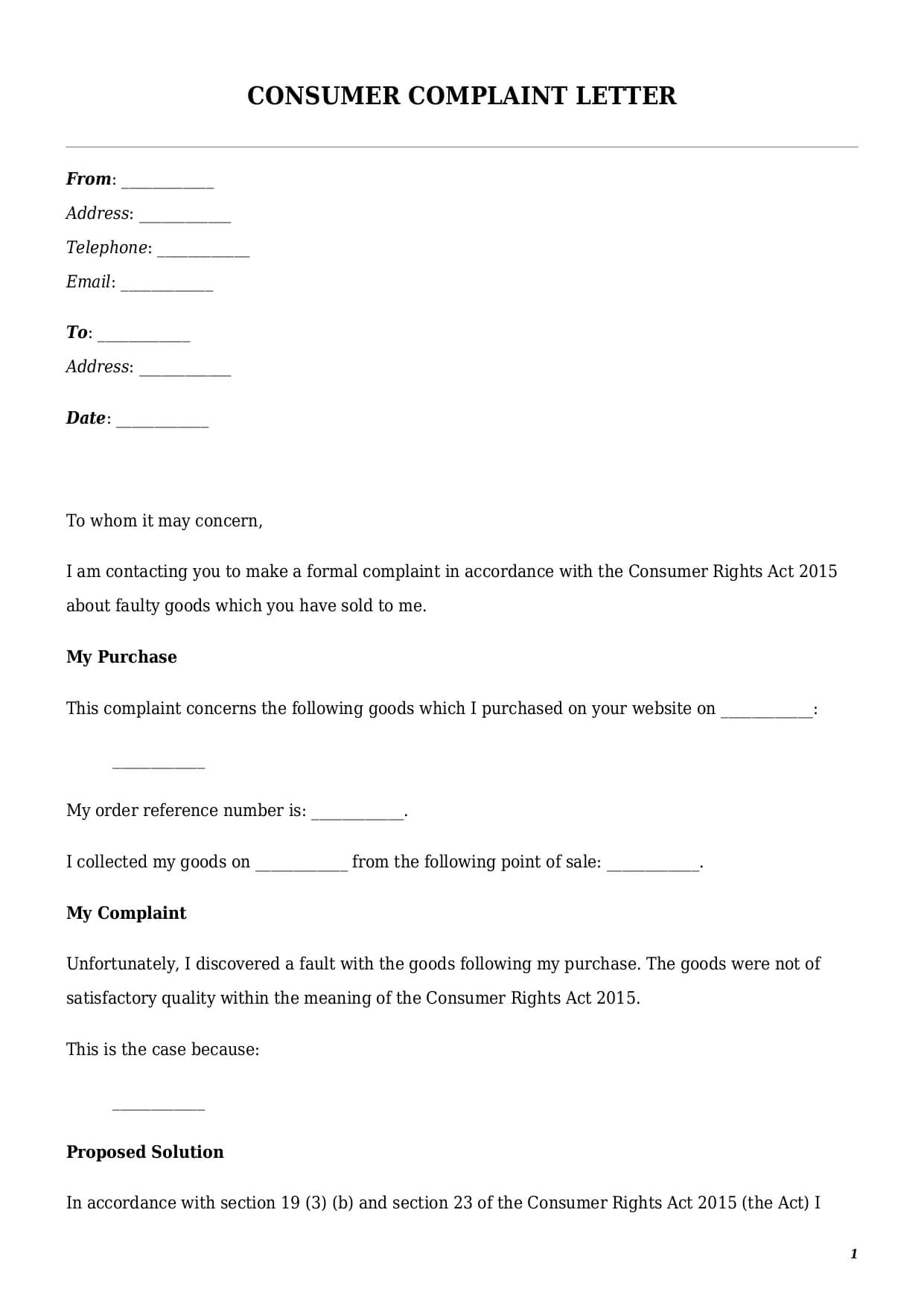
What is a consumer complaint letter about faulty goods?
A consumer complaint letter is an official notice that is being sent by individual consumers in the UK to complain about faulty goods. In simple terms, this is an official letter the buyer sends to the seller when the goods are defective, do not match the description, or are not fit for purpose. This document complies with main requirements set out by the Consumer Rights Act (CRA) 2015.
During the period 2024-2025, the Citizens Advice Consumer Service answered 726,562 consumer complaints from UK customers complaining about faulty goods, unsatisfactory consumer experiences, consumer scams, etc. Today, a consumer letter of complaint remains one of the most popular and powerful legal tools to professionally protect your consumer rights in the UK in B2C transactions.
This template is built to get you a refund, repair, or replacement faster than an informal email or a phone call ever will, and includes all the important information such as
- purchase details;
- description of faulty goods;
- proposed legal remedies to mitigate the dispute; and
- deadline clause.
No legal jargon, no confusing clauses — just a clear, ready-to-send letter you can complete and post or email within minutes.
Why choose this consumer complaint sample letter template from FasterDraft?
By customising this letter template with FasterDraft, you will receive the following benefits:
- UK-focused legal framing. The letter is built specifically around the CRA 2015 and aligns with the best consumer practices.
- No AI. This template is created by professional UK solicitors and never AI. We do not sell generic documents or multijurisdictional templates.
- Editable fields for quick personalisation. Drop in your details; the seller’s details; the product; the fault; and your preferred remedy — the letter’s legal framing is already done for you.
How to write a consumer complaint letter?
Before sending this consumer complaint letter to the business, as a first step after informal contact fails, make sure you are aware of the following important legal considerations:
- Check the business complaint policy first. Some businesses in the UK may have an available complaints policy for their customers, which you can find in a store or online on the official website. Make sure you quickly read it to know about the available means of communication and how a complaint can be submitted. You may also contact the company to discuss the issue first. Usually, a quick conversation, phone call, or informal email can resolve a minor fault with goods, while it may not be sufficient for serious claims. The person reading your letter may be more helpful if you keep the tone polite but firm.
- Set a reasonable response deadline. UK courts expect parties to a dispute to have given each other a fair opportunity to resolve things before going further — this principle underpins the Civil Procedure Rules’ Practice Direction on Pre-Action Conduct, which parties are expected to follow even before a claim is ever filed. A 14-day response deadline is a standard, defensible period to give a seller: long enough to be fair and short enough to keep the pressure on. Ask the business to confirm receipt and say when you expect to hear back. Keep the letter concise, fact-focused, and ideally no longer than one page; avoid emotional language. The template includes this as a default.
- Keep proof of postage and copies of everything sent. Whatever method you use to send such a complaint, keep a copy of the letter itself, your records, and evidence of when it was sent. Send it by certified mail for proof of delivery if possible. Keep enclosed copies of receipts, contracts, and warranty documents with your file as well. If the dispute continues in court, you would need to prove the fact of sending any prior complaints to the judge.
- Address the head office or the Consumer Complaint Division. Store-level or first-line customer service staff often have limited authority to resolve anything beyond a standard goodwill gesture. Where a business has a registered head office or a dedicated consumer complaints team, address your letter there directly rather than to the branch you originally bought from—it reaches someone with the authority to actually agree on a remedy. Include today’s date, your contact details, a contact number, and a clear subject line or title. Sending the letter to the correct recipient significantly facilitates the whole process.
What to include in the complaint letter?
To draft a professional and fully compliant letter with CRA 2015, include the important information below:
- Purchase details. Insert the purchase date and, where applicable, the product’s serial numbers in full. If the purchase was made offline, specify the name of the store, the location, and the city. Include the account number if relevant. If the goods were delivered, add the delivery details.
- Describe the defect in one clear sentence. A consumer complaint letter can be sent when something has gone wrong with the product or service: (i) when goods do not match the provided description; (ii) when goods are not fit for purpose; (iii) when goods are of unsatisfactory quality; (iv) when goods were wrongly installed; or (v) all of the reasons above. Precision matters more than length. It is important to specify as clearly as possible what the problem is and how it affects the usage of goods by the consumer. If relevant, identify the item as a device. For example, “The washing machine’s door lock failed on first use, and the machine will not start.”
- Previous customer support. If you have contacted customer support before and it was not a satisfactory experience, the consumer letter of complaint should also reflect that. Briefly state the outcome of the customer support and the approximate date when you tried to contact it. You can also mention related account or credit issues if they are part of the same complaint.
- Previous replacement or repair. If the faulty good has already been replaced or repaired in the past, provide details and explain why the outcome of such a replacement or repair is not satisfactory.
- Propose a practical solution. Wherever possible, suggest exactly how the issue could be resolved – price reduction, full refund, replacement, repair, exchange, or credit. Where appropriate, ask for your money back. For example, “I would like the item collected and a full refund issued within 14 days”.
- Attach your receipt or proof of purchase. Include receipts, enclosed copies, and other supporting records or documents, such as a bank statement, order confirmation email, physical receipt showing the purchase date and price, contracts, or warranty paperwork. If any previous replacement or repairs were made, also attach any available confirmation of that.
Which remedies are available for goods not of acceptable quality in the UK?
Before submitting this complaint, consumers should be aware of all legal remedies available to them under the Consumer Rights Act 2015, including the consumer guarantee that goods must be of acceptable quality. If the purchased goods or items are not of satisfactory quality, fit for purpose, or do not match the provided description, the consumer can use a structured ladder of remedies:
Short-term right to reject
A short-term right to reject, also known as a full refund, is the first legal remedy available to all consumers in the UK under Section 22 of the CRA 2015. This right is available to a consumer only for the first 30 days after (i) the goods are purchased, (ii) the goods are collected by the buyer, or (iii) the goods are delivered to the buyer. All in all, you cannot use the right to a full refund for faulty goods upon expiration of the 30-day statutory period. On the other hand, if the full refund is requested during the first 30 days after the purchase, the business cannot insist on offering a replacement or refund.
In one of the iconic cases, Clegg v Andersson (t/a Nordic Marine), the court decided that during a 30-day period, the buyer does not have to act “reasonably” in choosing rejection over repair, damages, or any other remedy. The customer has a right to reject goods which are not of satisfactory quality and does not have to act reasonably in choosing rejection rather than damages or a cure — he can reject for whatever reason he chooses.
Repair or replacement
The right to repair or replacement is available for consumers who identified the faulty nature of purchased goods after the expiration of a 30-day period of time. If this is the case, the consumer can require the seller to repair or replace the item, at no cost to you (including postage), within a reasonable time and without causing you significant inconvenience.
This right remains available to the consumer for the period in between (i) 30 days and 6 months after (i) the goods are purchased, (ii) the goods are collected by the buyer, or (iii) the goods are delivered to the buyer.
Price reduction or final right to reject
The price reduction or the right to request a full refund under Section 2 of the CRA 2015 is available for the consumer upon fulfilment of the following cumulative conditions:
- The faulty goods were reported within the period from 30 days to 6 months after the purchase was made, and
- The requested repair was not satisfactory, or a replacement was not offered by the business.
In such a case, the customer is entitled to either an appropriate price reduction or a final right to reject the goods for a refund. Only one failed repair or replacement attempt is needed before you can move to this stage — the seller doesn’t get unlimited attempts.
How to customise this consumer letter of complaint?
To get a fully customisable document template, follow a few easy steps below:
- Click the “Create Document” button.
- Answer simple questions in the form.
- Select a consumer complaint sample letter format – PDF or Word.
- E-sign the document online.
- Make a payment.
The document is ready for instant download immediately after the purchase.