

.svg) USA
USA.svg) Australia
Australia

What is this letter to claim compensation used for?
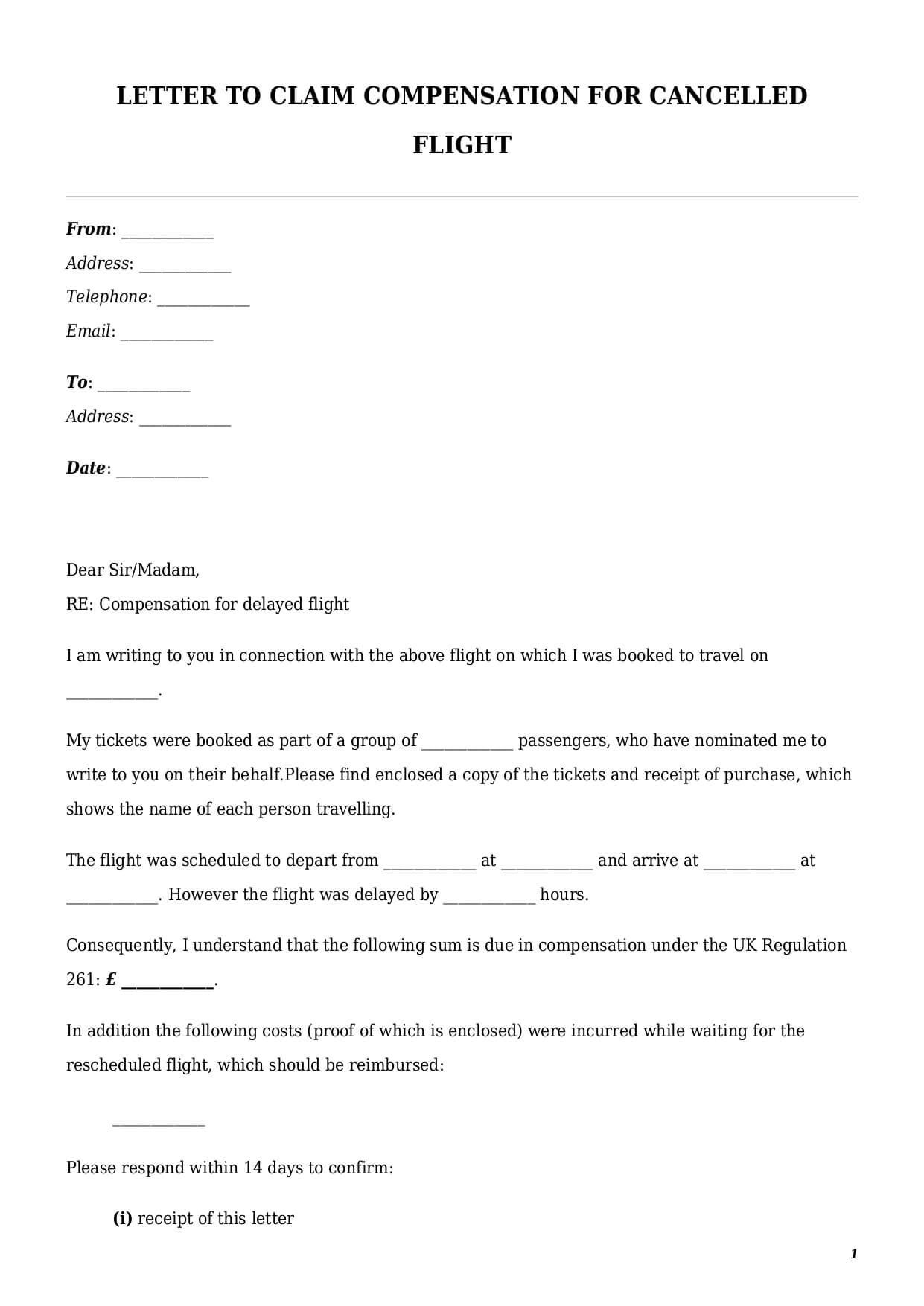
A letter to claim compensation is an official legal request addressed to the airline to claim compensation for the delayed or cancelled flight. This letter template is used by passengers in the UK when the scheduled flight is cancelled or delayed due to the airline’s fault.
According to CAA data on airline passenger complaints, UK airlines have reported a total of 43,238 complaints submitted by the passengers in 2024-2025, 62% of which were satisfied completely on the grounds of the violation of the UK 261.
In other words, a correctly framed claim has a genuinely strong chance of succeeding, and airlines pay out on a meaningful share of them every year. Using this letter, passengers can apply for up to £520 in statutory compensation directly from the airline without the need to hire a solicitor, which significantly saves costs.
This template is designed for UK passengers whose flight was delayed by three or more hours, or cancelled, and who want to put a clear, correctly framed demand in writing rather than navigating an airline’s customer service. If you are looking to submit a general complaint that is not related to the delayed or cancelled flight, it is better to check the airline’s internal complaint policy for passengers. If you want to complain about faulty goods, a separate complaint template should be used instead.
Flight Delay Compensation Overview in the UK
The principal legal document that applies to consumer rights of the UK passengers in relation to the delayed and cancelled flight is UK261 — Regulation (EC) No. 261/2004, as it continues to apply in UK domestic law, amended by the Air Passenger Rights and Air Travel Organisers’ Licensing (Amendment) (EU Exit) Regulations 2019.
The UK 261 Regulation establishes the three main rules that all airlines operating in the UK, travelling to or from the UK, should comply with:
Rule No. 1: A flight which is delayed at departure but somehow arrives on time at your final destination is not qualified for any compensation
No matter how long you have waited in the departure airport and even though the flight has been delayed for more than 3 hours, the actual time of arrival at the final destination matters. If the carrier manages to arrive on time, no compensation can be claimed for a delay. CASE
Rule No. 2: The compensation for a delayed flight is measured by the flight distance, not ticket price
Compensation amounts are fixed by flight distance, not ticket price:
- £220 for flights of 1,500km or less
- £350 for flights between 1,500km and 3,500km
- £520 for flights over 3,500km
For example, if you purchase an expensive business airline ticket for £1000 to travel from London to Paris and this flight is being delayed for more than 3 hours, you are entitled to the maximum compensation of £220, since the total distance between Paris and London is approximately 480 km. All in all, as a passenger, you cannot expect compensation covering the whole price of the ticket despite how expensive it was.
Rule No. 3: A flight should be delayed for at least 3 hours
The UK 261 states that the flight is available for compensation if the delay to the arrival airport is more than 3 hours. To make it clear, a 2-hour delay to the arrival airport does not qualify for compensation. The 3-hour rules apply to the following:
- all flights and carriers departing from the UK; or
- all flights arriving in the UK on a UK-registered carrier.
This rule comes from the Court of Justice’s decision in Sturgeon v Condor Flugdienst GmbH and Bock v Air France (Joined Cases C-402/07 and C-432/07), which treats a long delay as equivalent to a cancellation for compensation purposes — and it remains binding under UK law today, most recently confirmed by the Court of Appeal in Lipton v BA Cityflyer Ltd [2021] EWCA Civ 454.
Rule No. 4: Bring a claim within 5-6 years
In England, Wales, and Northern Ireland, you generally have 6 years from the date of the flight to bring a claim, treated as a contractual claim under the Limitation Act 1980. In Scotland, the equivalent period is 5 years. There’s no need to rush into a claim the moment it happens – but don’t sit on evidence indefinitely either.
Cancelled Flight Claims & Entitled To Compensation in the UK
When the flight is being cancelled, the UK 261 establishes specific conditions upon fulfilment of which the passengers are entitled to compensation, including the following:
Notice of Cancellation
It matters when exactly the airline provides you with a notice about the flight cancellation. If you’re told about a cancellation 14 or more days before departure, no compensation is generally payable. Any notice sent less than 14 days before the scheduled departure time provides you with a right of full compensation, refund or alternative transportation.
Full Refund vs Retouring
Once the flight is cancelled, the passenger can accept either of the following:
- a full refund for the tickets (in such a case, a refund should be paid within 7 days after the acceptance of the refund by the passenger);
- returning to your destination.
Where, however, you’re rerouted on short notice, and the replacement flight still gets you to your destination 2 or more hours later than originally scheduled, compensation generally remains payable despite the rerouting — the closer to your original departure the cancellation was announced, the tighter the airline’s rerouting has to be to avoid paying out.
No extraordinary circumstances
Under UK261, the starting position is that compensation is due for a qualifying delay or cancellation — it’s the airline’s job to prove otherwise, not yours to prove fault. The passenger cannot be left responsible for the cancellation of the flight due to technical reasons such as a technical fault with the aircraft or other extraordinary circumstances. For example, a technical fault with the aircraft is very often not an extraordinary circumstance at all; following Wallentin-Hermann v Alitalia (C-549/07), routine mechanical issues are treated as an ordinary part of running an airline, not an exceptional event, unless linked to something like a hidden manufacturing defect.
A letter structure for the claim of flight delay/cancellation compensation
A professional and solid letter template claiming compensation for the flight being delayed or cancelled must include the following components:
- Passenger and flight reference details. This section must clearly outline your name, booking reference, and flight number, stated upfront so the airline can locate your booking immediately. If the claim is being sent on behalf of a group of passengers, their full names and booking references of their tickets should also be included in the text of the claim.
- A chronological account of what happened. The letter should list a chronological order of events, including when the booking was made, what the number of the delayed/cancelled flight was, what the name of the departing airport and departure time were, and what the name of the arrival airport and precise arrival time were.
- A specific compensation amount and payment deadline. A named figure should be stated clearly in the letter as a sum for compensation indicated in pounds. Depending on the distance flight rule, the compensation for a cancelled/delayed flight can vary from £220 to £520.
- Additional expenses. If, due to the delayed or cancelled flight, the passenger incurred additional expenses, including transportation, refreshments and hotels, then the type, description and total amount of those additional expenses should also be listed in the document. Avoid vague wording for a request for compensation.
- A list of enclosed evidence. Attach as many supporting documents as possible to prove your expenses, including (i) boarding passes and e-tickets, confirming you were booked on and travelled on the affected flight; (ii) booking reference and flight number — so the airline can locate your record instantly; (iii) photos, receipts, and airline correspondence — departure board photos showing the delay; any app notifications; emails or texts from the airline about the disruption; and receipts for anything you’re claiming back; (iv) If you are claiming additional expenses, attach booking confirmation for the taxi, hotel bills, meal checks, etc.
Evidence Checklist For A Strong Claim
Once the draft letter to claim compensation is ready, follow the important tips below to ensure the claim is being sent correctly:
Recorded Delivery
You have to keep track of how the letter is being sent. The best way to do that is to send it by email to the official email address provided on the carrier’s website or inside the complaints policy or the registered mailing address of the carrier.
Set up the deadline
The standard deadline for the review of the claim letter is 14 calendar days. Include this deadline in the text of the letter and wait for the response.
Rejection
If the claim is rejected, it does not mean there is no way forward. First, check the airline’s complaints policy to find out other ways to submit your complaint. For example, many UK carriers used an alternative dispute resolution provider (for example, CEDR or Aviation ADR). If this is the case, you can access the website of the ADR provider to find out how the claim can be submitted.
Second, be ready that the airline is the one who needs to prove that the cancelled or delayed flights are not their fault. Passengers receive a guaranteed right to compensation under the UK 261.
How to customise this letter template with FasterDraft?
To get a fully customisable document template, follow a few easy steps below:
- Click the “Create Document” button.
- Answer simple questions in the form.
- Select a template’s format – PDF or Word.
- E-sign the document online for free.
- Make a payment.
The document is available for instant digital download immediately after the purchase.