

.svg)
.svg)
Service Contract Termination Letter
 PDF and
 Word
Word
A ready-to-use service contract termination letter sample is ideal for a fast, compliant, and professional way to end a service contract without complications.
Reviews

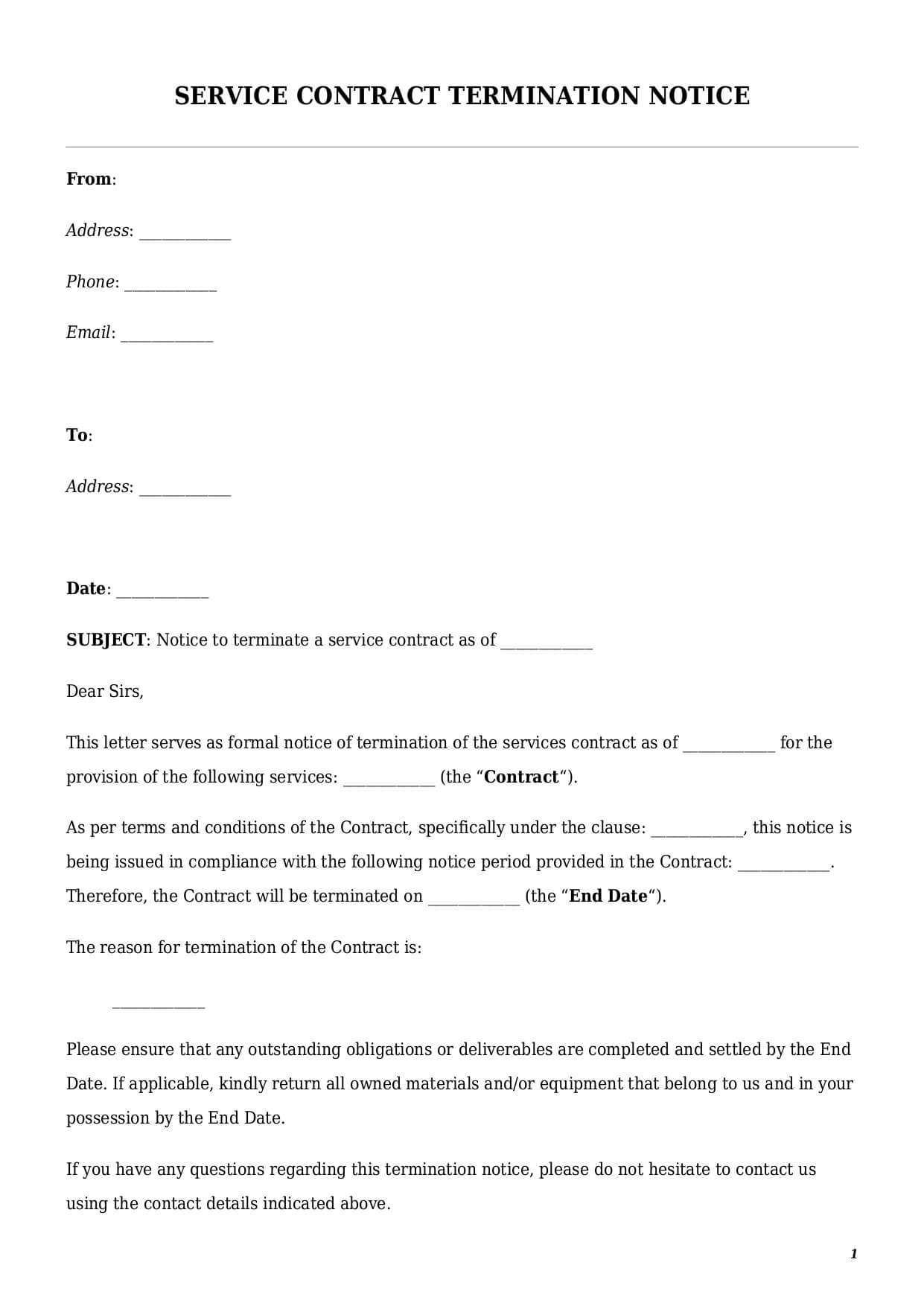
What is a service contract termination letter?
A service contract termination letter is a formal written notice issued by one party to another to end an existing service agreement. This notice helps to legally communicate the intent to terminate a contract under the terms outlined in the original agreement.
The parties involved in a termination notice of service contract template are the client and the service provider. Both parties could be individuals, self-employed, independent contractors, or businesses. A service provider is a person that provides professional services in exchange for remuneration and could be referred to in various ways, for instance, as a contractor, consultant, provider, etc.
Either party to the original contract can end it at any time. The present termination notice of service agreement can be used for termination of various types of service agreements, for instance:
- Professional services (translation, security, consulting, etc.)
- Marketing or advertising services;
- Cleaning or catering services;
- Repairing services, etc.
The present notice template can be used to terminate the ongoing services agreement for convenience (earlier) or in case of a material breach in full compliance with state common law of contracts.
Termination for Convenience, Material Breach, Non-Renewal or Mutual Termination – which type of the service contract notice shall I use?
Depending on the reason and grounds of termination, a different type of the notice shall apply.
| Termination for Convenience | Material Breach | Non-Renewal | Mutual Termination | |
|---|---|---|---|---|
| Purpose | To end the contract for any reason permitted by the contract. | Either party has committed a material breach. | To notify that a fixed-term contract will not be renewed. | To formally end the contract by mutual agreement. |
| Who sends? | Typically either party (if the contract allows). | Non-breaching party. | Either party, depending on the renewal clause. | Both parties sign. |
| Minimum notice period | Defined by the contract. | Immediate termination, or after an uncured material breach within the contractual cure period (commonly 10–30 days). | Defined by the contract. Commonly 30–90 days. | Defined by the parties. No statutory minimum. |
| Exceptions for certain contracts? | Yes. Some regulated contracts in certain states cannot be terminated merely for convenience (e.g., California – automobile dealer franchise agreements). | No. | Yes. Some regulated contracts in certain states prohibit non-renewal without good cause (e.g., Florida – motor vehicle dealership franchise agreements). | No. |
| How to apply? | Applicable if expressly included in the contract. | Applies by default under state contract law. | Applicable if expressly included in the contract. | Applies without limitation, provided both parties mutually agree. |
| Legal framework | State contract law. | State contract law. | State contract law and industry-specific statutes where applicable. | State contract law. |
Final Takeaway: if the parties are willing to end the ongoing services agreement due to termination for convenience or material breach, the present service contract template letter can be helpful. When, however, a termination of a services agreement takes place due to its non-renewal or mutual termination, a general non-renewal contract letter template or mutual termination agreement should be used instead.
How do I know which notice period to choose?
To know the right answer, the following three factors should be analyzed to understand the actual notice period applicable for your specific case:
Check the notice period defined in your original contract.
There’s usually no statutory notice period for a standard service agreement—neither federal law nor most state laws set a default. That means the contract’s own termination clause is the only place where you can find the exact notice period you need. Typically, this information is being placed in the document somewhere in the “Termination” of the agreement clause or “Notices.” A typical B2B services termination notice varies between 14 and 60 days, depending on the original duration of the contract.
If the contract is silent on notice entirely, no fixed legal minimum applies. In such a case we would recommend still sending a “reasonable notice.” This is not only a polite business gesture but also an ordinary court practice that requires all notices to be provided in a clear and advanced manner even when nothing obligates you to a specific number of days.
Check whether the sales context triggers a separate federal regulation.
Some categories of service contracts are subject to a notice/cancellation rule that has nothing to do with what your contract says. The clearest example is the FTC’s Cooling-Off Rule (16 CFR Part 429), which applies to consumer contracts, including the sale of services, made away from the seller’s regular place of business, such as a door-to-door sale or an in-home consultation. Where it applies, the buyer has an automatic right to cancel within three business days, regardless of any notice period the contract itself might specify. If your service was sold this way, this rule takes priority over whatever the contract says.
Material breach has its special termination rules.
Termination of the services contract on the grounds of material breach of contractual obligations is another thing compared to the mutual termination or termination for convenience. Therefore, contractual provisions here play a less important role. To qualify for termination of the services contract under the material breach ground, the following three cumulative conditions should be checked:
- Step No. 1: Type of a breach. Not every contractual violation is a material breach per se. Under the Restatement (Second) of Contracts §241, a breach is serious enough to justify immediate termination when it substantially deprives the non-breaching party of what they reasonably expected from the deal. For example, a delay of a payment deadline for 1 day is unlikely to qualify as a material breach, while losing a mandatory license to provide professional services (for example, dental or legal) is a serious breach.
- Step No. 2: Immediate termination. Some service agreements may provide an explicit list of breaches in which termination is possible immediately. If your contract is silent on immediate termination, move to Step 3. If there is a list of breaches for immediate termination, you can proceed with it.
- Step No. 3: Termination with cure period. Most of the service agreements, including software, accounting, security, and consulting, typically establish an additional cure period allowing a breaching party to remedy a breach. This is a short window of 10 to 30 days within which the breaching party can fix the breach. Failure to fix the breach within the specified period of time allows the non-breaching party to end the contract immediately afterwards.
How to draft a service contract termination letter sample?
When drafting a service contract termination letter sample, it is crucial to include key details to ensure that a final document is legally enforceable and concise.
Neither federal nor state laws provide any specific format a termination notice or letter should have. Therefore, the parties are free to pick up their own style or format. In rare cases, an original service contract may even provide a sample letter to end contract of service in a contract’s attachments or exhibits.
Despite a letter’s format, inclusion of certain elements is essential. We created a short roadmap below to guide you through this process.
What to Include?
A notice should include:
- sender’s details (i.e., their full name, mailing address, contact phone, and email);
- recipient’s details;
- date of the letter;
- reference to the original contract that is terminated (name and date);
- clause of the original contract that allows termination;
- end date (i.e., a date on which the contract should end).
Inclusion of other provisions in the text of a letter might be mandatory in certain circumstances only. For instance, if a sender informs about an immediate termination, usually a material breach of a contract should take place. Therefore, it is recommended to provide a detailed reasoning behind the immediate termination.
It is also a good practice to title a letter as “service contract termination letter” so that it is clear from a letter’s subject what this letter is about.
How to Send?
Once a services contract termination letter is drafted and signed by a sender, it should be delivered directly to the recipient. There are a number of ways how a termination notice could be sent:
- registered or certified mail (make sure to get a return receipt);
- courier service (make sure to get a signature confirmation upon receipt);
- email;
- in-person delivery (ask a recipient to issue a short written confirmation).
Before choosing either of the options above, the first step is to check the original services contract.
Most contracts provide the exact way how a service contract termination letter should be sent. If a contract defines one or a few particular ways of sending, a sender should use only those methods. If, for instance, a contract states that a notice should be sent via certified mail, and a sender uses email instead, an email notice cannot be considered as properly delivered. As a result, the contract cannot be terminated.
Service Contract Termination Letter for Consumer Contracts – FTC Requirements
The process of termination of B2B services agreements and B2C services agreement in the U.S. slightly differs, as the B2C contracts which fall within the consumer’s law umbrella of protection.
| B2B Services Contract | B2C Services Contract | |
|---|---|---|
| Purpose | Provision of services between businesses or commercial entities. | Provision of services to an individual consumer. |
| Parties involved | Business ↔ Business | Business ↔ Consumer |
| Right to end earlier | No default right to terminate the contract early unless a Termination for Convenience clause is included in the contract. | The FTC’s original Click-to-Cancel Rule was struck down by a federal appeals court in 2025. The FTC is now in the early stages of a new rulemaking process (as of March 2026), so no federal ‘easy cancellation’ rule is currently in force — though a growing number of states have their own automatic-renewal laws (e.g., California’s Automatic Renewal Law for online subscriptions and auto-renewing services). |
| Termination for material breach | Yes. The non-breaching party may generally terminate following a material breach, often after any contractual cure period. | Yes. Businesses and consumers may generally terminate for a material breach, subject to the contract and applicable consumer protection laws. |
| Immediate termination | Permitted for certain serious or uncured material breaches, if allowed under the contract or under applicable state contract law. | Permitted for serious or uncured material breaches, subject |
Finally, in B2C services contracts termination is also allowed within first 3 business days after entering the contract and applies only to the contracts made door-to-door sale or in-home consultation, known as FTC Cooling-off Rule (16 CFR Part 429). This, however, does not apply to B2B services contracts.
How to customize and send this termination notice in the U.S.?
In order to personalize a letter’s template for your particular situation, follow steps below:
- Click the button “Create Document” to open the questionnaire.
- Answer simple questions in the form.
- Select a document’s format—termination notice of services PDF or Word.
- E-sign the document online for free.
- Make a payment.
- Digitally download and print the document.
- Check if all included information is accurate (for example, if there are any spelling mistakes or typos in the name of your counterparty).
- Send this letter by post, mail or email (depending on the preferred method of communication defined in the original contract).
- Wait for the answer.
Table of content
Frequently Asked Questions (FAQ)
-
1. Can I cancel a service agreement before the end date?
Yes, provided a service agreement includes a termination for convenience clause allowing termination before its end date. For consumer contracts signed door-to-door or in home consultation, the FTC provides a cooling-off period of 3 days after signing the document to cancel it.
-
2. What is a termination for convenience clause?
This is a contractual clause that allows one or both parties to the services contract to end it earlier with or without reasons.
-
3. Does a termination notice have to be notarized?
No. There is no federal or state law requiring notarization of the termination notice.
-
4. How do you serve a contract termination notice?
The method of serving a contract termination notice is typically defined by the provisions of the services agreement. Common methods of sending the notice include:
- by post or paid delivery service;
- in person;
- by email.
-
5. Can a client terminate a service agreement at any time?
Termination of a service agreement at any time is also known as a “termination for convenience” and can be allowed in the contract for both or only for one party. The client can only terminate the contract earlier if such a right is granted to him in the contract.
However, even if there is no such right, a client can still end the contractor on material breach grounds or based on the mutual agreement.
-
6. Can a contractor terminate a service contract?
Yes, both the service provider (contractor) and the client have an equal right to terminate a service contract. The termination right is subject to the provisions of the existing contract and contractual common laws.
-
7. What makes a termination notice legally valid?
A legally valid services contract termination notice should
- be sent in compliance with required notice period;
- be sent using delivery methods defined in the contract;
- include termination details, such as last contract date, grounds of termination, and contract clause reference.
-
8. What happens after a service contract is terminated?
Neither federal nor state law defines exact steps parties should take after termination of a services contract. From the practical point of view, ex-parties usually
- pay in full any pending payment obligations;
- return to each other the property and equipment used for the provision of services;
- return copies of confidential information (if sensitive information is printed);
- destroy copies of confidential information (if sensitive information is in digital format);
- check the existing NDA for any contractual limitations after the termination (if the NDA was signed).
- check the existing non-compete agreement for any post-termination contractual limitations (if the non-compete was previously signed).

Looking for something Different?
Start typing to find out our collection of legal documents and contract templates