

.svg)
.svg)
Lone Worker Policy
 PDF and
 Word
Word
Protect your lone-working staff, and protect your business from HSE prosecution and negligence claims that follow when you don't. This template gives you a properly structured lone worker policy built around what UK law actually requires.
Reviews

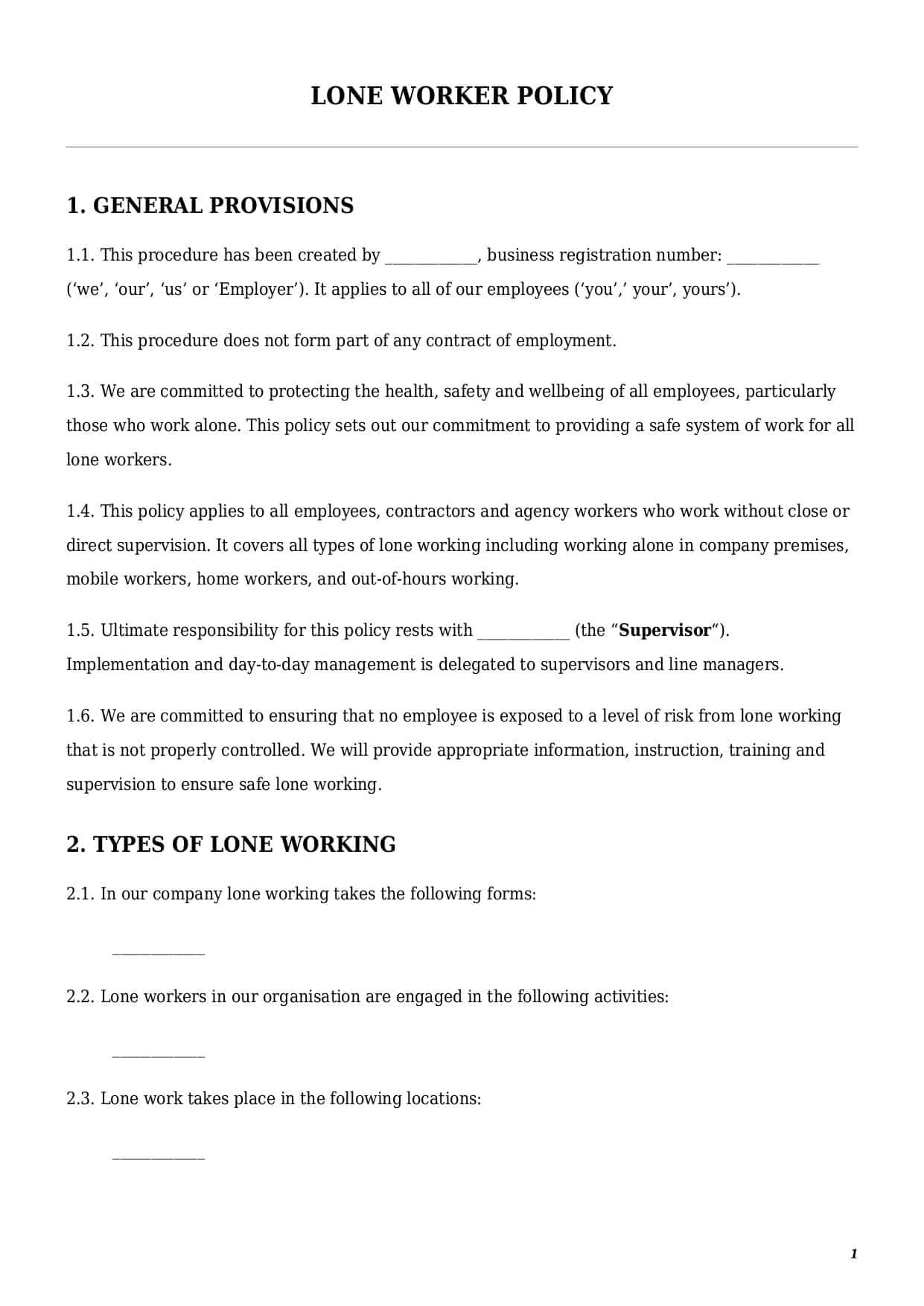
What is a lone worker policy in the UK?
A lone worker policy is a written corporate document setting out how your organisation identifies, assesses, and manages the risks faced by employees, contractors, or self-employed individuals who work without close or direct supervision, also referred to as lone workers. This policy document defines who counts as a lone worker in your organisation, how risks are assessed, what control measures apply, how contact and check-in procedures work, lists employees responsible within the organisation for the implementation of this policy, and what happens in an emergency.
The lone worker is not legally prohibited in the UK, though it requires employers to ensure safety and health measures of the working environment in line with the Health and Safety at Work etc. Act (HSWA) 1974, Management of Health and Safety at Work Regulations (MHSWR) 1999, and Workplace (Health, Safety and Welfare) Regulations (WHSWR) 1992.
Why Your UK Business Needs a Professional Lone Worker Policy
If you customise this lone worker policy with FasterDraft, you will get the following benefits:
- Compliance with the Health and Safety Executive (HSE). A written document serves as evidence showing your business complies with their statutory duties aimed at protecting the health and security of workers.
- Decreases the risk of corporate manslaughter liability. Under the Corporate Manslaughter and Corporate Homicide Act 2007, an organisation can be prosecuted if a death results from a gross failure in how senior management organised or managed activities. An unmanaged lone working risk is exactly what all employers must address to ensure compliance with the cited Act.
- Ensures compliance with ongoing insurance policies. Many insurance providers in the UK request employers and organisations to demonstrate documented risk management for higher-risk activities, including lone working.
- Reduces reputation risk. A written document confirms the employer’s commitment to protecting the health and safety of their employees, thereby strengthening their reputation.
- Helps your business to scale. With a solid lone-worker policy in place, your business can safely hire remote workers and offer remote work arrangements to existing employees.
How does this lone worker policy interact with other corporate policies and procedures within the organisation?
Having a standalone lone worker policy does not do lots of work or fill in all the necessary gaps. An efficient application of the policy is only possible with interaction with other important internal procedural documents, including the following:
- Drug and Substance Abuse Policy. Impairment is a materially higher risk for a lone worker than for someone working alongside colleagues, precisely because there’s no one present to notice, intervene, or call for help if something goes wrong. Your existing drug and substance abuse policy template provides specific measures regarding observation, reporting and investigation of employees or workers working alone compared with the rest of the employees engaged in working in groups or in the office.
- Workplace Code of Conduct. The following basic standards of the company’s corporate ethics apply throughout the organisation to all employees, no matter if they meet clients directly or work in the office or remotely. Maintaining professional boundaries and conduct standards is applicable to lone workers too. Therefore, the present lone worker policy should explicitly reference the lone worker’s obligation to align with the rules defined in the workplace code of conduct.
- Grievance Policy. Lone workers should be given an opportunity to raise their concerns or complaints should their working conditions not be in line with the minimum statutory requirements provided by the HSWA 1974. Having a proper grievance procedure in place can facilitate the complaint process for lone workers by establishing specific means of communication by which such a complaint can be filed.
What should be covered in the Lone Worker Policy Template?
A standard and well-drafted lone worker policy template must outline the following:
- Employer’s details. The policy should briefly state the employer’s name, business registration number and address.
- Supervisor’s details. This is a person within the organisation who shall be responsible for the policy’s implementation. The document must include their name, title and contact details.
- Scope of application. The document must outline who is covered by the application of this policy, including specific categories of employees and their job titles.
- Risk assessment framework. The People, Environment, and Task (PET) model is widely used in UK lone working risk assessment: who the worker will encounter, the environment they’ll be working in, and the nature of the task itself.
- Control measures. The policy should explicitly name all communication devices, check-in schedules, lone worker alarms, and any technology-based monitoring solutions used to monitor the performance of the lone workers.
- Emergency procedures. This section should outline obligations of the organisation and the lone worker in case something goes wrong. The policy must also outline the emergency contact details a lone worker can use to report the accident.
Key legal considerations for drafting a lone worker policy in the UK
Before release of a lone worker policy to your employees, check additionally on the following:
HSE Reporting
Every lone worker policy template must implement a standard reporting mechanism defined in the Reporting of Injuries, Diseases and Dangerous Occurrences Regulations (RIDDOR) 2013. This regulation requires employers to notify HSE once there is any incident at the workplace involving a lone worker.
Scope of Application
If the lone worker policy intentionally outlines certain categories of employees or staff from its scope of application, it does not automatically remove the employer’s liability for any future accident. In fact, under the HSWA 1974, the employer retains primary responsibility for managing the risk that applies not only to employers but also to contractors, freelancers, or self-employed individuals working for the business.
Scattered legal regulations
There is no single act in the UK legal framework governing specifically the health and safety of lone workers. The applicable legal norms are scattered around various acts, which makes it challenging for employers when it comes to drafting a real policy document. For example, there are separate Health and Safety (Display Screen Equipment) Regulations 1992 applicable to home-based or remote lone workers, requiring them to use special display screen equipment as part of their roles.
UK courts have also issued a number of important legal precedents confirming the employer’s common law duty of care towards their employees and workers. In particular, employers owe a non-delegable duty to provide a safe system of work, competent staff, adequate equipment, and safe premises, which was established in Wilsons & Clyde Coal Co. Ltd v English [1938] AC 57 and has been applied consistently since.
How to customise this document template for your business?
To get a fully customisable document template, follow a few easy steps below:
- Click the “Create Document” button.
- Answer simple questions in the form.
- Select a template’s format – PDF or Word.
- E-sign the document online for free.
- Make a payment.
The document is ready for instant digital download immediately after the purchase. - Print out and read the document carefully.
- Sign the document.
- Communicate the release of the new policy to the employees, workers and staff within your organisation.
- Review and update the policy regularly.
This article is reviewed by Daria Turanska, a lawyer with 15 years’ contract drafting experience. Fact checked by Sarah Collins.
Table of content
Frequently Asked Questions (FAQ)
-
1. Is a Lone Worker Policy required by law in the UK?
Not as a standalone document. But employers must be able to demonstrate they’ve assessed and managed the risks of lone working under the Health and Safety at Work Act 1974 and the Management of Health and Safety at Work Regulations 1999. A written policy is the clearest, most practical way to evidence that compliance.
-
2. Do employers have a legal duty to protect lone workers?
Yes, this is employer’s statutory duty they owe to any employee, applied to the lone-working context, and it cannot be delegated to the worker themselves. This duty also extends to contractors, freelancers, and self-employed individuals engaged by the business.
-
3. Can employees work alone at night?
Yes, it isn’t prohibited outright. At the same time, night working introduces additional legal considerations under the Working Time Regulations 1998, including limits on night working hours and a right to a free health assessment before starting night work and at regular intervals afterwards, and the underlying risk assessment should specifically address the additional risks night working creates.

Looking for something Different?
Start typing to find out our collection of legal documents and contract templates