

.svg)
.svg)
Letter Confirming Residency
 PDF and
 Word
Word
A letter confirming residency is one of the most commonly needed in the UK from opening a bank account to enrolling a child in school to supporting a visa application. This template gives you a correctly structured, UK-appropriate letter, along with clarity on exactly when you need this document and when you actually need something else.
Reviews

What is a letter confirming residency?
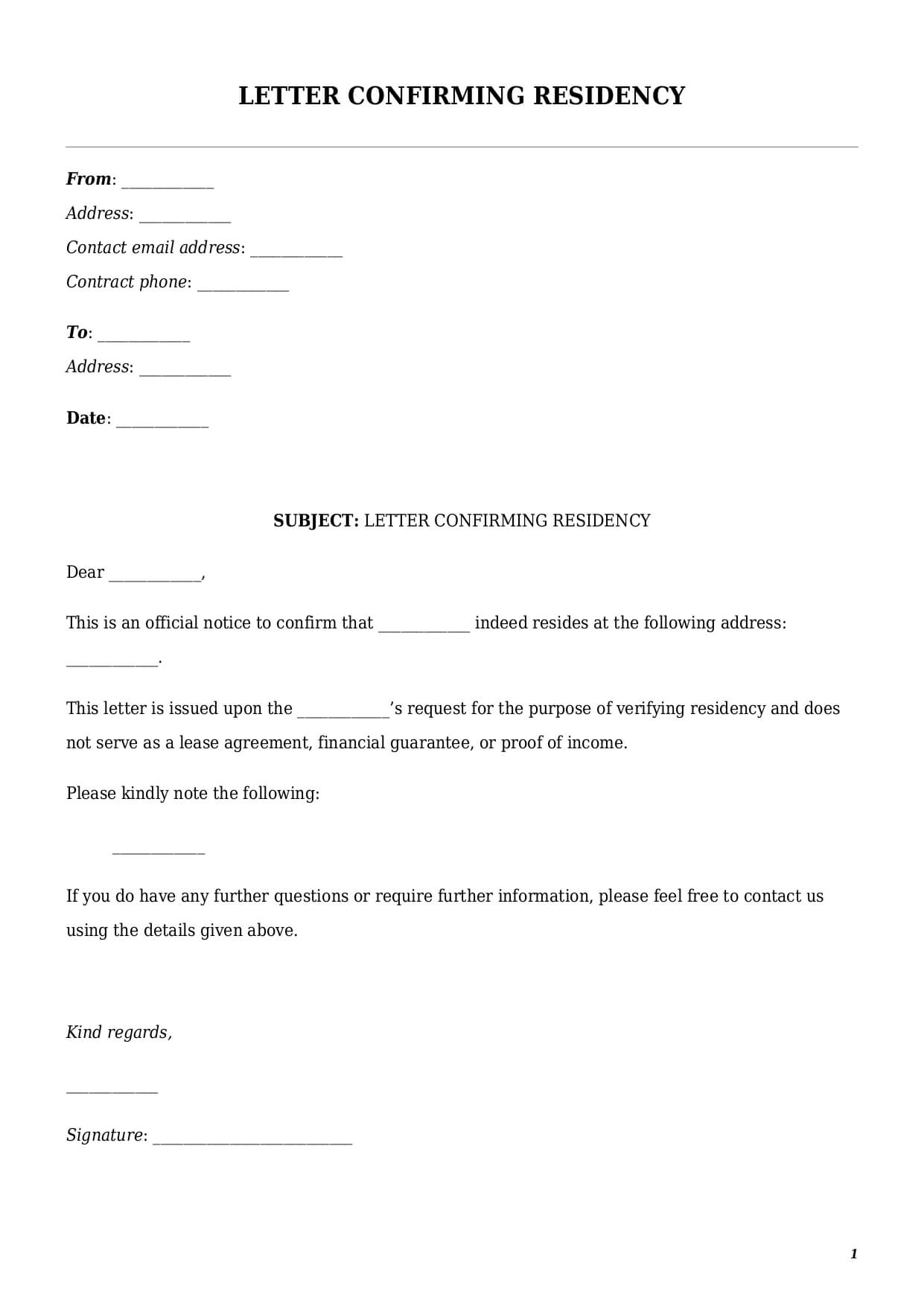
A letter confirming residency, also known as a residence confirmation letter, is a written statement confirming that a named person lives at a specific address for a specific period. This letter is typically written by someone in a position to confirm the residency, for example, a landlord, an employer, or a family member the person lives with and is used to satisfy a third party (a bank, school, government body, or visa authority) that the individual genuinely resides where they claim to.
The present letter to confirm residence is used to confirm the residency of a person and cannot be used to substitute an HMRC certificate of residence or a tenancy agreement.
This letter is suitable for application throughout the UK.
Letter Confirming Residency vs. HMRC Confirmation of Residence — Which one do I need?
This is a genuinely common mix-up, and getting it wrong wastes real time and important deadlines.
| Letter Confirming Residency | HMRC Letter of confirmation of Residence | |
|---|---|---|
| Purpose | Confirms where person physically lives | Confirms UK tax residency status |
| Signed | A landlord, employer, family member, or the individual, in a personal capacity | HMRC |
| Legal basis | No specific statute | Statutory Residence Test, Schedule 45 of the Finance Act 2013 |
| Used for | Bank accounts, school admissions, tenancy checks, general visa support, GP registration, DVLA applications | Tax-related situation, including claiming taxation relief, proving UK tax residency |
| Timeline | Get in 2 min. with FasterDraft | Apply to HMRC and wait for 2–4 weeks |
| Cost | £ 4.99 | Free |
When may you need this letter of confirmation of residence?
You may be requested to provide this type of letter in various daily situations, including the following:
- Opening a UK bank account. If you do not have a utility bill in your own name (for example, if your landlord keeps receiving bills in their name), a signed residency letter from a landlord, employer, or family member can serve as supporting evidence alongside other identity documents.
- Registering with a GP. If you are trying to be registered with a GP within a specific area, many private practices ask for proof of address to confirm you fall within their catchment area.
- DVLA driving licence applications — a UK residential address needs to be confirmed if it can’t be verified electronically.
- School or university enrolment. If you are applying for enrolment into the school, university or other educational institution, this document might be necessary for catchment-area verification.
- Scholarships. If you are applying for a reduction in tuition fees or a scholarship, some programmes may require you to provide the certificate of residence. For example, residents from the Isle of Man may benefit from scholarships applicable to UK residents on condition of providing the respective confirmation of residence.
- Tenancy verification. When signing a new tenancy agreement, a new landlord may request confirmation of your current living address.
- Employer or HR purposes. In the course of employment and internal HR checks, a future employee might be required to present a letter of confirmation of residence.
- Visa and immigration support. This is one of the most typical situations in which this type of letter can be requested.
Why do you need a professional template?
By customising this letter template with FasterDraft, you get benefits and prevent the risks below:
- Prevents rejection. There is a high chance of missing important sections in the letter when drafting it from scratch. This template includes every field institutions consistently ask for, rather than leaving you to guess based on a half-remembered example.
- Ensures professionalism. The template has a professional layout and is written in plain English by legal professionals. We neither use AI to generate our legal templates nor sell generic or multijurisdictional templates.
- Tailor the recipient’s expectations. The person or organisation asking for this letter usually has specific expectations about what it should say and how it should be structured, even if they haven’t spelt it out explicitly. The present template is built around what banks, schools, and visa authorities usually expect to see in the text of the document.
- No hidden fees. By customising this template with FasterDraft, you pay once, and you get a lifetime licence to use and modify the document an unlimited number of times. No hidden subscriptions or charges.
What does this letter of confirmation of residence cover?
This template includes the following essential sections:
- Full legal name and contact details of the person writing the letter (landlord, employer, family member, or the individual themselves);
- Full legal name and mailing address of the recipient;
- Full name of the resident the letter concerns;
- Start date from which the resident occupies the property;
- Detailed address of the property;
- Signature and date;
- Supporting documents (for example, a copy of a tenancy agreement, certificate of birth or certificate of marriage to confirm family relations), etc.
Who can write this letter of confirmation of residence?
There is not a statutory list of individuals who can write this letter. The most common examples include:
- landlord or letting agent under the ongoing residential or tenancy agreement;
- employer’s or HR’s representative under the existing employment agreement;
- homeowner;
- family member;
- spouse or civil partner;
- any other individual depending on the recipient’s requirements;
- resident’s management company;
- residents’ association;
- letting agent or property management company (acting on behalf of the landlord under tenancy agreement);
- individual themselves as a self-declaration.
Typical mistakes when drafting a letter of confirmation of residence in the UK
Whether you are being asked to present the letter confirming a residence or you are the one who is being asked to issue it, be aware of the following common pitfalls:
Mistake 1: Confusing this with an HMRC Confirmation of Residence
The present letter template can never be used to confirm tax residency in the UK, or for any other tax-related matters, including claiming relief from taxation or tax benefits.
Mistake 2: Vague wording
The document should clearly confirm if the person lives at the indicated address or not. Inclusion of the wording “I believe he/she may live at this address” carries far less evidential weight than a clear, direct statement.
Mistake 3: No supporting evidence
Most institutions expect this letter to accompany additional supporting documents. For example:
- If this letter is issued by a landlord, a copy of the tenancy agreement can be attached.
- If this letter is issued by the employer, a copy of the employment or zero-hours contract should be included.
- In the case of a self-referenced letter, a copy of the most recent utility bill should be enclosed with this letter.
Mistake 4: False or inaccurate letter
Under Section 2 of the Fraud Act (FA) 2006, knowingly making a false representation with intent to make a gain or cause a loss (or expose someone to the risk of loss) is a criminal offence. Therefore, issuance of the letter with false or inaccurate information may trigger application of the FA 2006. This matters because people are sometimes asked to write or sign a residency letter to confirm someone lives somewhere they don’t to trick immigration authorities, social care authorities or the school admission board.
Mistake 5: Confusing this template
In some circumstances, certain government agencies may specifically require a statutory declaration to confirm the residence. A statutory declaration is a document different from the present letter and is sworn before a solicitor, commissioner for oaths, or notary public under the Statutory Declarations Act 1835. Knowingly making a false statutory declaration is itself a criminal offence; therefore, many government institutions specifically ask for a statutory declaration rather than a simple signed letter.
How to use this letter to confirm the residence template?
To get a fully customisable document template which is ready to use, follow the steps below:
- Click the “Create Document” button to start the customisation process.
- Answer simple questions in the form to tailor the document for your needs.
- E-sign the document online for free.
- Make a payment.
- A digital download in Word or PDF format is available immediately after the purchase.
- Print the letter out.
- Attach supporting documents, for example, a copy of the signed tenancy agreement.
- The letter is ready to be sent by mail, post or email.
Customise today
We offer bespoke, professional and fully customisable legal document templates for the UK in the range of £4.99 to £50, depending on the document.
No hidden fees. No “free” subscriptions that turn out to be paid subscriptions. Only a lifetime free licence to use the document is provided.
Table of content
Frequently Asked Questions (FAQ)
-
1. Is a letter confirming residency legally binding?
If false or inaccurate information is being included in this letter, this may trigger application of the Fraud Act 2006. Therefore, this letter should always be treated as a serious, accurate declaration.
-
2. Can I write my own residency confirmation letter?
Yes. If the recipient of this letter accepts self-declaration, you can issue this letter by yourself.
-
3. Do I need this letter notarised?
No. A simple letter of confirmation of residence does not require further notarisation. However, if a party requires a statutory declaration to confirm the residency, the latter must be sworn before a solicitor or commissioner in accordance with the Statutory Declarations Act 1835.
-
4. What's the difference between proof of address and proof of residency?
“Proof of address” and “proof of residency” are commonly used as interchangeable documents across the UK. Commonly, different institutions use these terms inconsistently.
-
5. Can this letter be used for a visa application?
It can support certain visa applications as evidence of accommodation and residency, but always check the specific requirements of the visa category you’re applying under — some require very specific formats or additional certification.

Looking for something Different?
Start typing to find out our collection of legal documents and contract templates