

.svg)
.svg)
Employee Non-Compete Agreement
 PDF and
 Word
Word
Reviews

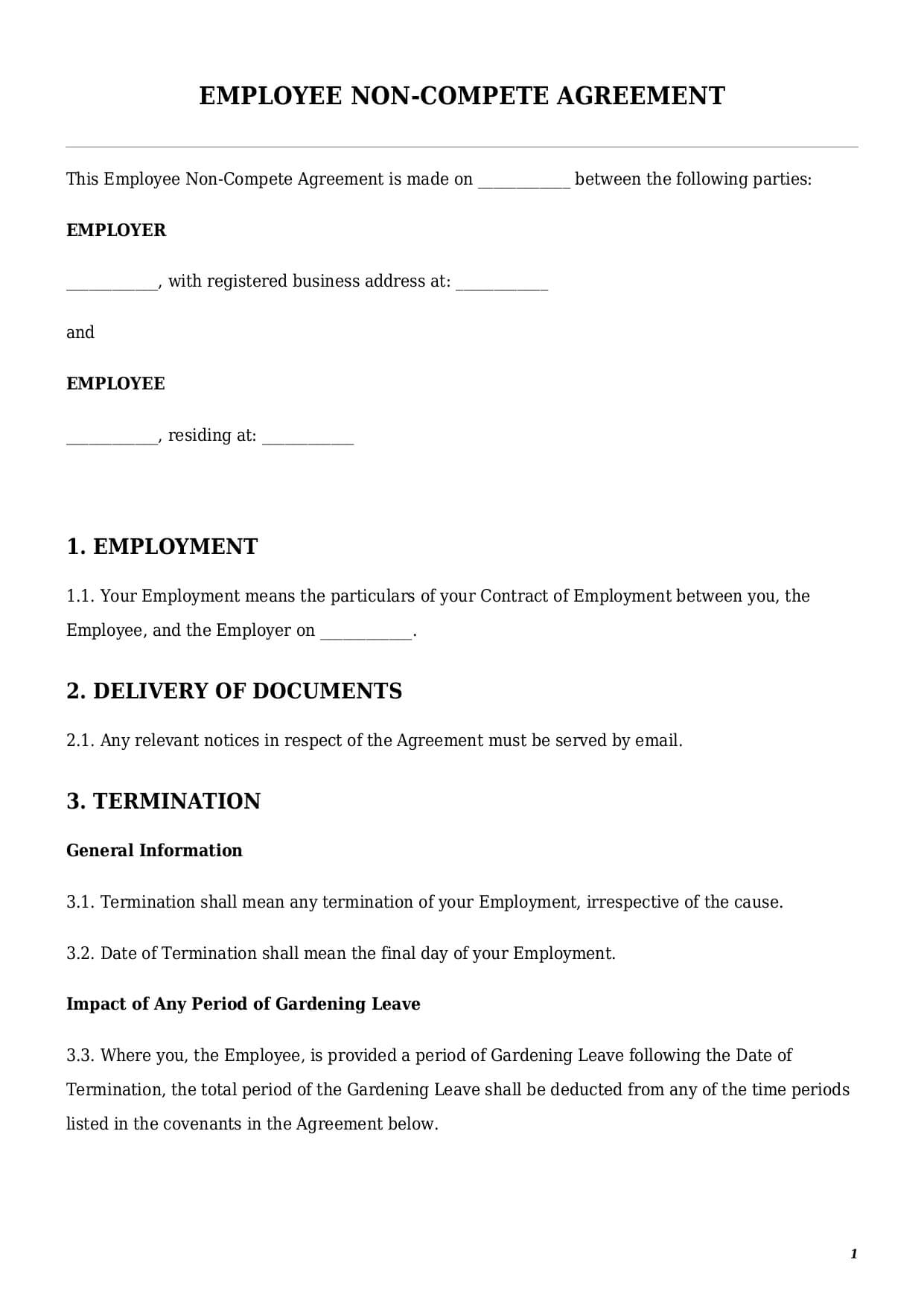
What is an employee non-compete agreement in employment contracts?
An employee non-compete agreement is a legal document signed between a former employer and an employee to protect the employee from competing with their former employer in a specific geographic area and for a defined period of time. This non-compete agreement template defines the competing business, the list of restricted actions, the type of consideration, and the geographic scope. The parties can also add a non-poaching and non-solicitation clause to restrain an employee from soliciting and hiring the former employer’s employees, staff, clients, contractors, or suppliers.
When a key employee leaves your business, they take with them the knowledge, relationships, and confidential information you have invested years in building. A professionally drafted employee non-compete agreement gives you a legally recognised mechanism to prevent that knowledge from being immediately used against you by a direct competitor.
This document is designed for employers of all sizes, covering the full range of post-employment restrictions, and ready to download and customise immediately.
Why use this employee non-compete agreement template from FasterDraft?
By customising this non-compete and non-solicitation agreement template with FasterDraft, you get the following benefits:
- Legally Compliant. This template fully aligns with English contract law, common drafting standards for UK employment contracts, and best business practices.
- Fully customisable. The document can be fully customised in several minutes.
- Ready to Use. Download and customise immediately. No legal appointments, no lengthy waiting periods. Plain English guidance in every section ensures you complete the document accurately.
- No AI. The document is created by real lawyers, and never by AI. We do not use AI to generate documents. We do not sell generic legal templates, templates available for free on the Internet, or multijurisdictional templates without the UK legal specifics.
- Balanced Restrictions. Every restriction is drafted to go no further than is reasonably necessary to protect the employer’s business interests. The template does not use catch-all “any competitor in any industry” wording that UK courts routinely strike down.
- Clear Definitions. The template precisely defines what counts as a “competing business,” sets out the prohibited activities, and states the exact geographic area of the restriction, with scope that can vary depending on the role and risk — removing the vagueness that makes many clauses unenforceable in practice.
- Professional format. Our templates are drafted by qualified UK solicitors. The document has a professional layout and is written in plain English.
What information and restrictive covenants should be included in the employee non-compete agreement template?
A well-drafted UK non-compete agreement should include all of the following:
Parties
The employer’s full legal name and registered address, and the employee’s full name and address. Both parties must sign and date this agreement.
If this agreement is being executed as a deed, it means that the employee will not receive any consideration or compensation for signing the document. In such a case, an employee’s signature must be witnessed by a witness (for example, HR, another colleague, or immediate supervisor).
Duration of the restriction
The precise period during which the restriction applies after the employment ends.
In UK law, there is no precise duration of the non-compete restriction. Currently, the Government is pushing back the papers to discuss the possibility of introducing a certain cap on the duration of the non-compete in the UK. However, this is a formal proposal only, without any legal consequences. Many jurisdictions have narrowed or restricted the use of non-competes, especially for lower-paid workers.
Non-compete clauses can last from 3 months to 2 years, but in the UK the period still needs to stay reasonable to be enforceable.
Definition of competing business
A standard non-complete agreement with an employee shall define the types or kinds of businesses the employee is restricted from joining or establishing. This must be limited to a similar business connected to the employer’s business, not unrelated future activity. For example, if the employer’s current major competitors are A and B, these companies can be listed as “competing businesses” in the provisions of the contract.
Restricted activities
A solid and well-written no-solicitation and non-compete agreement shall answer the following question: What exactly are the prohibited activities? The list of actions should be as precise as possible, and it should also make clear whether the employee may seek employment elsewhere outside the restricted scope. For example:
- joining a competitor as an employee, including taking a role with a competing firm;
- establishing a competing business;
- holding shares in a competing business;
- consulting for a competitor;
- holding an interest in a competitor, etc.
If a certain activity is not being named specifically in the text of the document, it means such an activity has not been restricted.
Geographic scope
Geographic scope is another delicate matter that causes most disputes between former employers and employees. Most employers in the UK tend to approach such a clause broadly by establishing a “universal” scope of application as “the whole world” or “throughout the UK”. While establishing such a clause might be tempting, it is always important to ensure a geographic scope limitation remains reasonable.
The geographical scope and geographical area covered should be defined precisely. Geography should be tied to where the employee actually works and where your business genuinely competes. A “worldwide” restriction is often difficult to justify unless you’re operating globally and the person’s role was genuinely global.
Non-solicitation and non-poaching clauses
These are the restrictions specifically preventing the employee from approaching the employer’s clients, customers, or suppliers — either to solicit their business or to deal with them at all. A non-poaching agreement is A restriction preventing the employee from recruiting or encouraging the employer’s other staff to join a competitor or the employee’s new venture.
Non solicitation agreements and non dealing provisions are often used as other clauses alongside non-competes. If the non-solicitation clause or a non-poaching clause is being included in the employee non-compete agreement, the parties must also outline its duration separately.
Consideration
Every restrictive covenant must be supported by consideration — something of value provided to the employee in exchange for accepting the restriction. These restrictions are forms of restrictive covenants and should be drafted so both parties understand what is being accepted. At the start of employment, the job offer itself is sufficient consideration.
Where restrictions are introduced during employment, additional consideration — a pay increase, a bonus, enhanced benefits, or a promotion — must be provided alongside the new clause. A restriction introduced without any additional benefit during employment is likely to be unenforceable. This template includes a consideration clause and guidance on when additional consideration is needed.
Confidentiality Agreement vs Non-Compete Agreement
The NDA, or non disclosure agreement, and non-compete agreement templates are not the same document, but different legal tools used widely in business and employment relations.
Scope of restrictions
The employee non-compete agreement restricts a former employee from joining a competitor or establishing a competing business. On the other hand, an NDA restricts the usage and disclosure of specific confidential, proprietary information and sensitive information.
Situations in which it applies
An employee confidentiality agreement applies during the employment and after its termination. While a non-compete agreement applies only once the employment relationship comes to an end.
Consideration
It is not common for employers to pay a separate consideration to employees for signing a confidentiality agreement. Usually, an employment itself is treated as a consideration. In the case of an employee non-compete agreement, it should be supported by consideration to be more easily enforced in court in case of a dispute. The courts in England and Wales require proof of compensation or benefit while an employee is being put outside the employment market.
All in all, a confidentiality agreement alone does not prevent an employee from joining a competitor and using their general knowledge and skills — it only restricts the use of specific confidential information. Employers often use a non-compete to protect sensitive information, but a non-disclosure agreement can be a narrower alternative.
Non-Compete Agreement, Competing Business, and Garden Leave — How They Work Together
Employers in the UK searching for the most robust options to protect their business against the competition from former employees normally combine the application of the non-compete agreement and garden leave as post termination restrictions. While this approach may appear reasonable and effective to protect the employer’s legitimate business interest, courts in England and Wales may not enforce in full such an arrangement, and some employers also use a longer notice period alongside these restrictions to protect continuity.
Garden leave
Garden leave occurs when an employee who has been given notice — or who has given notice — is required to serve out their notice period at home, away from the office, with no access to clients, colleagues, or confidential information. The employee remains employed (and continues to receive full pay and benefits) but is effectively excluded from the business. This prevents them from damaging client relationships, briefing clients on their departure, downloading confidential information, or engaging with colleagues before joining a competitor.
Once the garden leave comes to an end, the employee has already been kept away from the competitive market for 3, 6, or more months. As a result, the application of further restrictions, such as a non-compete or non-solicitation agreement template, may appear excessive.
View of the courts in England and Wales
Courts in England and Wales take garden leave into account when deciding whether to enforce a post-employment non-compete. An employee who has been on six months’ garden leave on full pay has already been kept away from the competitive market — requiring them to then observe a further six-month non-compete on top of that may be seen as excessive. By contrast, an employee who resigned with one week’s notice and returned to work immediately may face the full post-employment restriction period.
While courts do not directly exclude the possibility of applying both garden leave and non-compete agreements for post-termination relations, for employers, it becomes more difficult to justify that the risk of competition remains the same as on the last date of employment, depending on the impact on business operations and the employer’s remaining risk. For example, in the case Jump Trading LLC v Couture [2023], an employee was placed on one year of garden leave and, on top of that, the employer sought to enforce a one-year non-compete. The High Court refused to grant interim relief to the employer and enforce the non-compete clause as “seemingly long” and unusual for the sector.
Who shall use this non-compete agreement template?
This non-compete and non-solicitation agreement template is suitable for:
- Small business owners protect trade secrets, customer relationships, and proprietary methods when a key member of staff leaves, helping preserve a competitive advantage;
- Startup founders preventing employees from immediately joining a rival or launching a new business in direct competition;
- Professional service firms such as law firms, accountants, consultancies, and recruitment agencies that are willing to safeguard client relationships;
- Technology companies protecting source code, development processes, product roadmaps, and technical know-how from former employees; and
- Any employer with senior or specialist employees whose departure to a direct competitor could cause genuine, identifiable harm to the business.
This document can only be used for employees, workers, and staff engaged in relations with the employers by virtue of a full-time, part-time, or remote employment contract. Rules may differ for independent contractors, so for contractors and staff working based on the services agreement, a separate non-compete agreement for business should be used instead.
How to create a non-compete agreement to be fully enforceable in the UK courts?
When drafting a non-compete and non-solicitation agreement template, all employers want to make sure that once a dispute arises, their business interests and goodwill can be protected in court. To ensure that, an NDA non-compete agreement template should reflect key legal considerations under employment law and be based on the following two legal principles:
Legitimate business interest
An employer cannot simply stop their employees from competing. They need a legitimate business interest first to be protected, and the restriction must be tied to the employer’s interests. This may include:
- Trade secrets and confidential information — when employees have access to technical data, formulas, pricing, client lists, proprietary information, etc;
- Customer connections and goodwill — when staff and personnel liaise on a daily basis with the employer’s clients, particularly where the employee is the primary relationship-holder;
- Stability of the workforce — when senior staff leaves the company, they may undermine the stability of the workforce of the previous employer by soliciting former colleagues.
Reasonable Restriction
Once the court is able to determine that the legitimate business interest exists, the next step is to find out if the non-compete clause is fair and reasonable. The non-compete clause is considered reasonable when local laws and statutory limits are also taken into account:
- Duration. Non-compete clauses typically last from 3 months to 2 years, but enforceability still depends on whether the period is reasonable in the circumstances.
- Geographic scope. Worldwide restrictions are very difficult to justify outside genuinely global roles. Therefore, the geographic scope of application should be clearly defined and may include a specific district, county, or city.
- Activity scope. A solid non-compete agreement template does not prohibit all activities in general. Such clauses should define the prohibited activities clearly in the text of the agreement. For example, the restriction “do not compete directly” shall be explained further. In particular, the text of the document shall name whether the former employee cannot start their own business, cannot work for a similar business in the same industry, or cannot simply be a majority shareholder in such a business.
How to customise this non-compete agreement template for employment?
To get a fully customisable document template, follow a few easy steps below:
- Click the “Create Document” button.
- Answer simple questions in the form.
- Select a template’s format – non-compete agreement template Word or PDF.
- E-sign the document online (for the employer).
- Make a payment.
The document is ready for instant digital download immediately after the purchase.
Table of content
Frequently Asked Questions (FAQ)
-
1. What makes a non-compete clause enforceable in the UK?
Non-compete clauses in employment contracts can only be enforceable if they are reasonable, with enforceability depending on the clause’s geographical scope and the activities it clearly restricts.
- it is reasonable in scope;
- no excessive in duration; and
- specified in geographical reach.
For example, a court in the UK will likely not enforce a universal non-compete clause that applies throughout the UK. However, if the geographical reach of the non-compete clause is a specific city or county, in such a case, the clause can be enforceable.
Another example is when the cause is excessive in duration, for example, lasting for 5 or more years. For example, in Tom James UK Limited v Max Potter [2025] (High Court, July 2025), the High Court found that a 12-month non-compete clause was unenforceable because it went further than was reasonably necessary. The clause prohibited Mr Potter from working “in any capacity” for a competitor — which could include being a “receptionist, driver or floor sweeper.”
-
2. How long should my non-compete period be?
Non-competes often run from 3 months up to 2 years, although for most employees the practical range is still much shorter and depends on the employee’s seniority, access to confidential information, and industry standards.
For example, a 3-month restriction may be appropriate for a relatively junior employee or employees working at the entry positions. While a 6-month limitation is common for managerial roles with regular client exposure. As a last resort, a 12-month non-compete clause may be defensible for senior executives or directors with access to strategic information and key client relationships.
-
3. Can I use this for all employees?
No, an NDA and non compete agreement tempaltes cannot apply to all employees despite their position in the organisation. The choice of an employee should be made carefully to ensure there is a genuine risk that the employee could cause competitive harm after leaving. These clauses can affect worker mobility and an individual’s ability to move within the same industry or start a new job, so they should be reserved for real risk cases. Usually, not all roles in the company entails such a threat; therefore, signing a non-compete agreement is typically limited to strategic roles or roles that have access to sensitive or confidential information.
Around 5 million employees in Great Britain have non-compete clauses, and about 26% of UK workers are subject to them.
-
4. What if an employee breaches the agreement?
If a former employee breaches a non-compete clause, the employer should act as follows:
- send a formal notification about the breach to the ex-employee;
- apply to the High Court for an interim injunction to stop the breach immediately while the merits are determined (this can be done despite the fact of sending the notice in the first step); and
- claiming damages for financial loss caused by the breach.
An employer may also take legal action, but legal costs may be awarded to the winning party and enforcement can create additional costs.
The financial losses are being determined by the court in each specific case, depending on how the employer is able to prove the connection between the breach, damage, and the former employee’s actions.
-
5. Do I need to pay the employee during the non-compete period?
The UK laws do not impose on employers directly to pay any sort of compensation for the whole duraation of a non-compete agreement. However, in case of a court dispue, it might be harder for the employer to enforce the clause without any paid compensation during the non-compete period. Therefore, a solic non-solicitation agreement template should always include compensation for ane mployee.
-
6. What is the difference between a non-compete and a non-solicitation clause?
A non-compete prevents the employee from joining or establishing any competing business during the restriction period — regardless of whether they target the employer’s specific clients. This is a more general clause that typically covers all possible non-compete actions.
A non-solicitation clause is more targeted. This clause prevents the employee from approaching or soliciting the employer’s specific clients, customers, or suppliers, but does not prevent them from joining a competitor generally. It may be a narrower alternative where the aim is to stop contact with clients or staff rather than block work for a competing firm entirely.
Usually, non-compete and non-solicitation clauses are included in the same document for convenience.

Looking for something Different?
Start typing to find out our collection of legal documents and contract templates