
.svg)
 United Kingdom
.svg) Australia
Australia

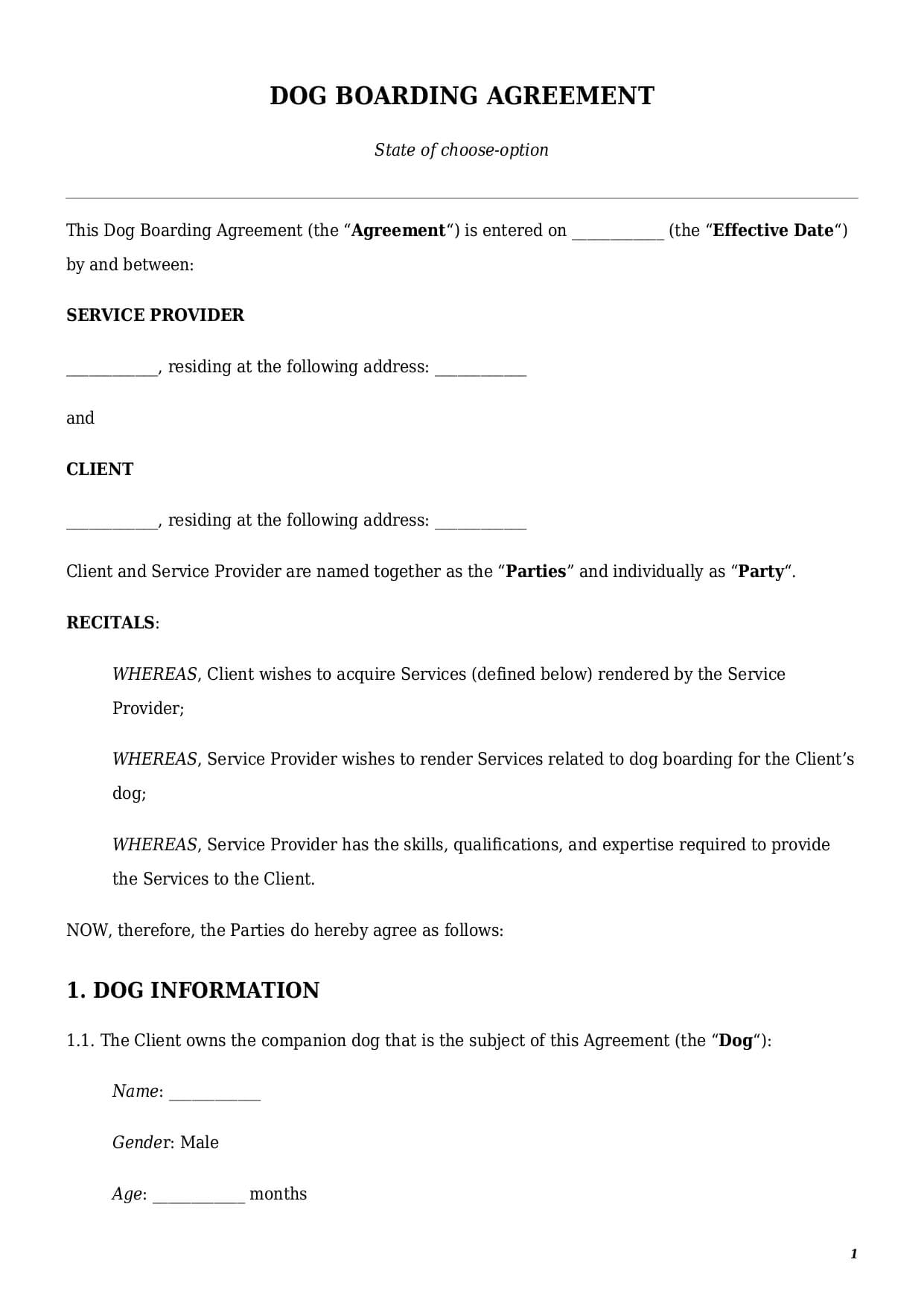
What is a dog boarding agreement?
A dog boarding agreement is a legally binding document that outlines the terms and conditions between a dog owner and a dog care provider for the temporary care and boarding of the client’s dog. A dog boarding business typically provides services where dogs are temporarily housed in a kennel, private home, or other facility while the owner is away. Services may include feeding, administering medication, organizing playdates, and providing general care.
The present template is suitable for long-term boarding or short-term boarding and covers the following essential elements:
- full information about the parties involved;
- detailed description of the dog;
- detailed description of services (e.g., administering of medication, organizing playdates, general care);
- list of applicable policies (e.g., emergency, late pick-up policy);
- payment provisions;
- liability and insurance; and
- dispute resolution and applicable laws.
The parties involved in a dog boarding agreement contract are the client and the service provider. The client is an individual who owns a dog and who wishes to order boarding services in exchange for remuneration. The service provider is normally a professionally registered business or self-employed individual.
Why does your business need a professionally written dog-boarding agreement?
A well-established common-law doctrine in the U.S. treats a dog-boarding relationship as a legal bailment—the dog owner (the bailor) transfers their personal property (which is a dog) in temporary possession and care to the third party (dog-boarding provider). Signing a handshake agreement does not exclude bailment relationships; it just leaves the terms of your duty of care undefined and open to dispute. A written agreement does three things an informal arrangement can’t:
- Sets terms and conditions of care. The document defines the provider’s responsibility, including when and how the dog should be fed, washed, and walked. A written agreement does not “imply” that a certain level of care should be provided; it simply specifies what should be done and how.
- Dog’s condition and medical record. If anything goes wrong and the dog is sick, heart- or dead, the dispute sparks immediately. Sometimes this is the owner’s fault for not informing a boarding kernel about any ongoing health issues the dog may have. A written document eliminates this gap by clearly outlining any pre-existing issues at drop-off.
- Fills in the gaps and grey zones. A verbal agreement or a simple written document often focuses on main conditions, such as duration, scope of services, and payment plan. Only a solid and well-written agreements allows to predict parties’ mutual obligations in a situation when something goes wrong – what happens with the agreement if the business looses their license; what happens with the dog in case of the abandonment; where to bring the dog in case of emergency etc.
Do I need a license to run a dog-boarding business?
There is no federal licensing regulation for dog boarding; thus, depending on where you want to start your kennel-boarding business, you may require a state license, a municipal/city permit or approval, or both.
Provision of boarding services from your home does not allow you to escape licensing requirements, because many states and cities set their kennel-license threshold by the number of animals housed or the fact that you’re paid, not by whether you operate out of a dedicated facility.
| State | Type of authorization | Scope of application | Fees |
|---|---|---|---|
| Pennsylvania | Kennel license, issued by the Department of Agriculture’s Bureau of Dog Law Enforcement | Any establishment where a dog(s) is housed for compensation on a specified or unspecified time (Section 102 Dog Law Act of 1982, P.L. 784, No. 225) |
$125/year for kennels boarding 1–10 dogs up to $325/year for 26 or more |
| California | No state regulation. Kennel permits are regulated by county, depending on the local zoning. | Boarding kennels | $200 to 7000 depending on the county |
| Texas | No state regulation. Boarding kennel permits are regulated by city ordinance. | Kennels and stables | $200 per one year permit (e.g., City of Corpus Christy) |
| Florida | No state regulation. Kennel permits are issued by county and city ordinance | Depending on the county, applies to all commercial kennels (e.g., Pinnell’s County Ordinance 14-29 requires obtainment of pet permit for any boarding kennel with at least 1 dog) | $200 per one year authorization (e.g., Pinnell County) |
| New York | Small Animal Boarding Establishment Permit, issued by Department of Health and Mental Hygiene + Animal Care and Handling Certificate (ACHC) | Any facility boarding animals that aren’t the proprietor’s own in exchange for a fee | $70 per one application (fixed despite the number of dogs) + $35 for ACHC |
Check if your boarding business shall comply with Animal Welfare Act
Running a dog boarding facility or kennel in the USA may sometimes fall within the complex and strict legal framework of the Federal Animal Welfare Act (AWA) 1966. It establishes additional requirements for businesses, such as pre-licensing, mandatory audit of premises, compliance with AWA care standards, and regular inspections by USDA/APHIS. If you can answer “Yes” to at least one of the questions below, then you fall within the scope of AWA 1996.
Are you a research facility?
Section § 2132(e) of the AWA 1996 defines a research facility as a The term “research facility” means any school (except an elementary or secondary school), institution, organization, or person that uses or intends to use live animals in research, tests, or experiments. It does not matter if such a business purchases or transports animals or simply receives grants or loans for subsidizing their activity.
If “no,” check the next question below.
Are you a dealer?
Section § 2132(f) of the AWA 1996 defines the term ‘‘dealer’’ as any person who, in commerce, for compensation or profit, delivers for transportation, or transports, any dog for research, teaching, exhibition, hunting, security, or breeding purposes. This clause does not cover retail pet stores.
If “no,” check the next question below.
Are you an exhibitor?
Section § 2132(f) of the AWA 1996 defines “exhibitor” as anyone exhibiting any animals to the public for compensation, including carnivals, circuses, and zoos exhibiting such animals.
If “no,” check the next question below.
If one of the given answers is “Yes,” it is better to consult further with the Animal and Plant Health Inspection service (APHIS) if your business requires any further licensing or inspection.
How to create a solid dog boarding agreement template?
Drafting a strong and reliable dog boarding agreement template ensures both legal protection and peace of mind for everyone involved. Neither federal nor state laws define any particular structure a solid legal template for a dog boarding business should have. At the same time, inclusion of certain information is essential to make the document clear, complete, and legally sound.
Below we summarized all important clauses you have to include in your dog boarding agreement template.
Description of the Dog
Make sure a service provider has all necessary information about your dog. This is not only about their name, gender, breed, age, or medical history. The client shall provide additional details as follows:
- Biting history: if your dog has any past biting incidents, a service provider should know all about them.
- Vaccination history: if your dog is vaccinated, make sure to list all the given vaccines.
- Dietary needs: the service provider shall be aware of any possible dietary needs, food intolerances, or allergic reactions well in advance.
- Ongoing contagious or communicable diseases: if your dog has one or experiences any symptoms, make sure a service provider is aware of that on the pickup date.
The information listed above is particularly important for a long-term dog boarding dogs agreement, to make sure a service provider can accommodate pet care services to each dog’s needs.
Abandonment Policy
A well-drafted dog boarding agreement contract must include a clear abandonment policy. This is a clause that defines the list of actions a service provider may take when:
- the client cannot be reached after the agreed pickup date; or
- the client refuses to collect the dog.
First, the parties have to agree after which period of time a dog should be considered abandoned—it could be a few days or a few weeks. Second, the text of a dog boarding agreement contract shall define which exact actions the service provider may take. For instance:
- Contact the animal control authority to pick up the dog.
- Re-home the dog with a third party.
- Transfer the dog to an animal shelter.
- Keep the dog at the service provider’s facility and file a lawsuit against the client to compensate for the maintenance costs, etc.
Emergency Policy
Having a clear emergency policy is a vital element for every dog boarding business. This policy addresses in detail which actions the service provider may take once there is an emergency with a dog. Therefore, this clause shall include the following information:
- the client’s authorization to seek emergency veterinary care;
- detailed information about the veterinary clinic or hospital where the dog should be taken in case of emergency;
- disclaimer about the client’s financial responsibility for the emergency bills; and
- client’s emergency contact phone or email.
Payment Provisions
Every dog boarding agreement contract shall define when, what, and how the client should pay for provided services. Therefore, the payment provision clause needs to include the mandatory elements below:
- payment model (e.g., daily, weekly, or monthly fees);
- payment deadline (e.g., by the end of the month); and
- payment method (e.g., bitcoin, bank transfer, cash, etc.).
Apart from that, it is also advisable for the parties to consider certain additional considerations. For instance, what will happen if the client picks up the dog earlier than the agreed pickup date? Shall the client still pay the agreed remuneration, or could the fees be adjusted pro rata to the number of days of actual stay?
Or, if the client cancels their booking before the agreed drop-off date, shall the client still pay in full? Addressing all those questions directly in the text of a dog boarding agreement may help to prevent potential legal disputes along the road.
Waiver and Indemnification
The legally sound dog boarding agreement contract must carefully address parties’ mutual waivers and indemnifications. While it is up to the parties of the agreement to decide if they shall or shall not be liable for certain faults or accidents mentioned below:
- Loss or damage of a dog’s personal belongings: Usually, a service provider shall not be liable for any such loss or damage. The best way is to prohibit clients from bringing personal belongings of their dogs at the drop-off.
- Unforeseen dog injuries, illnesses, or death: The rule of thumb is that the service provider remains fully liable for these events, provided this is the service provider’s fault or negligence.
- Damage to a facility or other animals caused by the dog: In most of the cases a service provider may recommend all clients take additional insurance to protect themselves from situations like that one. Normally, a service provider will remain liable due to their fault or negligence.
Which type of document template does your dog-boarding business in the USA really need?
There is a wide variety of contracts circulating around that have similar names and thus could be easily confused, especially if you have just just started your boarding business.
In this table you will immediately learn about key facts that differentiate dog boarding agreements from pet sitting contract, pet custody agreement and permission letters for pets.
| Dog Boarding Agreement | Pet Sitting Contract | Pet Permission Letter | Pet Custody Agreement | |
|---|---|---|---|---|
| Parties | Kennel, facility, or individual housing provider and dog owner | Sitter caring for the pet and pet owner | Homeowner, landlord or property management company and tenant | Divorced/separating couple or ex-roommates |
| Scope of Services | Overnight housing, feeding, general care, trainings, play, sometimes medication | In-home visits or overnight stays at the owner’s residence | Authorization to live with pets at the leased property | Division of ongoing care, possession, and decision-making rights |
| Duration of Services | From several days to several months | From several days to several months | One-time document | From several days to several months |
| Licensing implications | Depending on the location of a boarding/kennel facility may require federal, state and/or city licensing or permits | No special regulation. General principles of contract law apply. Some cities may require a general pet-care business license. | Not applicable | General principles of contract law apply. |
What Insurance Do You Actually Need to Run a Dog Boarding Business?
Most dog boarding businesses in the UK think that having standard commercial general liability insurance is simply enough. However, the typical mistake here is that such a type of insurance excludes damage or injury to property that is in the possession of the business. Since under the bailment relations explained above a dog is technically treated as a property in the possession while on boarding, this situation can be tricky. Once the dog is injured, the owner may ask for compensation, which you may not be able to pay right away.
Here is the solution. Boarding operators generally need a specific Care, Custody, and Control (CCC) endorsement or a dedicated pet-bailee/animal-care coverage product or a dedicated pet-bailee/animal-care coverage product, added to their policy. This is worth flagging directly in your buying guidance, since it’s a gap even experienced small-business owners frequently miss when they assume “general liability” already covers it.
How to customize a legal document template at Faster Draft?
To get a fully customized legal document template for your dog boarding business, follow a few easy steps below:
- Click the button “Create Document.”
- Answer simple questions in the form.
- Select a template’s format—dog boarding contract PDF or Word.
- Make a payment.
- E-sign for free, download, print, and use a customized legal template in minutes.
This article is reviewed by Daria Turanska, a lawyer with 15 years’ contract drafting experience. Fact-checked by Sarah Collins.