

.svg)
.svg)
Recording Artist Contract
 PDF and
 Word
Word
A recording contract is a key legal document in the entertainment industry across the UK, used to document the relationship between an artist and a record label or independent producer, governing who owns the recordings, how the artist gets paid, and what each side can and can't do with the music.
Reviews

What is a recording artist contract in England and Wales?
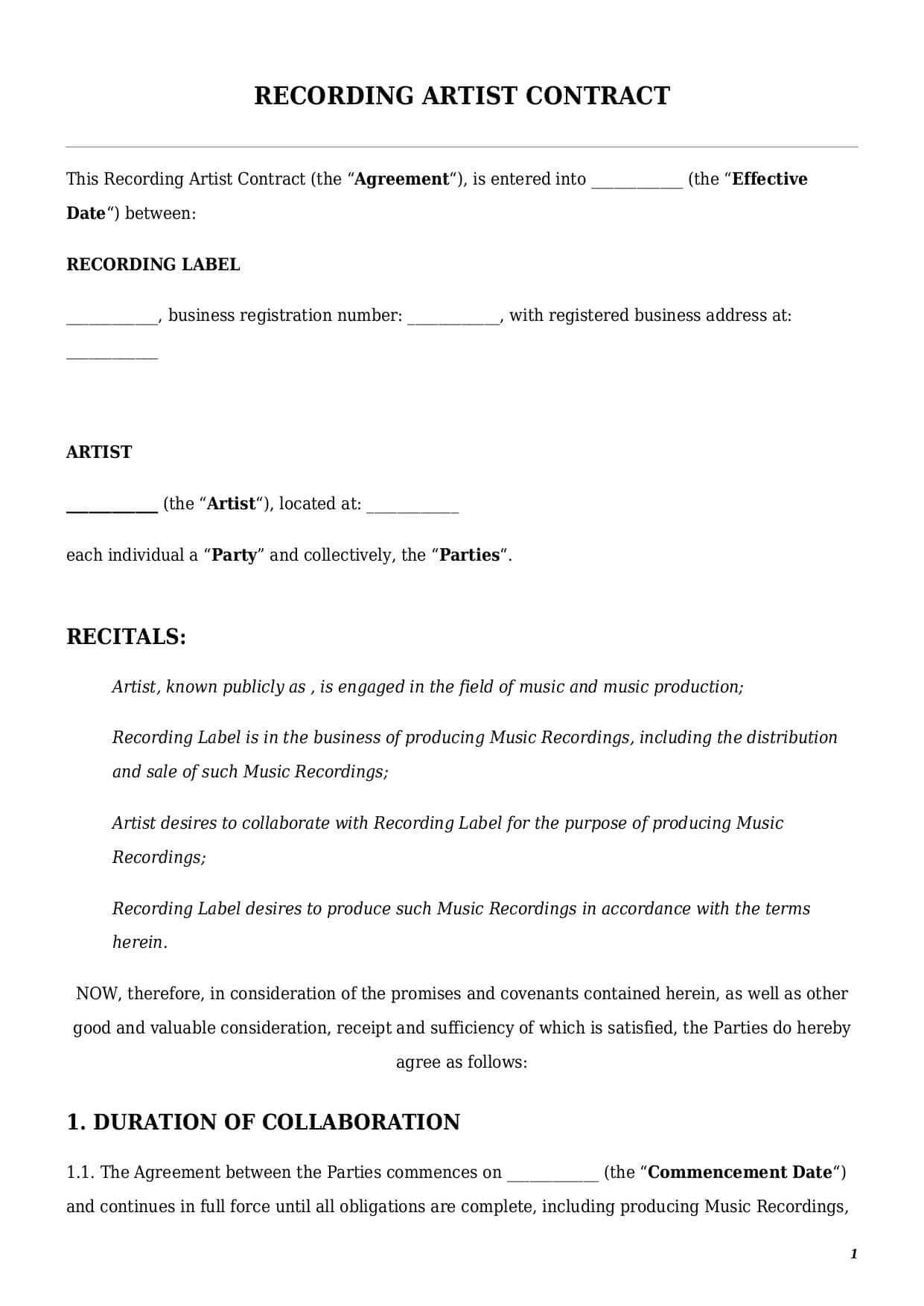
A recording artist contract, also known as an artist recording agreement, is a standard contract between an artist and a record label that decides who ends up owning the master recordings, how much an artist gets paid and when, and how long an artist is tied to the label. An artist may be a solo performer or a band. Under the agreement, the artist typically records music exclusively for the label in exchange for royalties and, often, an advance against those royalties.
This present document is different from a performance contract under which a client hires an artist or a music band to perform for a private, business, or corporate event in exchange for remuneration.
Why do artists and labels need a professionally written recording artist contract in the UK?
A properly written document defines important terms and conditions of future cooperation, including:
- Defines ownership of the masters;
- Stipulates how much and when the royalty should be paid.
- Defines the list of revenues which forms the base for calculation of royalties (for example, from the number of downloads, number of sold copies, etc.);
- Specifies the exact list of circumstances in which either party can immediately end the contract, as well as the financial consequences of such termination;
- Decreases disputes in the future over unclear provisions or arrangements significantly;
- Facilitates a productive working environment for both parties;
- Serves as solid legal proof in case of a dispute in court.
Record Label Artist Contract vs. Single Song Artist Recording Contract: Choosing the Right Document
In the UK music industry, it is common to use interchangeable terms such as ‘record label artist contract‘ and ‘single song artist recording contract‘, thinking they are the same. However, there are important practical differences that define in which situations either document should be used.
| Record Label Artist Contract | Single Song Deal | |
|---|---|---|
| Scope | Parties cooperate for creation one or multiple albums, or a defined “album cycle” structure. | Parties work together on one specific track or song. |
| Exclusivity | The artist is usually required to record exclusively for the label under an exclusivity clause in the agreement itself. They may also be required to sign additional non-compete agreement. | Exclusivity clause is not common for this type of recording artist contract. If such a clause is included, it is usually limited to that specific recording. |
| Ownership of masters | Label typically owns the resulting masters. The artist is given a right to purchase back the copyright for a fixed amount. | Ownership for a single track is retained exclusively by an artist and usually licensed to the label or producer. |
| Duration | The contract is usually signed for 1 to 3 years depending on the number of albums and tracks. | Short-term contract which ends once the specific deliverable is completed and delivered. |
| Typical use case | (i) New artists who need a label to start working on the album; (ii) Established artists. | (i) One-off collaboration deals; (ii) New artists; (iii) Established artists willing to test relations with a new label. |
To sum up: If you are looking for short-term collaboration focused on the delivery of one or several songs or tracks, perhaps using a single-song artist recording contract is the right choice for you. When, however, parties are looking to establish more unique, long-lasting relations, focusing on the creation of the whole album, a recording label artist contract should be used instead. This document template can be customised for both scenarios.
What should a standard UK recording artist contract include?
A typical recording artist contract in the UK includes the following important clauses:
- Details of the parties. The text outlines full legal names, registered business addresses and contact details.
- Ownership of masters. A clause which defines who owns the copyright in the resulting recordings, consistent with Sections 9 and 11 of the Copyright, Designs and Patents Act (CDPA) 1988.
- Term and exclusivity. This clause clearly defines the expected duration of the contract, scope of exclusivity, etc.
- Recording commitment. The parties must agree on specific deliverables, such as a number of songs/tracks, their duration, participation in video clips, etc.
- Advances and recoupment, royalty rate and calculation rules. This clause outlines how and when the artist is being paid for the works and how the income streams are calculated, as well as the artist’s accounting and audit rights.
- Territory application. In this clause, parties typically agree on where the label’s rights apply (worldwide or specific territories).
- Termination clause. It is essential to agree upon the exact circumstances and notice period allowing either party to terminate this recording artist contract at any time. Apart from that, the parties may also agree upon the list of material breach conditions upon which the immediate termination of the agreement is possible.
- Independent legal advice acknowledgement — a confirmation that the artist has had the opportunity to take advice before signing.
- Confidentiality clause. When the record label is willing to protect information about cooperation with an artist against any public announcements, they may additionally sign a separate non-disclosure agreement or include a simple confidentiality clause in the agreement.
- Governing law. The parties to this template can select the laws of England, Wales, Scotland or Northern Ireland to apply to the provisions of this agreement.
Common legal issues related to UK recording artist contracts
Whether you are an artist, a music band or a producer, knowing these common legal mistakes can save you from future disappointments and disputes:
Independent legal advice beforehand
Parties entering a recording artist contract do not automatically inherit equal contractual powers, as in most of the cases the label may exercise undue influence over an artist towards the inclusion of certain clauses. In O’Sullivan v Management Agency & Music Ltd [1985] QB 428, the court maintained that the record label had never encouraged the artist to take independent legal advice before signing. Since then, mandating an artist to take legal, independent advice has not been a formality but an important legal mechanism that prevents an artist from unwinding the whole agreement years later in court.
Ownership of the masters under the UK copyright law
An artist entering a recording artist contract in the UK may mistakenly be convinced that he is the first owner of the copyright. However, under Section 9(2)(aa) of the CDPA 1988, the producer of a sound recording is treated as the sole owner of the copyright on condition that such a producer makes the arrangements necessary for the recording to be made. In practice, this usually means whoever arranges and pays for the recording session owns the resulting master from the moment it’s created, by operation of law.
For a record label that pays for recording expenses, it means full protection of their ownership without the need to add a specific clause in the recording artist’s contract. However, for an artist who is looking for financial support for the release of a new song, track, or first album, that may come as a surprise. Therefore, parties must discuss in the text of the recording artist contract who shall be the sole owner of the copyright created.
However, when an artist who self-funds and self-produces a recording before bringing it to a label may already own the master outright, the contract needs to reflect that clearly rather than assume the label’s usual ownership clause applies by default.
Exclusivity clause in UK courts
The doctrine of UK music law is quite strict when it comes to the enforceability of exclusivity and non-compete clauses in the music industry. Unreasonable duration or limitations are typically struck down by UK courts. In the leading case Schroeder Music Publishing Co Ltd v Macaulay [1974] 1 WLR 1308, the House of Lords struck down a five-year exclusive songwriting agreement where the publisher had no obligation to actually publish or promote his work, while the songwriter had no ability to work with anyone else. This doctrine, however, has its limits. For example, in Panayiotou v Sony Music Entertainment (UK) Ltd [1994] ChD 142, George Michael’s claim that his long-term Sony recording contract was an unreasonable restraint of trade was rejected entirely by the High Court. The case turned on the fact that the contract wasn’t found to be genuinely one-sided, including the artist’s own control over the pace of delivery, and the substantial sums already paid under the deal all weighed against a finding of unreasonableness.
All in all, an exclusivity clause is likely to survive if the overall recording artist contract provides a balance of rights and obligations for both parties, as well as if the exclusivity does not constitute an unfair long-term commitment.
Advance Payment vs Royalties
A recording artist contract typically involves an advance payment to the artist up front against future royalties, as well as a royalty rate, usually expressed as a percentage of income from sales, streaming, and licensing. A not legally savvy artist may think that the advance payment is free money that is being given in addition to the royalties. However, the advance payment mechanism works the opposite way. In fact, an advance payment covers money which is recouped from the artist’s royalties before any further payments are made, meaning an artist can generate genuinely substantial sales or streams and still receive nothing further if the advance and recording costs haven’t yet been recovered by the label.
Knowing the legal difference between these two payment models protects artists against financial surprises in the future, as well as guarantees financial predictability for a future income stream.
How to customise this template for the music industry in the UK?
To get a fully customisable document template, follow a few easy steps below:
- Click “Create Document” to open the questionnaire.
- Answer the questions to customise the agreement to your deal — single song, album, or multi-album structure.
- Select your preferred format — PDF or Word.
- E-sign the document online for free.
- Complete your payment.
- Download your customised template.
- Take independent legal advice before signing – recommended for the artist.
- Make both parties sign this contract in two separate copies.
- Each party must keep a signed copy of the contract for their internal record.
This article is reviewed by Daria Turanska, a lawyer with 15 years’ contract drafting experience. Fact checked by Sarah Collins.
Table of content
Frequently Asked Questions (FAQ)
-
1. Who owns the master recordings under a UK recording contract?
By default, under section 9(2)(aa) of the Copyright, Designs and Patents Act 1988, the producer of a sound recording or whoever arranges and finances the recording is considered its author and, under section 11(1), its first owner. This can be changed by the contract, which is exactly why the ownership clause is the most important part of the agreement to get right.
-
2. Do I need independent legal advice before signing a record deal?
It’s strongly advisable, and not just as best practice. In O’Sullivan v Management Agency & Music Ltd [1985] QB 428, a series of agreements were set aside for undue influence specifically because the artist was never given the opportunity to take independent advice before signing. A label failing to ensure this leaves the whole agreement vulnerable to challenge later.
-
3. What are performers' rights under the Copyright, Designs and Patents Act 1988?
Part II of the Act (sections 180–212) gives performers rights independent of who owns the copyright in the recording. These rights include, for example, the right to consent before a live performance is recorded or broadcast (section 182). These rights belong personally to the performer and don’t automatically transfer just because the recording’s copyright has been assigned.
-
4. How long can a UK recording contract last?
There’s no fixed statutory maximum, but the longer and more exclusive the term, and the fewer obligations placed on the label in return, the greater the risk of the contract being challenged as an unreasonable restraint of trade.
-
5. What is recoupment, and why might an artist earn nothing despite good sales?
An advance is paid against future royalties, not in addition to them. The label recoups the advance and agreed recording costs from the artist’s royalty share before any further payments are made. The recoupment clause can be played out in practice in two different ways. First, when the artist receives nothing apart from the recoupment, even if the single or track makes profits. Second, the advance is paid up front, the label recovers it (plus agreed recording costs) from the artist’s royalty share, and only once fully recouped does the artist receive further royalty payments

Looking for something Different?
Start typing to find out our collection of legal documents and contract templates