

.svg)
.svg)
Shipping Policy
 PDF and
 Word
Word
Protect your online business in the UK with a professional and fully compliant shipping policy.
Reviews

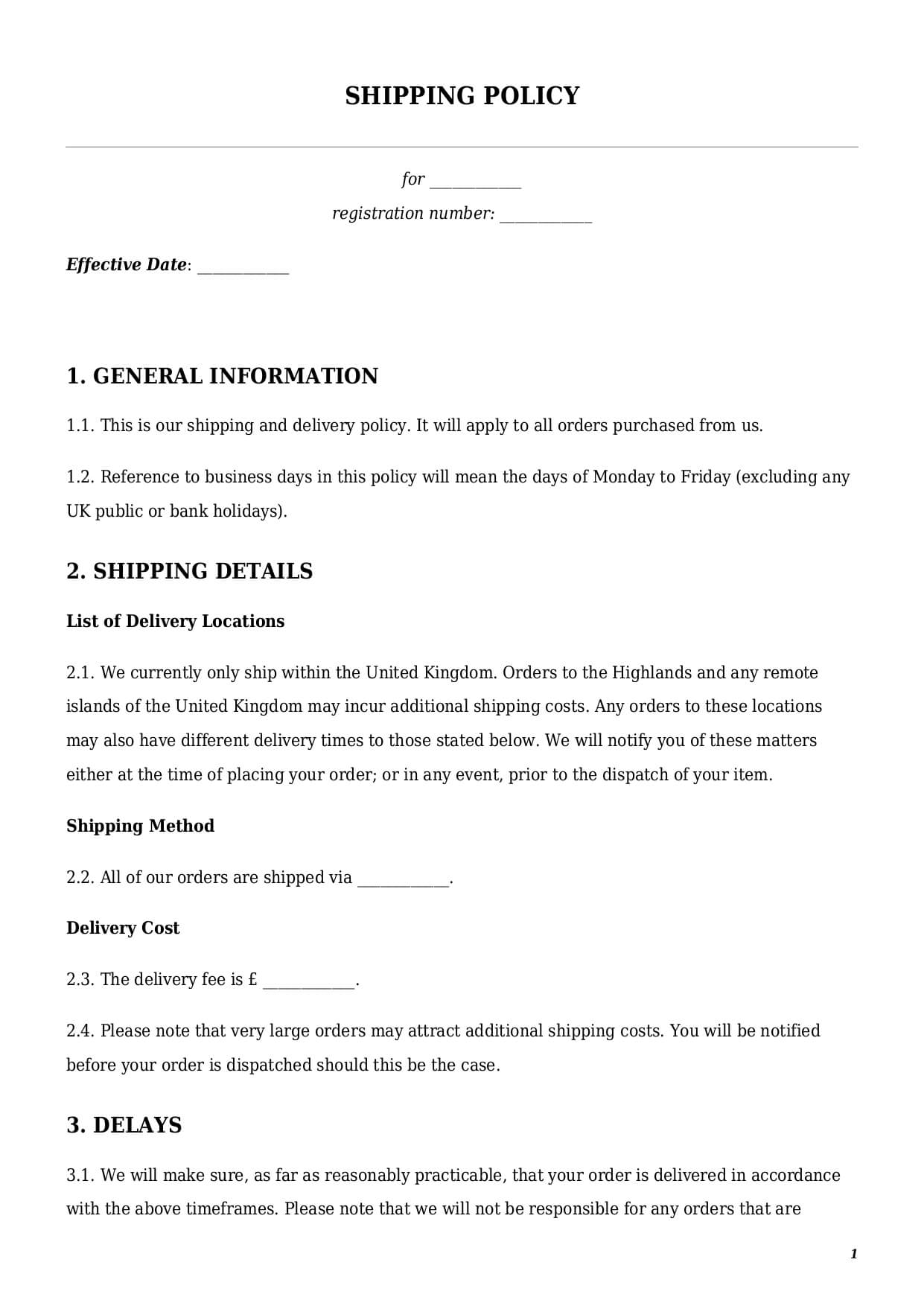
What is the shipping policy template?
A shipping policy is the document that tells a customer, before they buy, exactly how and when their order will arrive, including processing time, delivery method, and fees, and what happens if something goes wrong in transit. This is an important operational document every online store or platform in the UK should have.
This template entails all important statutory guarantees for consumers and legal obligations for businesses in the UK in full compliance with the Consumer Rights Act (CRA) 2015 and Regulation 42 of the Consumer Contracts (Information, Cancellation and Additional Charges) Regulations 2013.
The present template of shipping policy can be used for both domestic deliveries within the United Kingdom and Great Britain and internationally. The template is available for immediate use and publishing on the e-commerce website.
Why use FasterDraft’s shipping policy template?
By customising this policy template with FasterDraft, you get the document with the following benefits:
- UK-focused legal language. Every clause is written in full compliance with the Consumer Rights Act⁵, the Consumer Contracts Regulations 2013, and the Digital Markets, Competition and Consumers Act 2024.
- Professional wording. The document is written by qualified solicitors in plain English, which makes the policy easy to read and understand by both consumers and businesses.
- Speed up policy creation with automated clauses. Rather than drafting all clauses from scratch, the template lets you select and merge the clauses that match how you actually operate — single warehouse, multi-channel, dropshipping, or fulfilment-partner-based. It works well for ecommerce businesses that want their own policy in place without starting from zero.
- Digital download. The template is available for immediate usage and download right after the purchase. You can edit this document an unlimited number of times and get a guaranteed free lifetime licence to use it.
What does a standard shipping policy include?
A professional and consumer-friendly policy must include the following important information:
Type of delivery
The business must clearly outline where it delivers:
- throughout the United Kingdom;
- throughout Great Britain;
- internationally; or
- both options.
If there are several types of deliveries, the processing time, shipping methods, and delivery fees should be outlined separately for each type of delivery. From the practical point of view, this improves visibility and clarity for the consumers, as well as significantly reduces any confusion.
Order Processing vs. Order Delivery
A solid template of the shipping policy should clearly divide the order processing time from the order delivery time.
The order processing time is the time the business needs to check if the item is available, as well as other details. The order processing may result in order confirmation or a declined order (for example, when the payment has not been processed or has been declined). The order delivery is the actual delivery of the item to the customer. Therefore, the timeline and status for order processing and order delivery should be stated separately and should never be confused in the document.
Shipping methods
List the actual couriers you use (Royal Mail, Evri, DPD, Yodel, and so on). If the customer is able to engage their own courier for an additional charge, the same should be stated in the policy.
In this section, the business should always state that the risk of loss or damage of goods is being transferred to the buyer at the moment of physical possession – i.e., when the goods are delivered directly to the buyer. This also applies in a situation where the business uses third-party shipping providers to distribute orders domestically or globally.
Shipping costs and free-shipping thresholds
UK businesses dealing with the delivery of goods may apply either of the following shipping cost models:
- free delivery for all goods;
- free delivery only for domestic orders;
- free delivery for orders above a certain threshold (in such a case, the minimum required threshold should be stated in pounds).
Link clearly to your returns and refund policy
A shipping policy should not be confused with the returns and refund policy. A shipping policy defines how the goods are delivered to the consumer. While the returns and refund policy outlines how the faulty goods can be repaired, replaced, or refunded, the consumer can report the issue with the goods.
The text of the shipping policy must include a direct link or reference where the current returns and refund policy can be accessed and read by consumers.
Limitation of responsibility for delivery
This is one of the most important clauses that many online stores in the UK miss including in their shipping policies. After analysing dozens of shipping policies from UK online stores available online, we realised one missing point. Around 43.1% of all policies did not exclude the business’s liability for the delivery of goods to the wrong address, provided that this is a customer’s fault. This type of liability can be excluded under the provisions of the CRA 2015 since it does not relate to statutory rights of the consumers in the UK.
In a situation where the consumer fails to provide the correct delivery address, such as street number, city, or postal code, the business should be able to exclude its liability completely. The same section should also explain how missing or lost packages must be reported and what timeframe applies to inform customers clearly about delivery issues. Your returns and refund policy should also clarify who pays for return shipping and in which cases.
Import Taxes And Customs
For international shipping, it is important to clarify which party pays customs duties. This must be unambiguous in your policy and ideally visible before checkout completes — not discovered by the customer when a courier demands payment on their doorstep. This is directly relevant to the Digital Markets, Competition and Consumers Act 2024’s ban on drip pricing, in force since 6 April 2025: hidden charges that only appear after a customer has committed to a purchase are now a direct enforcement risk, not just a customer-experience problem. The CMA has already taken action on exactly this kind of practice — in late 2025, two driving schools admitted liability for drip pricing, agreed to refund over £760,000 to affected customers, and were fined a combined £4.2 million.
Important legal considerations before publishing the website shipping policy in the UK
Before creating a shipping policy template, businesses across the UK should consider the following:
Compliance with the Consumer Rights Act 2015
There are a number of statutory rights UK consumers typically have and which cannot be excluded or compromised by the text of the shipping policy. These rights include:
- maximum delivery is within 30 days; and
- the risk for loss or damage of goods cannot be transferred from the business to the customer earlier than when the customer gets physical possession of the goods.
Displaying prices inclusive of VAT
Where you sell to UK consumers and are VAT-registered, headline prices must include VAT — and following the DMCCA 2024 drip pricing ban, this principle now extends more broadly to any mandatory charge, including shipping where it isn’t genuinely optional. A 2026 review of UK checkout behaviour found that since the ban took effect, UK shoppers now expect the full price — including 20% VAT and mandatory fees — to be visible from the very start of the checkout journey, with essentially zero tolerance for costs appearing only at the final step.
Wording to limit liability lawfully
The businesses in the UK can insert the clauses in a shipping policy template by excluding or limiting their liability. However, such limitations should be made carefully to ensure that your policy does not exclude liability for main statutory rights which cannot be compromised. For example, the CRA 2015 guarantees that purchased goods should match the description, which is especially important for purchases made online. In such a case, the business cannot exclude liability for the shipping of goods that do not match the description.
Legal limitations for international policy
Delivery of certain gosh-darned items may be absolutely legal in one country and strictly prohibited in another. Therefore, before offering international delivery to either of the countries, the business should check specific duties and important requirements of that country. If there are certain items that cannot be delivered, in such a case, all of them must be listed in the section “Exclusions” in the text of the policy.
Do not give faulty promises
The text of the shopping policy template is a legal contract between the consumer and the business. Therefore, for every guarantee, warranty, or obligation stated in the policy, the business must be able to. Therefore, this is especially important for the precise delivery terms. Many businesses tend to be out of line. maximum number of days for the delivery, failing to take into consideration pick or holiday seasons. Holiday and peak-season disclaimers should explicitly flag that delivery estimates may extend around Christmas, Black Friday, and other peak periods.
Avoid ambiguous language
A shipping policy is not a descriptive general document but a solid holiday season. It defines how your business ships and delivers goods internationally or domestically. Our shipping policy template ensures that the following key mistakes are not included in the document:
- “Within X days” – for the purpose of the delivery, it is important to specify whether this is a calendar or business day.
- “From the moment of placing the order” – it is not clear what should be considered as the moment of placing an order. For example, some customers may think this is the moment when they receive a confirmation email from the business, while others may believe that this is the moment when the payment is made.
- “We may charge an additional fee” – the discretion of charging additional fees cannot be provided to the payment processes in B2C transactions. The text of the policy should clearly define circumstances in which the charges may apply, as well as the amount of such charges in pounds.
How to customise this template with FasterDraft?
To get a fully customisable document template, follow a few easy steps below:
- Click the “Create Document” button.
- Answer simple questions in the form.
- Select a template’s format – PDF or Word.
- E-sign the document online.
- Make a payment.
The document is ready for instant download immediately after the purchase.
Table of content
Frequently Asked Questions (FAQ)
-
1. What counts as a force majeure for the shipping policy in the UK?
A force majeure is a list of unexpected events the parties may not reasonably have foreseen when entering the contract. Force majere prevents parties from properly executing their obligations under the contract. The text of the policy should be able to address the list of events that are considered force majeure, including extreme weather, carrier network disruption, and industrial action.
Even in the event of force majeure circumstances, the customer may have the right to a refund under Section 28 of the CRA 2015 if the customer is able to prove that a delivery disruption is untimely and essential and is missed. For example, the client is waiting for their wedding dress to be delivered, and the dress arrives two days after the wedding ceremony.
-
2. Where can I get a free shipping policy template for my UK business?
FasterDraft offers nearly free templates of legal documents at the price of a coffee. Our templates are fully customisable and created by qualified solicitors. We do not sell generic templates, poor-quality templates usually available for free on the Internet, or templates generated by AI.

Looking for something Different?
Start typing to find out our collection of legal documents and contract templates