

.svg)
.svg)
Limited Liability Partnership Agreement
 PDF and
 Word
Word
A limited liability partnership agreement is a written contract between the members of an LLP that governs their relationship with each other and with the LLP itself.
Reviews

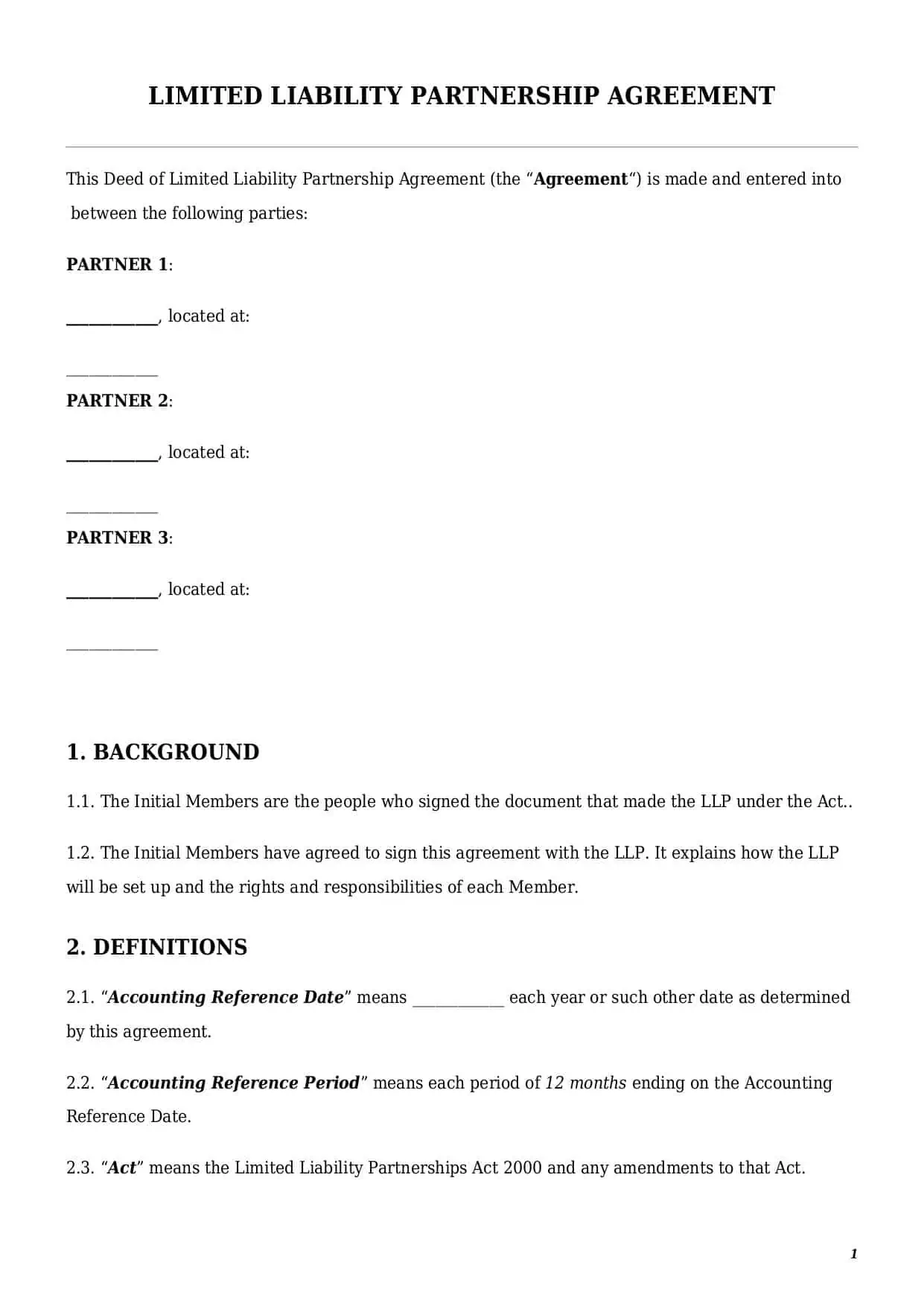
What is a UK limited liability partnership agreement?
A limited liability partnership agreement is a formal corporate document written between the members of an LLP that governs how the LLP shall be operated, how the profits should be shared and how daily management shall be performed. The document also sets out how profits are shared, how decisions are made, what each member contributes and receives, and what happens when a member joins or leaves.
In the UK, having a limited liability partnership agreement template is not compulsory. However, many businesses choose to have at least a simple document tailored to the real business needs. On top of that, it is always advisable to have a tailored document to override the default provisions in the Limited Liability Partnerships Act 2000 (the “LLP Act”).
Know the default rules for the LLP you must override
The default rules are the provisions of the Limited Liability Partnerships Regulations 2001 (the “LLPR 2001”) that automatically apply to the LLP in either of the following situations:
- The LLP is run without a customised limited liability partnership agreement; or
- The operation of the LLP is governed by the limited liability partnership agreement that does not explicitly override the default rule.
Below there is a list of the most significant default rules LLP members should be aware of and override immediately to prevent any negative consequences in the future:
- Equal profit sharing. Under the LLPR 2001, all members share equally in the capital and profits of the LLP, regardless of capital contribution or work input. For example, if one member has contributed £200,000 and another £20,000, they still share profits equally unless the agreement says otherwise. For almost every real-world LLP, this default produces the wrong result.
- No right to remuneration. No member is entitled to remuneration for acting in the LLP’s business. A member who works full-time or part-time in the LLP receives no salary unless the agreement specifically provides for one.
- No right to expel a member. Members cannot be forced to leave under the default rules, including in case of a long physical absence, retirement age, health conditions or damaging the LLP’s property. Without overriding that default clause, the remaining members’ only practical option may be to dissolve the LLP entirely.
- Equal management rights. Under the default rules, every member is entitled to take part in management. This works for a two-member LLP with strong personal relations. However, it may create practical difficulties in larger firms where management needs to be delegated to specific individuals or a management committee. The agreement should set out a clear management structure and specify which decisions require full membership consent.
- No provision for retirement on agreed terms. The default rules do not provide any mechanism for a member to retire and receive a payment for their interest. Without express provisions addressing how a departing member’s interest will be valued and paid, departure can become a source of serious and expensive dispute.
What is the difference between an LLP and a general partnership in the UK?
To choose the right business model for your future venture, below is a list of the main differences between operating an LLP and a general partnership in the UK.
Legal Framework
The operation and registration of the limited liability partnership in the UK is regulated by the Limited Liability Partnership Act 2000 and the Limited Liability Partnership Regulations. Typically, the partners of the LLP are referred to as “members”. Contrary to that, a general partnership is regulated by the Partnership Act 1890.
Liability
The most important feature about the LLP is that its members’ liability is limited to the capital contribution made. A limited liability partnership agreement format also allows members of the LLP to limit their liability by establishing a maximum threshold in pounds, for example, 5000 pounds per calendar year. On the other hand, partners in the general partnership are fully liable with all their property and assets for debts incurred in the course of business performed by the general partnership.
Registration
Running a business through an LLP in the UK requires the fulfilment of additional formalities such as registration with the Companies House. Upon signing this agreement, the designated members must submit the Form LLP IN01 to the Companies House, informing about the registration of the business.
This does not apply to the general partnership.
Top 6 important legal considerations for LLP’s operating in the UK
If the LLP is already formed and operates by virtue of a custom limited liability partnership agreement, make sure that the agreement entails the mandatory legal requirements as follows:
Check the salaried member rules
If any members receive a substantially fixed reward rather than a genuine share of variable profits, the HM Revenue & Customs(the “HMRC”) salaried member rules may apply to treat them as employees for tax purposes. This can significantly increase the LLP’s employer National Insurance costs. Ensure the financial provisions of the members’ agreement, including drawings, fixed payments, and minimum profit guarantees, are structured with the salaried member rules in mind.
Check for any changes
A limited liability partnership agreement template is not a static document. It means that once it is signed and adopted, it must be reviewed carefully to reflect the most recent legislative changes, as well as internal changes in the business. The agreement must be reviewed annually. However, the immediate review of the agreement is highly recommended once:
- One of the members leaves the LLP;
- the LLP’s business or structure changes significantly;
- The profit-sharing arrangement changes.
Check designated members
At least two members must be designated at all times.
If there are fewer than two designated members, every member is deemed to be a designated member. This is an automatic rule that applies to all LLPs across the UK and does not require any previous consent from the existing members.
Designated members take additional responsibilities for filings; therefore, their appointment should be carefully checked.
Check registration with HMRC
Every LLP must be registered with the HM Revenue & Customs as a business partnership, which implies filing a partnership tax return annually. The same shall apply to the members of an LLP who are subject to income tax on their income as trading income. Proper tax reporting is essential to ensure smooth business operation of the LLP without any fines.
Check applicable salaried member rules
The LLP members’ agreement must address salaried member status carefully. Members of the LLP can only be treated as employees for income tax if the following three cumulative conditions apply:
- If their reward is substantially fixed;
- They have no significant influence over the LLP’s affairs; and
- They have not contributed significant capital.
Check PSC Register
Every company and LLP registered with the Companies House is subject to the People with Significant Control (PSC) regime. A person with significant control of an LLP is broadly a member who holds more than 25% of the surplus assets on a winding up, controls more than 25% of the voting rights, or otherwise exercises significant influence or control over the LLP.
The LLP must maintain such a register at all times and inform all new members about the PSC implications.
Common mistakes to avoid when drafting a UK LLP agreement from scratch
Creation of a limited liability partnership agreement is a difficult task as it requires a lot of legal research, as well as a solid practical background. Below, there is a list of the most common mistakes individuals and businesses typically make when drafting this document from scratch.
Mistake 1: Incorporating an LLP without a members’ agreement
If you rely on the default provisions of the LLPR 2001 governing the operation and daily management of the LLP, that can be a temporary solution only. Statutory provisions governing the LLP in the UK can significantly interfere with real-life business and even cause negative legal consequences. If you solely rely on the LLPR 2001, you may face an immediate dissolution in case either of your members dies or exits the business; you may need to split the profits equally, no matter each partner’s real contribution, etc. These and other defaults create the conditions for an expensive dispute the moment the relationship between members becomes difficult. A members’ agreement is not a formality — it is the foundation of a well-governed business.
Mistake 2: Confusing an LLP members’ agreement with a general partnership agreement
Limited liability partnership and general partnership in the UK are two absolutely different forms of business. Even though both businesses operate as a partnership, the scope of legal liability, registration requirements and daily management rules differ significantly. This is because a general partnership is governed by the Partnership Act, while the limited liability partnership is regulated by the LLP Act.
Using the wrong template or adapting a general partnership agreement for an LLP will produce a document that does not address the LLP-specific provisions that matter most, including designated member duties, the salaried member rules, and other operational requirements.
Mistake 3: Build in a clear, workable exit mechanism
Once partners start the business together, they may believe that things will remain unchanged in the future. However, relations may change, business appetites may no longer match, and more internal disputes may occur in the future. Therefore, building a clear exit mechanism from the LLP is the greatest thing you can do for your business.
A solid and well-written limited liability company partnership agreement shall be able to answer the following important questions:
- How is a departing member’s interest valued?
- Is goodwill included?
- Over what period is the payment made?
- What happens if the LLP cannot afford to pay it?
These questions become very difficult to answer in litigation.
Mistake 4: Address the default rules explicitly — do not rely on them
Every provision in the LLPR 2001 default rules shall automatically apply to the LLP, unless otherwise stated in the provisions of a customised limited liability partnership agreement sample. If there is any provision you and other members do not agree on, that provision should be expressly overridden in the members’ agreement.
This applies particularly to profit sharing, management rights, expulsion, and retirement terms. Work through each default rule carefully to ensure the agreement addresses it.
Why choose FasterDraft for your LLP agreement?
By customising this limited liability company partnership agreement with FasterDraft, you get:
- a UK-specific document that is created in full compliance with the Limited Liability Partnerships Act 2000, Limited Liability Partnership Regulation 2001, and the LLP (Application of Companies Act 2006) Regulations 2009;
- a document that includes all necessary provisions for effective daily management of the LLP;
- a template that has a clear structure and is written in plain English;
- a document which is ready for immediate use after the purchase;
- a document that can be modified and reused for similar businesses an unlimited number of times in the future;
- a template that is created by qualified solicitors, not by legal writers or editors;
- a document which entails solid legal research of legislation, not an AI compilation of legal acts.
How to customise his template with FasterDraft?
To get a fully customisable limited liability partnership agreement template UK, follow a few easy steps below:
- Click the “Create Document” button.
- Answer simple questions in the form.
- Select a template’s format – limited liability partnership agreement PDF or Word.
- Make a payment.
The document is ready for instant download immediately after the purchase. Once the document is ready, all members must sign and date it to make a legally binding document.
Table of content
Frequently Asked Questions (FAQ)
-
1. Is a written LLP members' agreement legally required in the UK?
There is no legal requirement to have a written limited liability partnership agreement for the LLP. Since the LLP is registered as a separate legal entity, it is being regulated by the Limited Liability Partnership Regulation 2001 and its default provisions.
However, applying by default provisions may not always be the way members are willing to operate their partnership. Therefore, almost all LLPs in the UK choose to have a written partnership agreement to avoid the application of any inappropriate default provisions.
-
2. What are the default rules if there is no LLP agreement?
The default provisions of the Limited Liability Partnership Regulation 2001 include the following:
- that all members share equally in the capital and profits of the LLP;
- that the LLP must indemnify any member for payments and liabilities incurred in the ordinary and proper conduct of the LLP’s business;
- that any member may take part in the management of the LLP, etc.
Most of the provisions may seem to be unfair or unsuitable for most real-world LLPs. For example, imagine you as a partner contribute more to the management of the LLP and its financial maintenance, while other members – no. The fair allocation of earned profits in such a case would be a distribution in accordance with the specific share or contributions made. If, however, your LLP does not have a custom partnership agreement, an equal allocation of all the profit and capital shall apply by default.
-
3. Why choose FasterDraft for your limited liability partnership agreement template?
FasterDraft is the sole online platform with customisable legal documents that:
- does not generate documents using AI;
- documents created by qualified solicitors and lawyers, and not by legal editors or writers;
- no hidden subscription or fees – one purchase means one payment.
-
4. Can I get a limited liability partnership agreement template for free?
At FasterDraft, we offer fully customisable templates of legal documents, letters, and contracts in the UK at a very affordable price. We do not sell generic documents, documents generated by AI or very simple documents.
-
5. Can an LLP have only one member?
No. An LLP must have at least two members at all times. If membership falls below two, the LLP may need to be dissolved. The good news is that the LLP does not have any upper limit, which means you can grow the number of partners without any limitation.
-
6. What is the difference between a member and a designated member?
All designated members are the same members of the LLP, but with extra duties, which include statutory filing obligations, preparing and signing the confirmation statement, and acting on behalf of the LLP if it is wound up. Designated members carry personal liability for failures to meet these obligations.
-
7. Does an LLP members' agreement need to be filed at Companies House?
No. A written limited liability partnership agreement template is a private document and shall not be filed or registered with the Companies House or HM Revenue & Customs. However, the LLP agreement shall not be confused with the incorporation documents of the LLP, which must be filed for registration with the Companies House and be available publicly.
Important: The fact of signing a limited liability partnership agreement does NOT create or form a limited liability partnership. This is the fact of registration with the Companies House, which makes the LLP being formed.
-
8. What happens when a member leaves an LLP?
Leaving the LLP entails loss of important financial and legal compliance requirements the LLP shall undergo to record such an exit, including:
- File a Form LL TM01 to Companies House informing about the member leaving the LLP;
- Performance of the member’s share evaluation and preparation of all necessary accounting statements;
- Discussion of the payment terms on which the share must be repaid;
- Signing the deed of exit their additional documents, such as a non-disclosure agreement or a non-compete agreement.
-
9. Can a corporate entity be a member of an LLP?
Yes. LLP members may be individuals or corporate bodies, including a company, a general partnership, a limited partnership, another limited liability partnership, etc. The corporate status of the LLP’s member does not affect their duties, rights or obligations within the LLP. Where, however, a corporate member is also a designated member, identity verification requirements apply to the relevant individuals within that corporate entity.

Looking for something Different?
Start typing to find out our collection of legal documents and contract templates