

.svg) USA
USA.svg) Australia
Australia

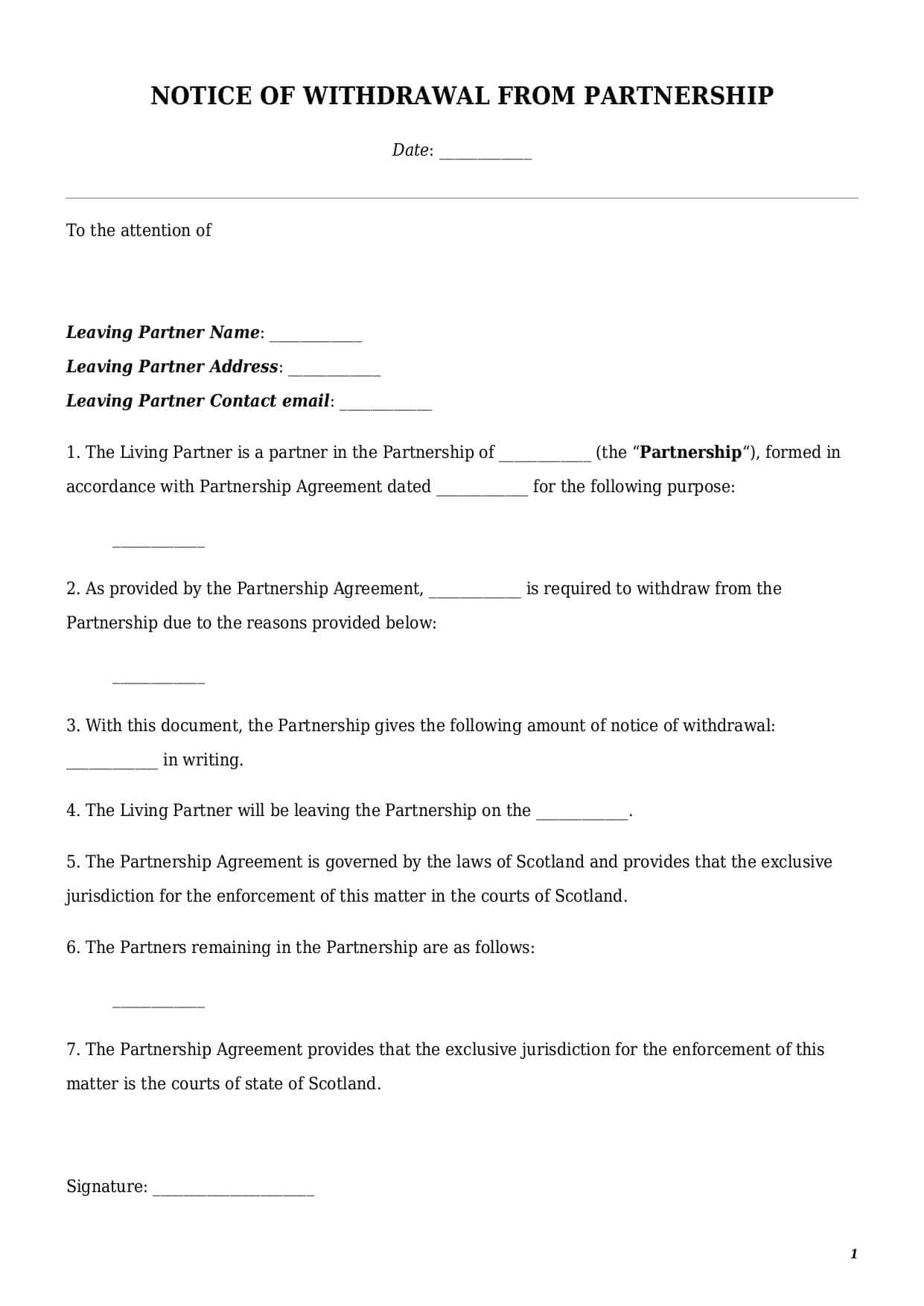
What is a notice of withdrawal from partnership?
A notice of withdrawal from partnership is a formal written document served by a departing partner (in a general partnership) or member (in an LLP) on the remaining partners or members, confirming their intention to withdraw, the proposed effective date of withdrawal, and any other relevant terms.
In the UK, this notice of withdrawal can be used to exit a general partnership, a limited liability partnership (LLP), or a limited partnership (LP) in a professional and compliant way. A standard withdrawal notice includes:
- details of the partnership;
- identification information of the leaving partner;
- type of withdrawal;
- last date and notice period;
- signatures.
This notice template can be used for both types of withdrawal:
- voluntarily (when a partner decides to exit the partnership); or
- involuntarily (when a decision to expel the partner is being made by the remaining partners).
Types of withdrawal from the partnership in the UK
According to the Partnership Act 1890 and Limited Liability Partnerships Act 2000, the withdrawal from the partnership could be of two main types:
Voluntary withdrawal
In this case a partner or member decides to depart from the partnership at their own will. No one can be forced to remain a member of a partnership in the UK.
Involuntary withdrawal
Involuntary withdrawal is possible in an exceptional number of circumstances that must be clearly stated in the text of the partnership agreement. The usual list of grounds allowing the other partner to expel a member or partner is the following:
- the partner has a criminal conviction imposed by the legal judgement;
- the partner reached the age of retirement;
- the partner becomes bankrupt;
- the partner violates fiduciary duty towards the partner, etc.
What should be included in the notice of withdrawal template?
A notice of withdrawal template should include a number of important pieces of information, including:
- Partnership’s Details. The letter must outline the full name of a partnership and its type, the jurisdiction where the partnership was formed or registered (England and Wales, Scotland or Northern Ireland) and the date of its formation or registration.
- Type of withdrawal. This notice can be customised for both types of withdrawal – voluntarily and involuntarily.
- Leaving Partner. Include full name and registered address of a partner who is leaving the partnership.
- Details of withdrawal. The notice must outline the last date in the partnership, reasons for withdrawal (in case of involuntary withdrawal), and the notice period that is being chosen for the present notice.
- Conclusive remarks. If a buyout is prescribed in the text of the partnership agreement, the remaining partners’ right to the buyout should be included along with the suggested buyout price in pounds.
- Date and Signature. Once the document is ready, it must be signed and dated. In case of a voluntary withdrawal, the leaving partner must sign it. When it comes to involuntary withdrawal, this notice should be signed by the managing partner appointed as per the partnership agreement.
Important legal considerations before serving a notice of withdrawal
Sending a notice of withdrawal from a partnership requires significant preparation and additional research beforehand, including:
Read the partnership or members’ agreement first
Before doing anything else, locate the written partnership or members’ agreement to read it carefully. This is your roadmap that shall answer the following main questions:
- whom to send the notice;
- when to sent the notice;
- what to include in the notice;
- how to send the notice etc.
Understand the process of valuation
Check for in a partnership agreement how the buy out of your share shall take place, including the provisions for its valuation, timeframe for repayment and any other possible constraints.
Review liabilities
Leaving a partnership does not automatically terminates all your current liabilities as a member or partner. Review any guarantees, indemnities, or personal commitments you have given before assuming your departure is clean.
Find the replacement
If you are one of the key partners or the first point of contact on behalf of a partnership, your departure may significantly affect the daily business routine of the partnership. Therefore, the best way to prepare the business for your departure is:
- transfer or allocate your duties between the remaining partners.
- inform key clients, suppliers or contractors of the partnership about your intention to leave; and
- perform any other appropriate actions as might be needed.
In a general partnership without a continuity clause in the partnership agreement, your withdrawal may trigger automatic dissolution of the entire firm under the Partnership Act 1890. Make sure you understand whether this is the intended outcome — and, if not, that your partnership agreement contains appropriate provisions to prevent it. If you are unsure, take legal advice before serving the notice, not after.
Common mistakes associated with withdrawal from partnership in the UK
When sending a letter to inform about the withdrawal, members of partnerships across the UK usually do these typical mistakes:
Mistake 1: Withdrawal from a general partnership does not affect the firm
Some partners may think that a partnership’s withdrawal is only their own business that cannot affect the ongoing affairs of the firm. However, in certain circumstances, the decision to exit may have significant legal consequences.
For example, if the partnership has two existing members, the exit of one member automatically triggers its statutory liquidation. The partnership cannot run with one partner only. Or, if in the limited partnership there is only one general partner and two limited partners, the exit of a general partner will also lead to the partner’s dissolution even if the two limited partners remain. The limited partnership cannot be run without at least one general partner.
Mistake 2: Not giving notification to third parties
In case of a limited liability partnership in the UK, the remaining members must notify the Companies House about the leaving partner to update the records. However, there is no such requirement for a general partnership. As a result, many partners may think that withdrawal is complete.
To sufficiently protect the partnership from any potential legal risks, it is highly recommended to notify other third parties who have previously dealt with the firm about the exit of the remaining partner. The third parties may include key clients, suppliers, lenders, and other third parties.
Mistake 3: Failure to allocate shares
The departure of a partner has significant financial and accounting consequences. Upon the exit of the partnership, the leaving partner is entitled to a compensation of their share in a way described in the text of the partnership agreement. Failure to do so may result in potential conflict between remaining and exiting partners or members.
Mistake 4: Post-exit obligations
Some partnership agreements across the UK may impose additional post-exit obligations towards the members, including confidentiality or non-compete restrictions. As a result, the remaining partners may think to sign an additional NDA or non-solicitation agreement to prevent possible competition with the ex-partner.
Mistake 5: Automatic dissolution rule
If the ongoing partnership agreement does not include a continuity clause, in such a case the exit of a partner from the partnership can automatically trigger automatic dissolution of the partnership. To prevent this, it is better to discuss your withdrawal with remaining partners well in advance. Should there be no continuity clause in the text of the partnership agreement, the respective amendments related to the continuity clause should be introduced before the departure.
Why use FasterDraft for your notice of withdrawal from partnership?
By customising this template with FasterDraft, you get the notice with the following benefits:
- a document that is suitable for both voluntarily and involuntarily departure;
- a template that can be used for general, LLP and LP partnerships registered in England and Wales;
- a template that aligns with the Partnership Act 1890 and Limited Liability Partnerships Act 2000;
- a template created by qualified UK solicitors;
- a document that is fully customisable for your particular needs.
How to use this template?
To get a fully customisable document template, follow a few easy steps below:
- Click the “Create Document” button.
- Answer simple questions in the form.
- Select a template’s format – sample notice of withdrawal PDF or Word.
- E-sign the document.
- Make a payment.
The document is ready for instant digital download immediately after the purchase. Once it is downloaded, it can be used to notify the members about the exit from the partnership.