

.svg)
.svg)
General Partnership Agreement
 PDF and
 Word
Word
A comprehensive general partnership agreement sets out exactly how the partnership will operate, how profits are shared between the partners, how the partnership is managed on a daily basis, etc.
Reviews

What is a general partnership agreement?
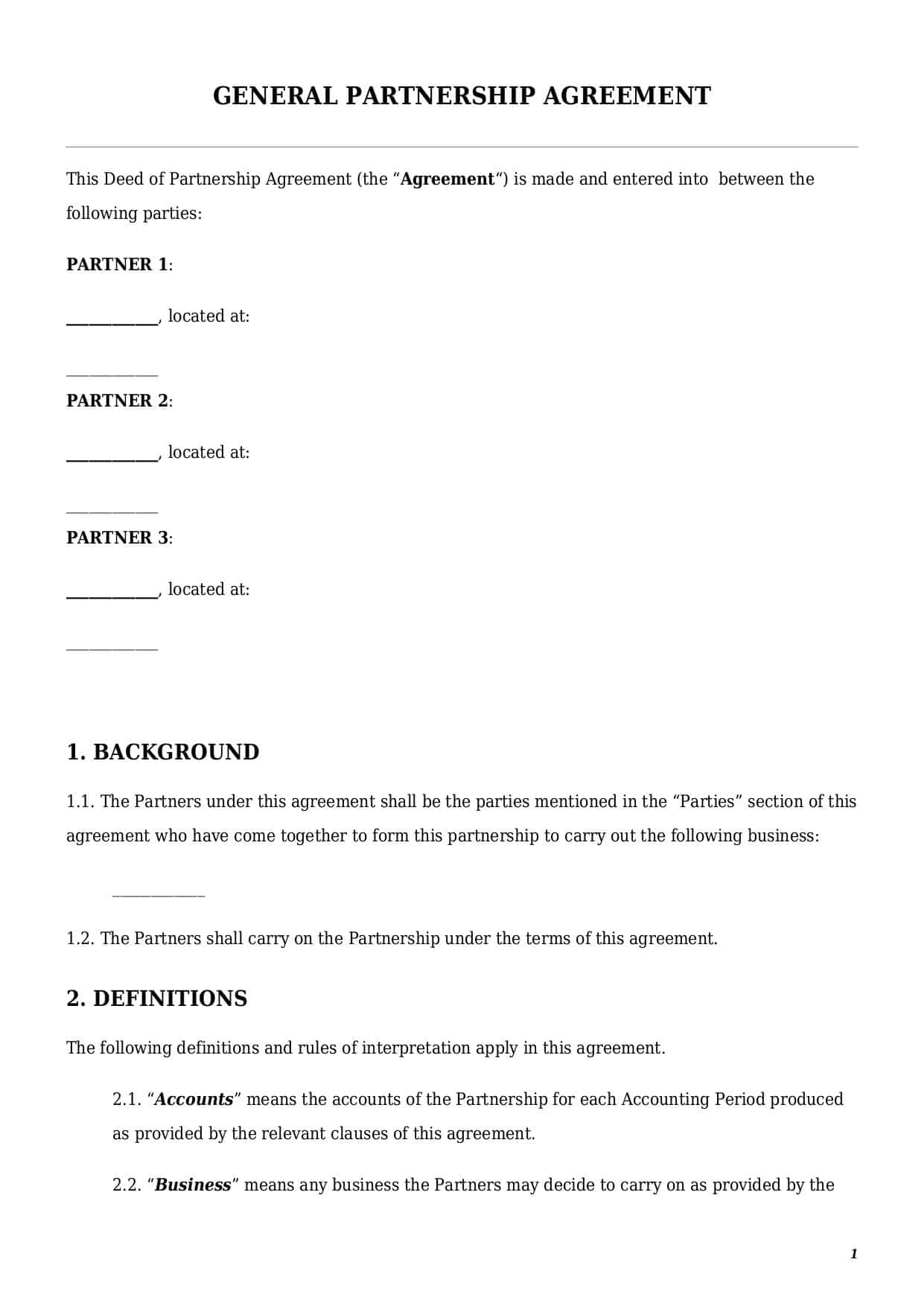
A general partnership agreement is the main document which governs operation of the partnership, how profits and decisions are shared, and what happens if things go wrong. A standard general business partnership agreement template outlines:
- each partner’s contributions;
- duties and obligations;
- daily management of the partnership;
- voluntary and involuntary withdrawal;
- dissolution of the partnership;
- dispute resolution clause.
The creation and operation of general partnerships in the UK is governed by the Partnership Act 1890.
What should be included in this general partnership agreement sample?
Inclusion of certain elements in the text of a general partnership agreement is essential to ensure the document is fully compliant with the UK legislative framework.
Details of the Partners
The text of every partnership agreement should outline the full name and contact mailing address of the partners involved. Each partner named in the document must sign and date this agreement.
Partnership Details
A general partnership agreement form must outline a partnership’s name, including the wording “general partnership”, its main place of business and a brief description of intended business activity. This document template can be used for an existing partnership and for the newly created partnership.
Duration
The general partnership may start on the date of signing this agreement by both parties or on any other date in the future. The general partnership can run until terminated by the partners or until a specific date. In the latter case such a date should be indicated in the text of the document.
Capital Contributions
Each partner shall contribute the capital in the form of the initial financial contributions. The contribution can be made in the form of cash, goods or services. A cash equivalent of a contribution should always be indicated in pounds in the text of the agreement.
Duties and Powers
A standard general partnership agreement sample shall outline the partners’ duties and powers. These powers may include compliance with all legislation and regulations, keeping financial accounts properly, carrying the business for the benefit of the partnership, etc.
Restrictions on Partners
It is also common to include into the text of a general partnership agreement a set of restrictions all partners should follow when acting on behalf of the partners. Such restrictions may include obtaining the prior approval from the remaining partners for the following:
Entering into any transaction, agreement or undertaking above agreed threshold;
- for borrowing or lending money on behalf of the partnership;
- drawing any cheque on any account;
- engaging or dismissing any employee of the partnership, etc.
Admission and Withdrawal of Partners
Every general partnership agreement form shall outline the following:
- list of conditions upon fulfilment of which a person can be accepted as a partner;
- list of conditions that require immediate withdrawal of a partner;
- age by reach of which a partner shall retire;
- process of withdrawal and repayment of a leaving partner’s contribution.
Confidentiality
Usually a standard general partnership agreement template shall include a confidentiality clause defining which type of information should be classified as confidential. All partners undertake to not share or disclose in any way confidential information to third parties while being a partner or after one year after leaving the partnership.
If needed, parties can also enter a separate non-disclosure agreement in addition to the present document for more detailed regulation of sensitive information and its disclosure.
General Partnership Agreement vs Limited Liability Partnership Agreement — What Is the Difference?
This is the most common question people ask when comparing business structures. Depending on the selected type of partnership, the different documents should be used.
Legal framework
A general partnership in the UK is regulated by the Partnership Act 1890. In case of a limited liability partnership (LLP), the Limited Liability Partnerships Act 2000 should apply instead. Both documents differ fundamentally in terms of legal structure and formation requirements.
Registration
A general partnership is the simplest form of doing business in the UK. It does not require forming a separate legal entity; as a result, a general partnership emerges by virtue of signing a document. Contrary to that, an LLP is being formed as a separate legal entity that requires further registration with the Companies House.
Partner’s Liability
Another key distinction lies within the difference of the partners’ liability in a general partnership and LLP. In case of a general partnership, the liability of partners is unlimited. Each general partner is personally liable for the debts of the firm, including debts incurred by other partners.
By contrast, LLP is a separate legal entity, which means its members’ personal liability is generally limited to the capital they have agreed to contribute.
Important legal considerations before signing a partnership agreement
There are three important pillars on which partners must first agree to ensure smooth operation of their general partnership in the future:
How are profits shared?
Running any business, including a general partnership, is aimed at generating profit. When things are going great, allocation of profits may become a hidden pitfall interfering with the business and relations between the partners. Therefore, deciding on how the profits should be split in advance is an important task. The most common allocation models include:
- allocation of profits in equal shares;
- allocation of profits according to early-made contributions; or
- allocation of profits in accordance with specifically agreed shares.
The partners are also advised to consider whether partners will receive a priority allocation (salary or interest on capital) before profits are divided and how losses will be shared if the business has a bad year.
Who manages the partnership?
A general partnership can be managed by all partners. However, when the number of partners is significant, this can intervene and pose risk to daily operations of the business. It can also create uncertainty in the eyes of suppliers, contactors and business partners.
Therefore, many general partnerships prefer to appoint a managing partner in charge of daily operations. It is also possible to list specific decisions that should be adopted only unanimously or by a majority of the partners, including:
- dissolution of the partnership
- amendments of the general partnership agreement;
- admission of the new partner;
- changing business of the partnership;
- performance of transactions or undertakings above certain thresholds, etc.
Who does the exit look like?
A general partnership agreement template is a roadmap that shall consider all possible scenarios for the partnership in the future. One of these scenarios is how the voluntary or involuntary leave of a partner should look.
A solid and well-written general partnership agreement should provide:
- circumstances in which involuntary removal of a partner is possible;
- notice period for both voluntary and involuntary removal;
- how the partner’s share in the business should be repaid.
Common mistakes when starting general partnership in the UK
Mistake 1: Assuming a verbal or implied partnership agreement is sufficient
According to the Partnership Act 1890, a general partnership can legally exist without a written agreement. However, lack of a written agreement may have significant negative consequences for future business, including:
- list of assumptions with no clear rules;
- lack of definition of each partner’s duties;
- constant misunderstandings along the road;
- frequent disputes that impede normal business activity, etc.
Therefore, almost all partnerships in the UK prefer to have at least a simple general partnership agreement to ensure smooth daily operations and good relations between the partners.
Mistake 2: Using a template without tailoring it to the specific partnership
It is easy to generate a general partnership agreement form using AI nowadays. Though AI cannot follow legal logic yet, check the consistency of clauses and sufficiently analyse applicable legislation with all recent changes. As a result, you may get a document template that is fully or partially inapplicable in the UK.
FasterDraft offers a fully customisable general partnership agreement template that reflects all specific circumstances of your business, including industry, number of partners, daily management, contributions, etc.
Mistake 3: Forgetting to register with HMRC
Once created, the general partnership does not require further registration with the Companies House. With this in mind, many individuals and businesses across the UK tend to think that all formalities related to the creation of a partnership are finalised.
Since the general partnership is aimed at generating profit, the partnership should also be registered with HM Revenue and Customs (HMRC).Failure to register can result in penalties, interest on late tax payments, and complications when filing individual self-assessment returns.
Mistake 4: Address dissolution and continuity explicitly
By virtue of a standard clause of the Partnership Act 1890, once one of the partners dies, is expelled from the partnership or retires, the partnership shall automatically be dissolved. If the partners want to overcome that, the provisions of a general partnership agreement sample must outline a continuity clause. This clause shall state that no automatic dissolution should take place unless the other is decided by an explicit vote of the partners.
Failure to include such a clause may significantly affect the future business operations at any time.
Mistake 5: Plan for disputes
Many partners omit including a dispute resolution clause when drafting a general partnership agreement template from scratch. This mainly happens because many people believe that nothing wrong can happen with their relations along the road. However, this is the greatest mistake partners usually make. Inclusion of a solid dispute resolution clause allows mitigating potential disputes efficiently and without spending much on legal costs. From the outset the parties can select a jurisdiction in which disputes should be resolved – Northern Ireland, Scotland or England and Wales.
Why use FasterDraft for a general partnership agreement?
By customising this template with FasterDraft, you get the document with the following benefits:
- a template that is fully customisable for operation of a general partnership in the UK;
- a document that can be used for GPs registered in England and Wales, Scotland and Northern Ireland;
- a document that is created in compliance with the Partnership Act 1890;
- a template that is created by qualified UK solicitors, and never by AI;
- a document that can be used for either an existing or a newly created general partnership.
This document template cannot be used for a limited liability partnership in the UK. In such a case a separate limited liability partnership agreement template shall be used instead.
How to customise this template?
To get a fully customisable general business partnership agreement template, follow a few easy steps below:
- Click the “Create Document” button.
- Answer simple questions in the form.
- Select a template’s format – general partnership agreement PDF or Word.
- Make a payment.
The document is ready for instant download immediately after the purchase.
Table of content
Frequently Asked Questions (FAQ)
-
1. Does a general partnership need to be registered at Companies House?
No. A general partnership does not need to be registered at Companies House. Once the partnership agreement is signed, the partnership is created automatically. The parties may suggest in the text of a partnership agreement another date from which the general partnership will start operating.
-
2. How many partners can a general partnership have?
There is no maximum number of partners a joint partnership can have in the UK.
-
3. What happens to the partnership if one partner dies?
Under the default rules of the Partnership Act 1890, the death of any partner automatically dissolves the partnership. It means that the business must be wound up, unless the agreement provides otherwise. The parties to the future general partnership should be aware of such a default rule and, if necessary, change it in the provisions of the ongoing partnership agreement.
-
4. Can one partner bind the firm to a contract without the others' agreement?
Yes. According to section 8 of the Partnership Act 1890, every partner has the authority to enter agreements and transactions on behalf of the partnership, which should be binding for that partnership. If the partnership has a managing partner, in such a case such a transaction or agreement can only be signed by a managing partner.
However, the partnership agreement may impose certain limitations related to the partners’ right to enter agreements or transactions by establishing a maximum threshold. Usually, the right to sign an agreement above such a threshold requires obtaining the prior written approval from the rest of the partners.
All in all, the partnership agreement can restrict individual partners’ authority, but that restriction is only effective against third parties who have notice of it. This is one of the most significant liability risks in a general partnership.
-
5. What is the difference between a general partnership and a limited partnership?
A general partnership and a limited partnership differ from each other by the scope of partners’ liability for the debts of the partnership.
In a general partnership all partners take an unlimited liability for the firm’s debts and obligations. In case of trouble, general partners undertake to cover any losses using personal assets and cash. In the case of a limited partnership things are a bit different. A limited partnership in the UK has two types of partners – limited and general. A liability of a limited partner is limited to the amount of their contribution, though they do not have the right to daily manage the partnership. On the other hand, a general partner is fully liable for the debts of a partnership, though they have a right to manage the business operations of the partnership on a daily basis.
-
6. Can I get a free general partnership agreement from FasterDraft?
At FasterDraft you can customise a general partnership agreement template at a very affordable price. We do not offer free templates generated by AI, multijurisdictional templates or generic documents. Behind our templates is a work of real UK-qualified solicitors.

Looking for something Different?
Start typing to find out our collection of legal documents and contract templates