

.svg)
.svg)
Sale of Goods Agreement
 PDF and
 Word
Word
Reviews

What is the sale of goods agreement?
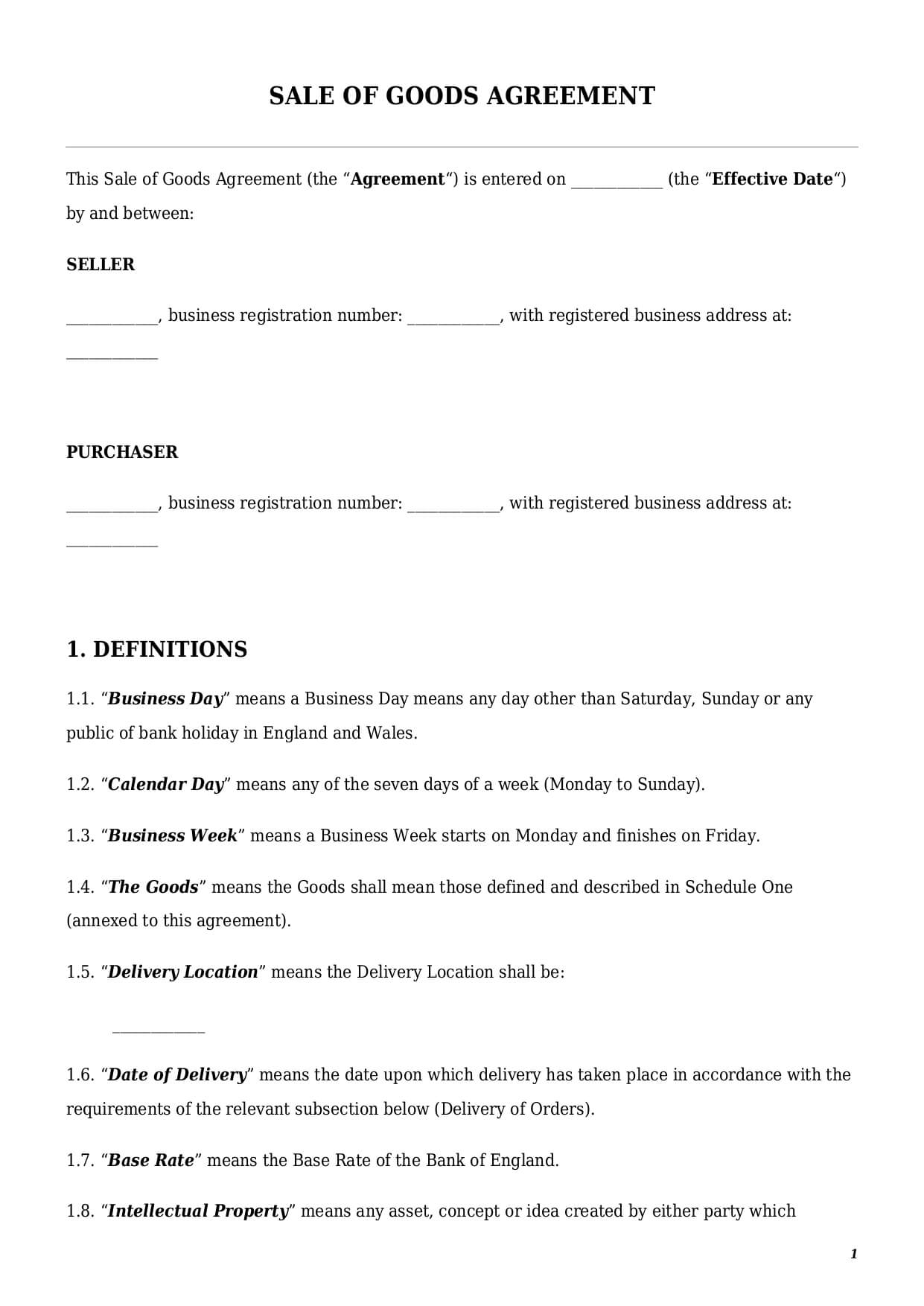
A sale of goods agreement is a contract used when a seller transfers ownership of specific, tangible goods to a buyer in exchange for money or other consideration. This document template is used between businesses operating in the UK for a one-off sale or a fixed-quantity batch sold once. A standard template outlines terms and conditions of the sale, a description of the goods, payment terms, warranties and liabilities for the parties involved, dispute resolution and a governing clause.
This template is drafted specifically for England and Wales.
Why choose this goods agreement template?
By customising this document template with FasterDraft, you get the following benefits:
- Fast to customise for small businesses. This goods contract template is structured so that filling in party details, the goods’ description, price, and delivery terms take minutes, not hours – with guidance notes explaining what each field is protecting you against. It also includes delivery, payment, and inspection terms as part of its core protections.
- Cost savings versus instructing a solicitor. A bespoke sale-of-goods contract drafted from scratch by a commercial solicitor commonly costs several hundred to several thousand pounds, depending on complexity. This template gives you the same core protections for a very affordable price.
- One-off purchase, no subscription. You buy the template once, and it’s yours to reuse for every future sale. There’s no recurring licence fee and no obligation to keep paying to keep using a document you’ve already bought.
- Compliance with UK laws. Every clause in this template fully aligns with the main legal requirements established by the Sale of Goods Act (SGA) 1979 and the Unfair Contract Terms Act (UCTA) 1977.
What does this sale of goods agreement template cover?
A standard and well-drafted sales of goods agreement for business should include the following important sections:
Parties
The template requires full legal names and addresses for both buyer and seller. Where a party is a limited company, the clause includes fields for the company’s registered number and registered office.
The document should be executed by two authorised signatories on behalf of each party to the agreement or by one director in the presence of a witness for each contractual party.
Title Clause, Risk and Transfer
Under Section 17 of the SGA 1979, property (ownership) in the goods passes when the parties intend it to pass. The Act does not define the exact moment on which such a transfer should take place. Therefore, the parties to this agreement can define either of the following moments to be considered as the transfer of title, for example:
- on delivery;
- on collection;
- once payment is made in full;
- once the goods are placed in transit, etc.
Title risk by default is being transferred with the title ownership for goods. So once the buyer gets the title ownership, the buyer becomes fully liable for the risk of loss and damage to goods by default. However, Section 20 of the SGA 1979 allows parties to change that by defining other moments for the risk transfer, for example:
- Once the goods arrive at the transit point;
- Once the goods arrive at the warehouse;
- Once the goods are in the physical possession of the buyer, etc.
A well-drafted sale of goods agreement addresses title and risk separately and explicitly, rather than relying on the Act to fill the gap.
Payment Terms and Remedies
Every template for the sale of goods should outline detailed payment terms, including the amount due, when it must be paid, and the agreed method of payment.
- Payment moment. The parties have to agree if the payment should be made in full upon placing the order, upon delivery or in a hybrid arrangement and whether the method will be invoice, card or wire transfer.
- Late payment interest. It is also possible to fix an interest rate on overdue sums. The standard average annual interest rate for B2B sales of goods does not exceed 5% per annum.
- Deposit, escrow, and security wording. The parties may consider additional securing mechanisms by taking a non-refundable deposit, holding the price in a third-party escrow account pending delivery confirmation, or securing payment against the goods themselves through the retention of title mechanism. If the buyer fails to pay as agreed, the seller may exercise the contractual remedies already set out.
Delivery, Inspection, and Acceptance
A standard template should also define:
- Delivery method and deadlines. Whether the goods should be delivered by the seller or by a third party. The timeline is of the essence for this type of contract; therefore, the parties should clearly outline the period of time after the payment for the delivery of the goods.
- Inspection window and rejection procedure. Under Section 34 of the Act, a buyer is entitled to a reasonable opportunity to examine goods before being treated as having accepted them. But under Section 35, that right has real limits: a buyer is deemed to have accepted goods if they intimate acceptance, if they do something inconsistent with the seller still owning them, or – critically – if they simply keep the goods for a “reasonable time” without saying anything. This template gives the inspection period a specific number of days, so both parties know exactly when the acceptance clock starts and stops, rather than relying on the more subjective statutory “reasonable time” test.
- Remedies for failed or late delivery. Unlike with B2C sales of goods, when the consumer may reject goods, the rejection is not possible under the Sales of Goods Act. In case of a failed or late delivery, the buyer typically has a limited number of remedies, for example, a reduction in price and a claim for damages.
Liability Limits And Indemnities
- Mutual liability cap options. Wording to cap each party’s overall liability at a fixed sum or a multiple of the contract price. This cap is always subject to the reasonableness requirement under UCTA 1977 – and to one absolute rule that cannot be contracted around: under Section 2(1). Under the UCTA 1977, liability for death or personal injury caused by negligence can never be excluded or limited, full stop. The leading case on the limits of exclusion clauses more generally is Photo Production Ltd v Securicor Transport Ltd [1980] AC 827, in which the House of Lords confirmed that a properly drafted and reasonable exclusion clause can, in principle, cover even a serious breach — but only if it’s clear, and only within what UCTA 1977 actually permits.
- Indemnity for third-party claims. Includes indemnity wording covering claims that the goods infringe a third party’s intellectual property rights, plus optional compliance representations for corporate parties. Two are worth flagging specifically. First, a warranty that neither party will engage in conduct that would breach the Bribery Act 2010 — under Section 7 of that Act, a commercial organisation can be criminally liable if a person associated with it bribes someone to obtain or retain business unless the organisation can show it had adequate anti-bribery procedures in place, so a compliance warranty in your commercial contracts forms a small part of that defence. Second, for larger sellers, a reference to compliance with the Modern Slavery Act 2015—Section 54 of that Act requires commercial organisations with a total annual turnover of £36 million or more to publish an annual slavery and human trafficking statement, and buyers increasingly expect a supply chain compliance warranty from sellers as standard practice, even below that threshold.
Governing law
The text of every sales of goods agreement should outline the laws of which jurisdiction must apply to the provisions of this agreement. Once the law is selected, the courts located in the selected jurisdiction shall have an exclusive right to hear the case. The amendment of such a clause, including the rest of the clauses in the agreement, can only be done upon the mutual agreement of both parties involved.
This template includes a by-default clause according to which the law of England and Wales shall apply.
Legal framework for the sale of goods in the UK
A professionally drafted sales of goods agreement template should fully align with the key legislative acts below:
Sale of Goods Act 1979
The Act implies terms into essentially every business sale of goods in England and Wales – title, description, satisfactory quality, and fitness for purpose. Whether the contract directly refers to the clauses or simply implies them, the main statutory provisions apply by default to all sales of goods agreements and cannot be excluded by the parties in the contract.
Data protection
Where the contract involves collecting personal details, a buyer’s contact information, delivery address, or payment details, that processing needs to comply with the Data Protection Act 2018 and the UK GDPR. All in all, the personal data obtained should be processed for strictly contractual purposes and for the duration of the contract only. Once the agreement comes to an end, the processing party must erase all personal information obtained from the other party.
Incoterms for export shipments
If the goods are being shipped outside the UK, incorporate a recognised Incoterms rule (EXW, FOB, DAP, and so on) to fix who bears shipping costs, insurance, and risk during transit – none of which UK domestic sale-of-goods law resolves on its own for cross-border movement, especially where the deal may also involve services, import or export obligations, taxes, and other compliance requirements.
What is the difference between a sale of goods agreement and a supply of goods contract?
It is typical for many businesses to confuse these two documents. Some may even use them interchangeably. However, this is a wrong approach from the legal point of view, and here is why:
Purpose of transaction
If the parties intend to enter a single defined sale, the present sale of goods agreement template should be used instead, especially when the seller plans to sell goods in one transaction rather than on repeat terms. When the parties are looking for ongoing relations with repeated orders, then a supply of goods agreement is the better choice.
Key clauses
The key provisions for a typical sale of goods agreement are delivery, transfer of risk and title, and acceptance conditions. While for the supply of goods, the clauses such as order acceptance, minimum volumes and invoicing period remain the most important.
Duration
The sale of goods agreement ends upon the completion of the sale, while the supply of goods may remain effective for a defined or indefinite period of time.
If you expect the same buyer to place repeat orders over months or years, or you’re agreeing terms meant to apply to future purchase orders rather than one specific transaction, use a supply of goods agreement instead.
What are the common mistakes in commercial sales contracts in the UK?
Mistake 1: Using a supply agreement template for a one-off sale
Many businesses are typically confused about in which cases and for which purposes the supply agreement and sale of goods agreement should be used. If you are looking to enter a one-off transaction for the sale of goods, a solid sale of goods agreement template should be used. If the long-term supply relationships are planned to be established, it is better to go with the supply agreement, including forecasting and volume terms.
Mistake 2: Assuming an exclusion clause is enforceable just because it’s in writing and signed
Exclusion clauses in sale of goods agreements are governed primarily by Section 6 of the UCTA 1977. By virtue of this clause, the liability of either party for the faulty goods can be excluded in full or partially. However, simply including such a clause in the text of the agreement is not enough. The clause also has to be reasonable in the circumstances — and the burden of proving that falls on the party relying on it, not the party challenging it. Therefore, parties should be ready in case of a dispute to demonstrate the necessity of excluding liability.
Last but not least, the exclusion of liability clause can never touch the seller’s title warranty. If such a clause is still included in the agreement, it will be automatically considered void by the courts in case of a dispute.
Mistake 3: Separate the risk clause from the title clause
The good business practice when it comes to the B2B sales contract is to separate the transfer of risk clause from the transfer of title clause. The transfer of the risk clause defines when the risk for the damage or loss of goods is transferred from the seller to the buyer. While the transfer of title clause defines the moment of transferring the title from the seller to the buyer. Many businesses, for convenience purposes, prefer to make one default transfer moment for both title and risk. However, it is not necessarily true that the statutory default (risk following ownership) reflects what parties actually want. If goods are in transit via a third-party carrier, it should be explicitly decided whether the buyer or seller carries that risk.
Mistake 4: Leaving the retention of title clause out because “we’ve never had a problem before”
Many businesses, especially those that have been in the business for many years, prefer to omit the retention clause as an unnecessary addition to the contract. Another may think that trust and personal good relations with the counterparty will protect them against unpaid goods.
A solid template must always incorporate a retention clause allowing the seller to keep legal ownership of the goods until the buyer has paid in full, even though the goods are physically delivered and in the buyer’s possession. This is one of the most commercially valuable protections available to an unpaid seller: if the buyer becomes insolvent before paying, goods still owned by the seller do not form part of the buyer’s insolvent estate and can, in principle, be recovered directly – rather than the seller joining the queue of unsecured creditors.
There is an important caveat to keep in mind – a retention clause is not a statutory right of the seller that applies by default even if not directly mentioned in the text of the contract. Therefore, once this clause is omitted, it cannot be added after a buyer has already run into financial difficulty.
Mistake 5: B2B vs. B2C sales
If you are planning to apply the statutory regime provided by the SGA 1979 and UCTA 1977, in such a case both parties under the agreement should be businesses and corporate entities. If the buyer is an individual consumer, in such a case, a more protective regime established by the Consumer Rights Act 2015 shall apply. The present template cannot be used for B2C transactions of the sale of goods.
How to customise this sales contract template with FasterDraft?
To get a fully customisable document template, follow a few easy steps below:
- Click the “Create Document” button.
- Answer simple questions in the form.
- Select a template’s format – PDF or Word.
- E-sign the document online.
- Make a payment.
The document is ready for instant digital download immediately after the purchase. Once downloaded, the parties can sign and use it for selling goods.
Table of content
Frequently Asked Questions (FAQ)
-
1. Does this contract cover future goods, not just goods that already exist?
Yes. The goods description clause can be adapted to cover goods that
- already exist or are in possession of the seller;
- will be manufactured for the buyer upon the submitted order; or
- or aren’t yet in the seller’s possession at the point of signing.
-
2. Can either party assign or transfer their rights under the contract to someone else?
The template includes an assignment clause that, by default, prevents either party from transferring their rights or obligations without the other’s written consent. If the prior written consent is obtained, in such a case, the other party can further transfer their rights and obligations under this agreement to a third party.
-
3. Is this template suitable for both online and in-person sales?
No. This document is a customisable legal template that can be used for the commercial purchase of goods between businesses and corporate entities operating in the UK. This template cannot be used for individual or personal sales with individual customers.
-
4. What happens if the goods turn out to be defective after the buyer has already accepted them?
Once goods are accepted under Section 35 of the Sale of Goods Act 1979, the buyer generally loses the right to reject them and is limited to a claim for damages rather than rejection and refund — which is exactly why the inspection window matters so much. This template’s warranty clause still gives the buyer a route to repair, replacement, or a price reduction after acceptance, but outright rejection becomes much harder to achieve once that point has passed.
-
5. Do I need a different version of this template if I'm selling internationally?
No. This document template is only suitable for the sale of goods in England and Wales.

Looking for something Different?
Start typing to find out our collection of legal documents and contract templates