

.svg)
.svg)
General Supply of Goods Agreement
 PDF and
 Word
Word
Supply of goods agreement helps to define the legal foundation of every commercial relationship between a supplier and a buyer of physical goods, including delivery and payment terms, warranties, liabilities, transfer of risk and title, and termination arrangements.
Reviews

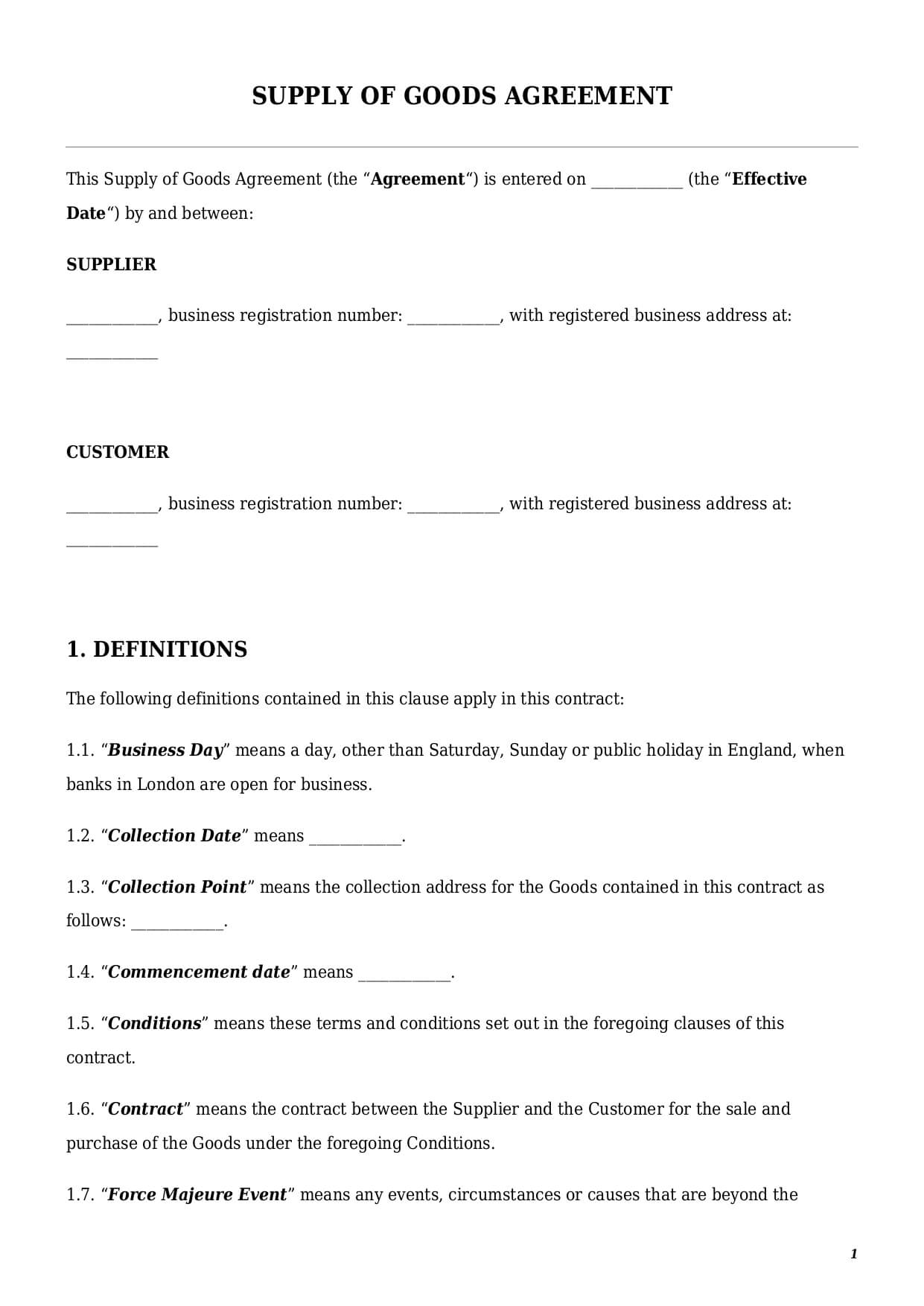
What is a supply of goods agreement?
A supply of goods agreement is a written contract between a supplier and a buyer that records the terms on which physical goods will be supplied, including price, delivery terms and conditions. A standard supply of goods agreement should outline what is being sold, at what price, how and when it will be delivered, who bears the risk of loss or damage in transit, how inspection and acceptance will work, how payment is made, how long the arrangement lasts, when either party can terminate, any warranties and liability limits, and what remedies are available if the goods do not meet the agreed standard.
For small business owners, freelance entrepreneurs, startup founders and individuals who need a fast, reliable and affordable legally compliant template, this page explains the key clauses to check and customise before use. It is built for supply arrangements in England and Wales, where the supply of goods is governed mainly by the Sale of Goods Act 1979 and general principles of English contract law, so both supplier and buyer can set clear expectations, meet UK legal requirements and reduce the risk of disputes.
A supply of goods agreement cannot be used for:
- standard purchase of goods, as a sale-purchase agreement should be used instead;
- provision of services, as a general service agreement should be used instead; or
- purchase of shares in the company, as a share purchase agreement should be used.
This template is designed specifically for England and Wales and can be customised with FasterDraft.
Why choose the supply of goods agreement template from FasterDraft?
By customising this document template with FasterDraft, you get the following benefits:
- Rapid customisation workflow. Answer a structured set of questions about your goods, price, delivery terms, payment schedule, and inspection requirements — and the template generates a complete, tailored agreement for your business. No starting from a blank page, no overlooked clauses, and a clause structure designed to help reduce misunderstandings and disputes between parties.
- Compliance with UK laws. Every provision in this template has been aligned with the current requirements of the Sale of Goods Act 1979 (the “SGA“), the Unfair Contract Terms Act 1977 (the “UCTA“) the Contracts (Rights of Third Parties) Act 1999, and the Insolvency Act 1986. The liability cap, exclusion clauses, and retention of title provisions are drafted to pass the UCTA 1977 reasonableness test in a B2B context.
- No subscription or hidden fees. Purchase the template once. Download it in editable Word format. Use it for an unlimited number of transactions. No recurring charges, no hidden subscriptions.
- Professional template. All templates are crafted by qualified UK solicitors. The document has a professional outline and is written in plain English.
- No AI generation. At FasterDraft, we do not sell templates available for free on the Internet, generic documents, multijurisdictional templates or templates generated by AI.
Key clauses to include in the supply of goods agreement template
A solid and well-written supply of goods agreement for England and Wales must address a list of important clauses without which the document cannot be complete or legally enforceable. These clauses are:
Mandatory Supply Terms
The supply terms are the key element of every supply of goods agreement. The parties must outline the following, along with clear definitions of key commercial terms:
- choose the supply model – recurring orders or one-time delivery;
- choose the delivery type – collection by the customer or delivery by the supplier;
- description of goods to be delivered, including their quality, quantity and specification (if applicable); and
- identification details of both the supplier and the customer, including each business’s legal details and, where relevant, where it is incorporated.
Delivery, Title, and Risk Transfer
Under Section 20 of the Sale of Goods Act 1979, risk for the loss or damage of the supplied goods is passed from the moment the title is transferred from the seller to the buyer. That means that the seller remains fully accountable and liable for any damage or loss of the goods until such a risk is transferred to the seller. Therefore, the parties must clearly outline in the document the moment of the transfer of such a risk between the buyer and the seller. This moment can be:
- when the goods are dispatched for delivery;
- when the goods are delivered to the agreed pick-up or drop-off location;
- when the goods are being paid in full by the buyer;
- when the goods are being delivered to the physical possession of the buyer (i.e., customer), etc.
This template also defines a clear delivery obligations clause, including the supplier’s obligation to deliver by the agreed date and the delivery location, and compliance obligations that ensure the goods and delivery process meet applicable laws and relevant acts. It is also possible to customise this template to add a retention of title clause – a provision under which the supplier retains legal title to the goods until the buyer has paid in full. This is one of the most commercially important provisions in any supply agreement.
Price, Invoicing, and Payment Terms
A well-written contract agreement for the supply of goods must specify:
- the price per unit (for recurring orders) or total contract price (for one-time purchase);
- whether the price is fixed or subject to variation, and whether amounts are inclusive or exclusive of VAT (for example, if the international delivery costs increase over time, or the exchange rate drops);
- the invoicing schedule (when the invoice should be paid by the customer, how the invoice should be sent by the supplier, and any payment terms included in the agreement);
- the payment due date (typically 30 days from invoice date for B2B transactions, though parties may agree shorter or longer periods);
- the consequences of late payment (non-mandatory but typical for B2B transactions clause that grants the supplier the right to statutory interest at 8% above the Bank of England base rate);
- the list of acceptable payment methods (for example, bank transfer, cash, standing order, etc).
Inspection, Acceptance, and Rejection Terms
Under Section 34 of the Sale of Goods Act 1979, the customer has a right to examine the goods before being deemed to have accepted them, with inspection rights defining the scope of the buyer’s review before acceptance. Under Section 35 SGA 1979, the buyer is deemed to have accepted goods if they have intimated acceptance, or if they have had a reasonable opportunity to examine the goods and have done an act inconsistent with the seller’s ownership, or if they have retained the goods without intimating rejection within a reasonable time. Once goods are accepted, the buyer loses the right to reject them for breach of condition and is limited to a claim in damages.
To fully implement such a customer’s right into the provisions of the supply agreement, a solid template must include the following provisions:
- An inspection window — a defined period within which the buyer must inspect and notify of any defects or non-conformities (usually between 7 and 30 days depending on the quantity of goods delivered);
- An acceptance mechanism — confirmation that goods meet the specification and how such a confirmation should be served (for example, by email, in person, by fax);
- A rejection procedure — the steps the buyer must follow to reject non-conforming goods, including a notice requirement and a description of the defects relied upon (the rejection cannot be unreasonable and should be based on the goods requirement provided in the specifications or plans);
- A dispute resolution mechanism for disagreements about whether goods conform to the specification, including mediation or arbitration.
These inspection procedures also support the agreement’s quality procedures, warranties, and liability clauses in relation to defects and non-conforming goods.
Warranty and Defective Goods Remedies
The supplier must accept liability where defective goods breach the agreement’s standards and cannot supply goods that are:
- Unsatisfactory quality. According to section 14(2) SGA 1979, goods supplied under the contract must be of satisfactory quality. That means that in the case of a dispute, a supplier should be able to prove that the supplied goods are what a reasonable person would regard as satisfactory.
- Not matching description. By virtue of Section 13 SGA 1979, the supplied goods must meet the minimum description provided in plans or specifications agreed earlier by the parties.
- Not fit for purposes. Where the buyer makes known a particular purpose for which the goods are required, the seller implies they are reasonably fit for that purpose. There is an implied term that the goods supplied under the contract are reasonably fit for that purpose, whether or not that is a purpose for which such goods are commonly supplied, except where the circumstances show that the buyer does not rely, or that it is unreasonable for them to rely, on the skill or judgment of the seller. If the buyer has not stated the specific intended purpose for goods, the buyer may not later claim that such goods are not fit for purpose. The good example here is a famous case, Griffiths v Peter Conway Ltd [1939] 1 All ER 685, where the claimant bought a Harris tweed coat from the defendant seller. She had unusually sensitive skin, but she never told the seller this. After wearing the coat, she developed dermatitis. She sued, arguing the coat wasn’t fit for her purpose. However, the court refused to satisfy the claim, stating that the seller was not aware of her abnormally sensitive skin and could not be expected to assume it existed.
The template should also set out the result of a valid defect claim, including repair, replacement, refund, or damages compensation.
Contract Duration and Renewal Options
This template can be customised as a:
- fixed-term supply agreement with a set end date; or
- supply agreement on an indefinite basis that remains legally valid until terminated by either party.
If a contract is on a fixed-term basis, the parties may include an automatic renewal clause, according to which the contract is renewed at the end of each term for the same duration again and again. If the renewal clause is being implemented, it is worth considering including an opt-out mechanism allowing both parties to stop such an automatic renewal in advance.
Termination Rights and Effects of Termination
The template includes a comprehensive termination clause covering termination in the following circumstances.
- Termination for material breach. This is either party’s right to terminate immediately where the other party commits a material breach. The material breach is a violation of the party’s obligations and duties under the contract, which may include failure to pay for the delivery on time, inability to provide a replacement for the damaged goods, failure to deliver the goods on time, or a breach of confidentiality obligations where sensitive commercial information is involved. Confidentiality clauses protect sensitive commercial information shared during the agreement, and conduct likely to bring disrepute or commercial harm may also justify termination.
- Termination for insolvency. This is a supplier’s right to terminate immediately where the buyer becomes insolvent, enters administration, is wound up, or a receiver or liquidator is appointed.
- Termination for convenience. This clause allows the buyer to terminate the contract at any time on the condition that all delivered goods are paid in full and advance notice of termination is provided to the supplier.
- Effects of termination. The provisions of the contract should also outline what happens in case of termination if: (i) orders placed but not yet fulfilled; (ii) goods are in the process of delivery; (iii) invoices for the delivered goods remain unpaid, and whether some clauses continue after termination where appropriate.
Liability Caps and Mutual Indemnities
It is common for B2B supply agreements in the UK to include a limitation of liability clause for limiting the supplier’s liability for violation of certain provisions in the contract. It is also important to note that the liability clause is the most challenged clause in all commercial litigation across the UK. Therefore, to create a fully compliant and litigation-proof liability clause for the supply agreement template, the following conditions should be met:
- Absolute prohibition. The supplier cannot exclude or restrict liability for breach of the implied title warranty under Section 12 SGA 1979. These warranties include the buyer’s right to goods free from any undisclosed charge or encumbrance, as well as the buyer’s right to enjoy possession of the goods. If such a clause exists in the contract, it won’t be enforced in court in case of a dispute.
- Limited prohibition. The supplier can exclude or restrict liability for breach of the implied terms such as provision of goods of unsatisfactory quality, failure to provide goods fit for purpose or goods matching the description, provided that such limitation or exclusion is reasonable. In such a case, the course of England and Wales will demand that the supplier prove that such an exclusion or limitation of liability is reasonable and does not harm the buyer. For example, in the case R W Green Ltd v Cade Bros Farms [1978] 1 Lloyd’s Rep 602 the court upheld the limitation-of-liability clause to be reasonable because of the following cumulative conditions: (i) the bargaing power of both parties was equal; (ii) the buyer got no special inducement to accept the term, but had chosen cheaper uncertified seed knowing it carried more risk than certified seed; (iii) and the clause had been in long-standing use with the approval of bodies representing both sides of the trade.
- Consequential loss exclusions. In B2B supply agreements, it is standard practice to exclude liability for indirect or consequential loss — loss of profit, loss of revenue, loss of goodwill. Such exclusions are generally enforceable in B2B contracts provided they pass the UCTA 1977 reasonableness test.
Important compliance notice for a valid supply agreement template in England and Wales
To create a legally enforceable supply of goods agreement template, parties must be aware of the following important considerations:
UK GDPR compliance and data protection
If, in the course of the performance of the supply of goods agreement, either party is processing personal data on behalf of the other party, the parties may need to enter into a separate data processing agreement before such processing, and in such a case, this agreement shall comply with the minimum compliance requirements established by the Data Protection Act 2018.
Processing of personal data for the purpose of the present agreement may include, for example, where the supplier holds the buyer’s customer delivery addresses, or the buyer provides employee data to the supplier for account management purposes, and appropriate data security measures should be used to protect shared personal data.
Governing law and jurisdiction
This template must comply with UK law and is governed by the law of England and Wales. It also includes a chosen jurisdiction clause requiring both parties to submit to the exclusive jurisdiction of the courts of England and Wales in the event of a dispute. This agreement template is suitable for the parties:
- both trading in England and Wales;
- either party trading in England and Wales; or
Parties are trading outside of England and Wales but specifically intend for the laws of England and Wales to apply to the provisions of this contract.
If one or both parties to the supply of goods agreement are based in Scotland or Northern Ireland, jurisdiction-specific legal advice is recommended before using this template, especially to understand the meaning of the jurisdiction clause for cross-border parties choosing England and Wales.
Third Parties Rights
According to the provisions of the Contracts (Rights of Third Parties) Act 1999, a third party who is identified in the agreement and on whose benefit a term is intended to confer a benefit to enforce that term directly against either party. The provisions of the cited act apply by default, unless directly excluded by the parties. Most commercial supply agreements include an express exclusion of the Contracts (Rights of Third Parties) Act 1999 to prevent unexpected third-party claims.
How to customise this agreement supply of goods with FasterDraft?
To get a fully customisable document template, follow a few easy steps below:
- Click the “Create Document” button.
- Answer simple questions in the form.
- Select a template’s format – PDF or Word.
- E-sign the document.
- Make a payment.
The document is ready for instant digital download immediately after the purchase.
Table of content
Frequently Asked Questions (FAQ)
-
1. When should I use this template versus a goods-and-services agreement?
Use a supply of goods agreement when the primary obligation under the contract is the transfer of physical goods from supplier to buyer for a price. This template can be suitable in a situation where the goods are being manufactured and subsequently delivered to the buyer.
A services agreement is another document template mainly used between the service provider and the client to deliver various types of professional services, including cleaning, accounting, IT development etc.
-
2. Can this template be used for online sales as well as in-person delivery?
Yes. The template covers both in-person delivery arrangements (where the buyer collects from the supplier’s premises or the supplier delivers to a named location) and distance or online supply arrangements, including orders placed through a website, where goods are ordered and paid for remotely before delivery.
For B2B online transactions, and in some consumer-facing online use where B2C transactions may also arise, the delivery, risk transfer, and acceptance provisions operate in the same way as for in-person arrangements. Note that for consumer online sales in England and Wales, the Consumer Contracts (Information, Cancellation and Additional Charges) Regulations 2013 impose additional pre-contract information requirements and a 14-day cooling-off right — these consumer-specific obligations are not addressed in this B2B template.
-
3. Is FasterDraft providing legal advice with this template?
No. FasterDraft provides this template as a starting-point legal document to assist businesses in drafting their commercial supply agreements. The template and the guidance notes that accompany it are not legal advice, and FasterDraft does not provide legal advice in connection with the use of this template. For transactions involving significant value, unusual goods, complex delivery or payment arrangements, or any matter where legal enforceability is critical, you should seek advice from a qualified solicitor admitted to practise in England and Wales before using or signing any legal document.

Looking for something Different?
Start typing to find out our collection of legal documents and contract templates