

.svg)
.svg)
Rent Book for Private Tenancies (Northern Ireland)
 PDF and
 Word
Word
Meet your legal obligations under the Private Tenancies (Northern Ireland) Order 2006 and provide a rent book to your tenant within the 28-day statutory time limit after stating the tenancy agreement in Northern Ireland.
Reviews

What is a rent book, and why does Northern Ireland require one?
A rent book is a written document provided by the landlord to the tenant upon signing the tenancy agreement and used to record rent and other payments made under a private tenancy. Provisions of the rent book are a landlord’s legal obligation under Article 5 of the Private Tenancies (Northern Ireland) Order 2006, failure to comply with which may result in fixed penalty notices or further prosecution.
The present rent book is being used in conjunction with a residential tenancy agreement which is being signed between the landlord and the tenant. A standard rent book must be delivered to the tenant within 28 days after signing the tenancy free of charge.
Top 4 reasons to have a rent book in Northern Ireland
Typically a rent book might be omitted from the landlord’s attention, as it is considered unnecessary. However, usage of rent books in Northern Ireland is mandatory for the following reasons:
- Legal requirement. Article 5 of the PTNIO 2006 mandates the landlord to proceed with issuance and delivery of this document to the tenant.
- Protection against payment disputes. The document is sole written proof of all the payments made under the ongoing tenancy, which helps to remove any ambiguity if a tenant or landlord later disputes the amount of the rent paid or whether rent was paid at all.
- Ensures transparency. A tenant with a clear running record of what they’ve paid and when is less likely to raise a payment dispute in the first place — this is a document that genuinely benefits both sides of the tenancy, not just a box-ticking exercise for the landlord.
- Protects from penalties. Failing to provide a rent book within the 28-day window is a criminal offence under the PTNIO 2006.
Rent Book vs. Tenancy Information Notice vs. Tenancy Agreement – When, How and Why to Use Them?
Entering a residential tenancy for a private dwelling in Northern Ireland is a complex legal procedure that requires both landlord and tenant to meet various compliance obligations and requirements at each stage. In practice, the rent book, tenancy agreement and tenancy information notice are often confused as similar or interchangeable documents. To prevent any further penalties and prosecutions and ensure proper compliance, check your legal obligations below:
| Rent Book | Tenancy Information Notice | Tenancy Agreement | |
|---|---|---|---|
| Statutory basis | Private Tenancies (NI) Order 2006 | Private Tenancies Act (NI) 2022 | General contract law |
| Purpose | Ongoing written record of rent and payments | One-off notice to inform about the key tenancy information at the start of the tenancy | Defines terms and conditions of the letting (deposit, rent payment, duration, duties) |
| When to provide the document? | Within 28 days of the tenancy starting | Within 28 days of the tenancy starting | Before the tenancy starts |
| Requires regular update? | Yes. Each time upon the receipt of the payment. | No. The document remains static once sent. | No. The document remains static once signed. Any changes are done via separately signed addendum by both parties |
| Who produces the document? | Landlord free of charge | Landlord free of charge | Both parties |
What should a standard template of a rent book include?
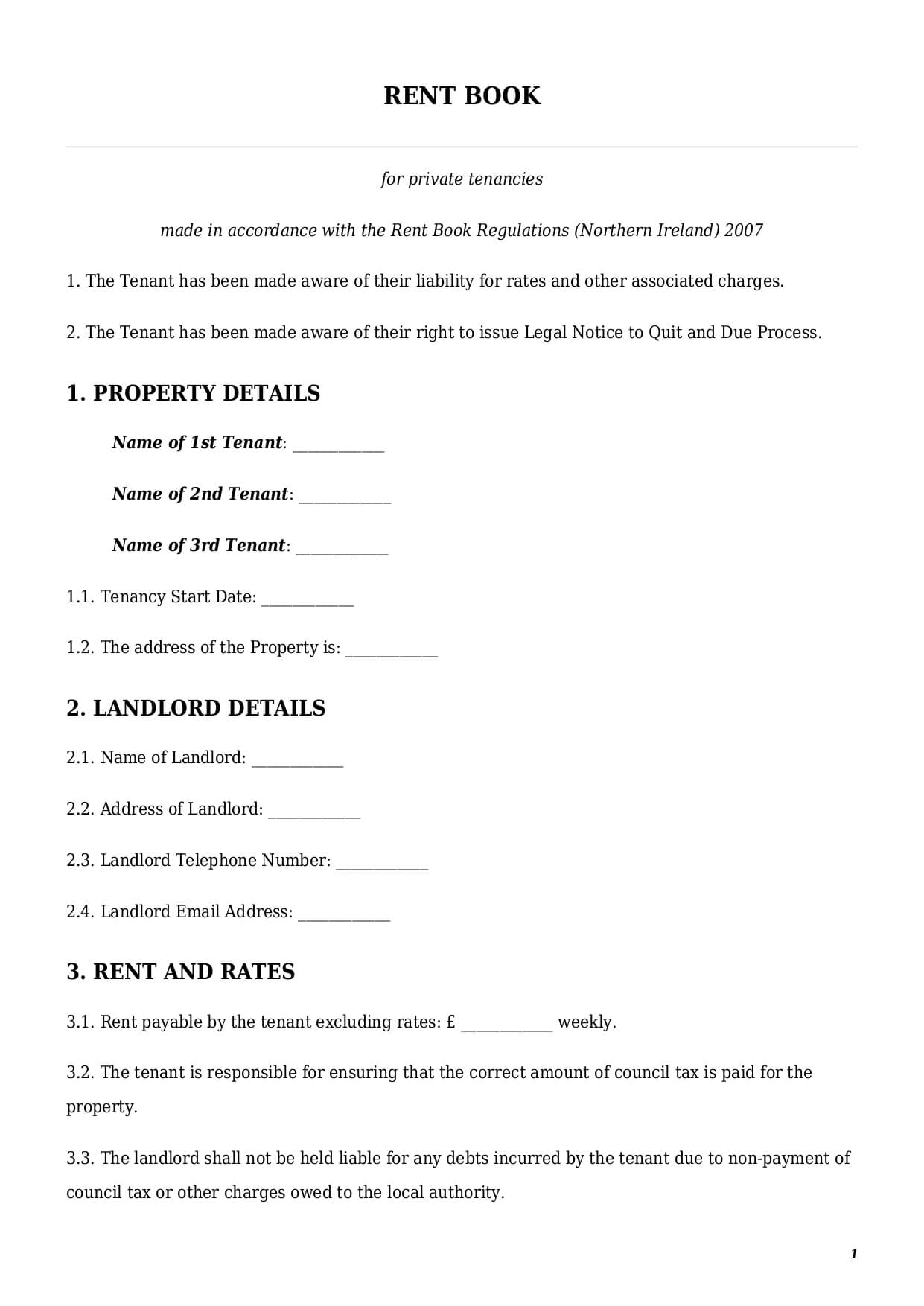
Provisions of the PTNIO 2006 define the list of particulars that must be included in this document:
- The landlord’s name, contact address, telephone number, and email address must be included;
- If the landlord uses a letting agent, the document must include the full name, contact address, and contact information of the letting agent;
- Full name of each tenant residing in the rented property;
- The amount of payable rent in pounds and its frequency (weekly, monthly, or as agreed);
- A list of any other charges or sums to be paid by the tenant (e.g., utility bills, council tax, Internet);
- A running, dated record of payments made — space to record each payment as it happens, not just a single landlord figure.
Typical misconceptions about the rent book landlords must know before signing the lease agreement
By knowing the most common misconceptions about renting books in Northern Ireland, you can prevent non-compliance and penalties.
Misconception 1: Assuming the Tenancy Information Notice replaces the rent book
Since both documents must be sent right after signing the tenancy agreement, most landlords believe that they are interchangeable and simply have different names for the same document. However, this is not true. Sending these two documents addressing two separate statutory obligations of the landlord. Thus, sending only one document inevitably triggers a violation of another statutory duty of the landlord.
Misconception 2: Providing a rent book late is better than not providing it at all.
Article 5 of the PTNIO 2006 provides a maximum statutory deadline for sending a rent book to the tenant. This is not a recommended period that a landlord may prolong at their own discretion. Therefore, if even the rent book is sent with one day of delay, it still triggers application of the penalties.
Misconception 3: Treating the rent book as a one-time document
Unlike with the tenancy information notice, which must be sent once upon signing the main tenancy agreement, a rent book is a “live” document that requires ongoing updates every time the new payment is being received.
How to proceed with the customisation of the rent book template at FasterDraft?
To get a fully customisable rent book template for private tenancies in Northern Ireland, follow the given instructions below:
- Click the “Create Document” orange button to open the questionnaire.
- Answer questions to customise the document.
- Make a payment online.
- Digitally download the document in PDF or Word format.
- Open the file to check that the information you entered is free from any typos or mistakes.
- Print the document out.
- Deliver the printed rent book to your tenant free of charge within 28 days after signing the tenancy agreement.
- Keep it updated throughout the tenancy.
Table of content
Frequently Asked Questions (FAQ)
-
1. Is a rent book a legal requirement in Northern Ireland?
Yes — under Article 5 of the Private Tenancies (Northern Ireland) Order 2006, landlords must provide one within 28 days of the tenancy starting, free of charge.
-
2. What happens if I don't provide a rent book?
Failing to comply is a criminal offence under the Order, enforceable through the local district council’s Environmental Health Department.
-
3. Is a rent book the same as the new Tenancy Information Notice?
No — these are two separate documents. The Tenancy Information Notice (introduced by the 2022 Act) is a one-off notice of key tenancy information; the rent book is an ongoing written payment record required separately under Article 5.
-
4. Can I charge my tenant for the rent book?
No — it must be provided free of charge.
-
5. Does a rent book apply to all private tenancies in Northern Ireland?
It applies to private tenancies as defined under the order, subject to the order’s standard exclusions (such as certain long leases, Crown tenancies, and holiday lettings)—check your specific tenancy type if you’re unsure.
-
6. Do I still need a rent book if I have a full tenancy agreement?
Yes, a tenancy agreement and a rent book serve different purposes; the rent book specifically satisfies Article 5’s payment-record requirement. The landlord’s overlap with your tenancy agreement’s contractual terms.

Looking for something Different?
Start typing to find out our collection of legal documents and contract templates