|
Party Wall Notice |
Building Construction Agreement |
| Parties |
Property owner/builder and your neighbour |
Property owner and builder/contractor |
| Purpose |
Statutory notification of works affecting a shared wall, boundary, or nearby excavation |
Private contract defining terms and conditions of performed works |
| Governing law |
Party Wall etc. Act 1996 |
Housing Grants, Construction and Regeneration Act 1996, Consumer Rights Act 2015 |
| When it’s needed |
Mandatory for party structures, boundary walls, nearby excavation |
Whenever you’re commissioning building work |
| Duration |
1–2 months’ statutory notice |
Defined by the parties privately |
| Non-compliance |
Injunction risk, loss of statutory protection, personal liability for damage |
Ordinary breach of contract |
If the projected works can affect a shared wall, boundary or nearby excavation, the original building construction agreement must project in advance who shall be responsible for sending a proper notice, as well as how it can intervene with the suggested timeline for works. If you are planning to sign a building construction agreement, we would recommend confirming your party wall position and serving any required notices before locking in your contractor’s start date.
Types of property wall notice – legal framework
In England and Wales, the builder or homeowner planning to perform construction works can send either of the following notices:
- Line of junction (Section 1 of the PWA 1996). This document is being sent in a situation where you are building a new wall astride, or up to, the boundary between two properties. The minimum statutory notice period is at least 1 month before the planned start date.
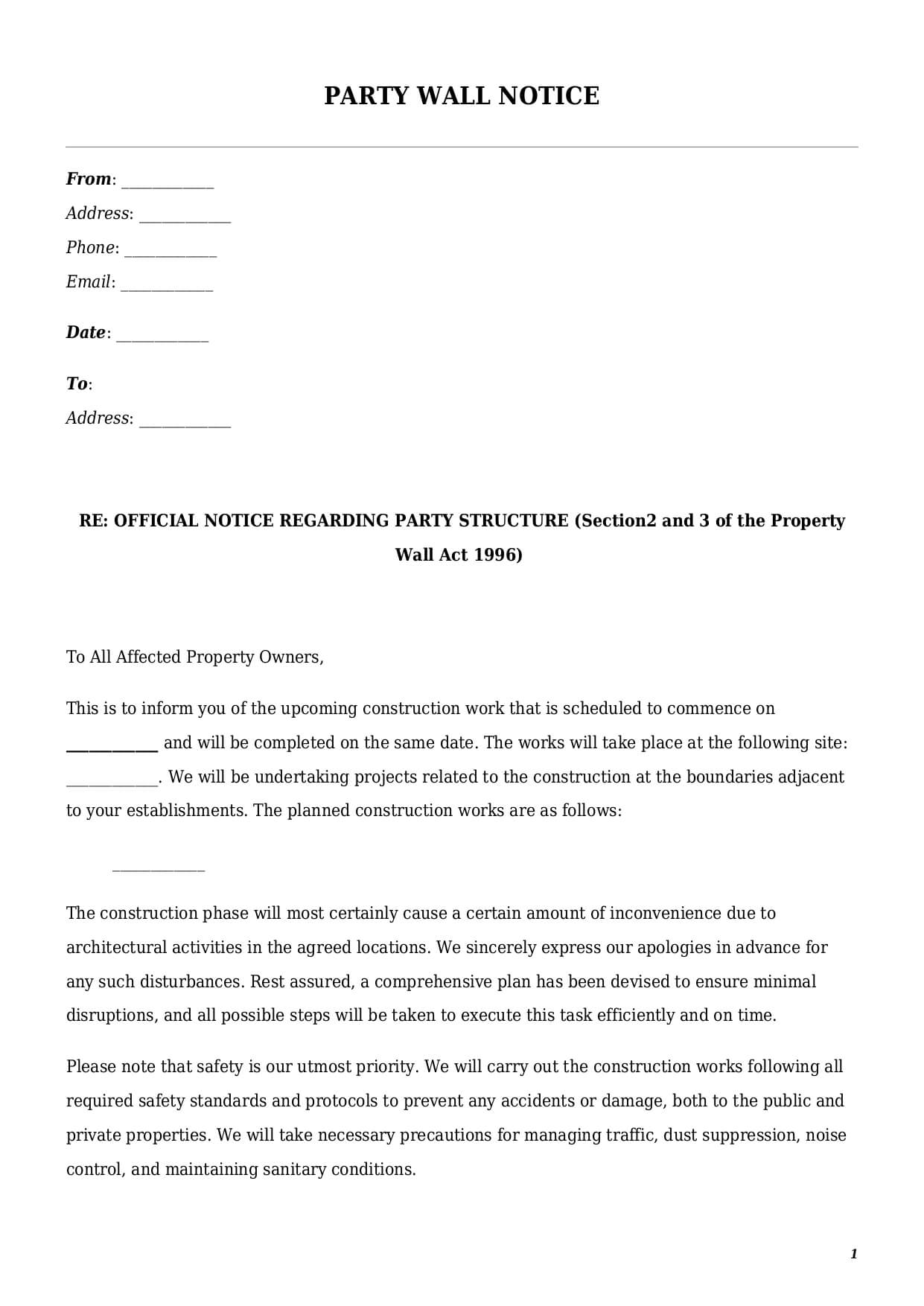
- Party structure notice (Sections 2 and 3 of the PWA 1996). Where you are planning to carry out work directly on an existing party wall — cutting into it, raising it, underpinning it, demolishing and rebuilding it. The minimum statutory notice period for sending this notice is at least 2 months’ notice before the planned date of the commencement of construction works.
- Excavation near a neighbouring building (Section 6 of the PWA 1996). Where you’re excavating within 3 metres of a neighbouring building or structure and going deeper than its foundations, or within 6 metres where a 45-degree line drawn from the bottom of the neighbour’s foundation would be crossed by your excavation, this type of notice must be sent. The minimum required notice period under Section 6 is at least 1 month’s notice before the beginning of the construction works.
What does this party wall notice template cover?
Our template includes the following mandatory elements as per PWA 1996:
- identification and contact details of the sender (builder or homeowner);
- type of the notice (line injunction, party wall structure or excavation);
- information about the minimum statutory notice period;
- description of the proposed works;
- the intended start date;
- the planned duration of construction works;
- plans and sections showing the site and depth of excavation where required (for excavation notices only);
- date of signing this letter; and
- sender’s signature.
Which mistakes do builders commonly make when sending the party wall notice in England?
Sending a party wall notice may appear a straightforward task – however, this is only at a glance. Below is the list of the most common pitfalls builders should be aware of:
Mistake 1: No response from a neighbour means “yes”
What happens after the notice is one of the most misunderstood parts of the PWA 1996. Once the notice is served, the adjoining owner (recipient) has three options:
- consent to the notice
- dissent and appoint their own surveyor
- dissent and agree to a single “agreed surveyor” acting for both parties.
Even if the adjoining owner does not respond to anything, by virtue of the PWA 1996, they are deemed to have dissented, and the survey process should be automatically triggered. If the builder proceeds without obtaining explicit written consent from the adjoining owner, it will automatically inflict the penalties.
Mistake 2: Serving notice too late
Compliance with the minimum required notice period provided by the PWA 1996 is mandatory. The 1–2 month statutory notice periods depend on the types of work and cannot be compromised by the builder. Even if the notice is served with the violation of the minimum required statutory notice period, it will constitute a violation of the PWA 1996.
Mistake 3: Serving a generic “letter to neighbour”
The Act requires specific content depending on the notice type, including:
- identification details of the builder;
- specific timeline for the performance of works, including start and end date;
- description of works to be done;
- details of the construction site;
- brief description of potential inconveniences.
A friendly heads-up letter, however well-intentioned, doesn’t meet the statutory requirements and offers none of the PWA 1996’s protections. In other words, a non-compliant notice, even if sent in compliance with the statutory notice period, constitutes a violation of the PWA 1996.
Mistake 4: Not budgeting for surveyor fees in advance
As the builder or the homeowner, you’re typically liable for both surveyors’ fees in a dispute scenario. Therefore, before starting any construction works or signing a construction agreement, budget all additional expenses correctly and agree in advance which party should cover the additional surveyor costs involved.
Our template can be customised to include the clause defining the split up of additional costs between the parties.
Mistake 5: Skipping a schedule of conditions
Even where a neighbour consents without dispute, recording the pre-works condition of their property in writing (with photographs) protects both sides if a damage question arises later — don’t rely on memory or goodwill months into the project.
How to use this template?
To customise this party wall notice template, follow the steps below:
- Click “Create Document” to open the questionnaire for the template.
- Answer simple questions in the questionnaire.
- E-sign the document online for free.
- Make a payment.
- Instant digital download in Word or PDF format.
- Print out this notice.
- Serve the notice on the adjoining owner—by hand, post, or (where they’ve agreed) email.
- Keep proof of the delivery of this notice. If there is a dispute, you can use it to witness the fact of sending this notice.
- Wait until the full statutory notice period has passed (1 month for Line of Junction/excavation, 2 months for Party Structure works) and you have either received your neighbour’s written consent or resolved any dispute through the surveyor award process.
Try FasterDraft today
We offer bespoke, professional and fully customisable legal document templates for the UK in the range of £6 to £50, depending on the document.
No hidden fees. No “free” subscriptions that turn out to be paid subscriptions. Only a lifetime free licence to use the document is provided.


.svg)
.svg)
 PDF and
 Word
Word