

.svg)
.svg)
Construction Agreement
 PDF and
 Word
Word
This building construction agreement template helps parties to get the payment terms, dispute mechanism and liability position right before the first brick is laid in full compliance with the UK construction law.
Reviews

What is a Building Construction Agreement?
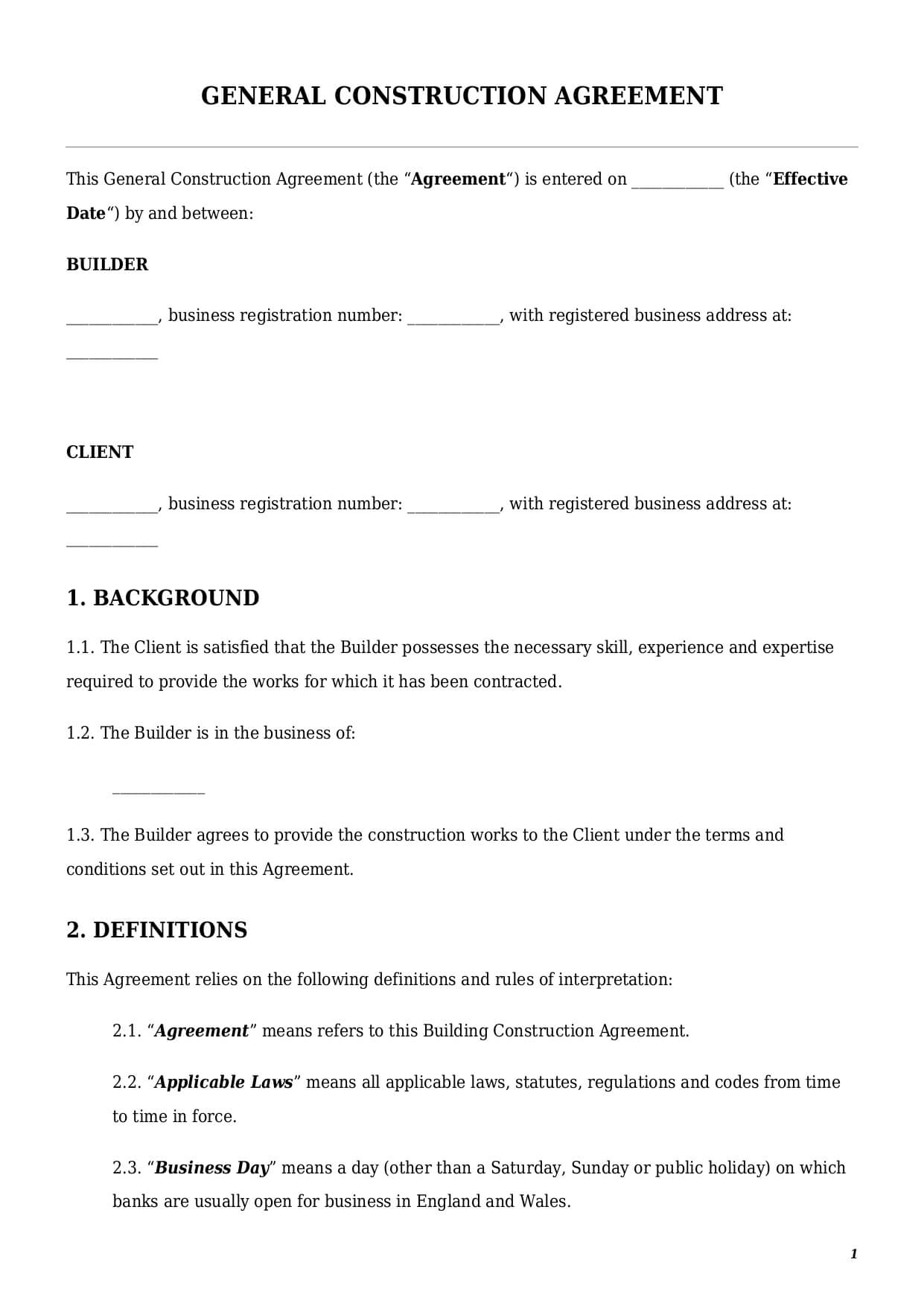
A building construction agreement is the contract between the party commissioning building work and the party carrying it out. The document sets out the scope of works, the price and payment schedule, timescales, defect liability, insurance obligations, and how disputes will be resolved.
A party ordering construction works under the contract is a homeowner, developer or business (client), while the party performing construction works is a contractor or builder.
This document template sets out a solid legal framework for the performance of construction works in the UK in full compliance with the Building Safety Act (BSA) 2022, the Housing Grants, Construction and Regeneration Act (HGCRA) 1996, and the Construction (Design and Management) Regulations (CDM) 2015, as well as separate provisions of the Consumer Rights Act (CRA) 2015.
A building construction agreement does not create employment relations between the parties. If the client is willing to hire a contractor as an employee or worker, an employment contract should be signed instead.
What is the difference between a construction agreement and a services agreement?
Construction works in the UK should be performed under a special construction agreement, rather than a general service agreement. These two document templates differ from each other as follows:
| Construction Agreement | General Service Agreement | |
|---|---|---|
| Purpose | Used specifically for building, renovation, repair, alteration, or other construction-related works. | Used for the provision of professional services. |
| Parties | Client and Builder. | Client and Service Provider. |
| Nature of Work | Physical works. | Professional, technical, administrative, creative, or operational services. |
| Payment Structure | Often based on milestones, stages of completion, and final deliverables. | Usually based on fixed fees, hourly rates, or monthly retainers. |
| Materials and Equipment | The parties define who is responsible for supplying equipment and materials. | Usually provided by the Service Provider. |
| Compliance Obligation | Health and Safety at Work Act 1974, CDM Regulations 2015, site safety requirements, and worker responsibilities. | Usually limited to general compliance with applicable health and safety obligations. |
| Insurance Requirements | Public liability insurance, employers’ liability insurance (where applicable), and professional indemnity insurance. | General liability insurance and/or professional indemnity insurance. |
Why do you need a professional contract agreement template for construction in the UK?
Performance of construction works in the UK cannot be done by virtue of a verbal agreement. A solid and professionally drafted template from FasterDraft helps to:
- Ensure full compliance of the construction contract with the statutory requirements provided by the HGCRA 1996, BSA 2022, CDM 2015 and other industry-applicable regulations;
- Provide bespoke professional legal documents at a fraction of a solicitor’s legal costs.
- Customise professional document templates in minutes, not weeks or months.
- Formalise relations of the parties to ensure the clear list of duties and obligations of either party;
- Summarise best practices of drafting and managing construction agreements in the UK into one complete document.
- Get a solid legal template in PDF and editable Word document format;
- Customise a document template for a fixed one-time fee, without hidden subscriptions and charges;
- Get a document drafted by real lawyers – no AI generate, no generic template, no multijurisdictional documents.
What is being covered by this building construction agreement template?
The template of construction agreement from FasterDraft includes the following essential clauses:
- Scope of works. This section outlines details of the works to be performed, final deliverables, list of milestones, description of the construction site and general requirements for the works to be performed as well.
- Contract price and payment schedule. In this part of the document the parties are able to agree on stage payments, retention percentages, price reviews in case there is a change of order, and valuation methods, structured to comply with the HGCRA 1996.
- Duration of works and completion date. The template also defines the start and end of the works and provisions for extensions of time where delays are outside the contractor’s control and force majeure circumstances, as well as how changes to the scope are agreed upon and priced.
- Limitation of Liability. Our template outlines a typical 12-month contractual liability for post-termination defects in the performed works. The document also includes the list of cases in which the liability under this agreement shall be excluded completely, including loss of profits, loss of sale or business, loss or damage to goodwill, and indirect or consequential loss.
- Insurance requirements. These document templates also define the builder’s obligation to undertake the respective insurance, including public liability and employer’s liability if the contractor has staff, while performing the works under this agreement. The parties can also customise the document by establishing the builder’s maximum liability cap for each claim.
- Dispute resolution. The wording of the template provides the parties’ statutory right to adjudication. The document also provides a by-default clause that the jurisdiction of the courts of England and Wales is exclusive when dealing with disputes arising from this agreement.
- Termination provisions. The document template also provides for circumstances in which termination of this agreement is possible, including for non-payment, insolvency, or persistent breach.
Top 4 compliance requirements to include in your construction agreement template in the UK
Unlike a general service agreement that is being mainly governed by the provisions of the contract law, the performance of construction works in the UK is intensely regulated. A solid and well-written template usually ensures that the final document fully aligns with the provisions of the following acts:
Housing Grants, Construction and Regeneration Act 1996
This is the foundation of UK construction contract law, and it operates differently from ordinary contract law in two important ways. In brief, the HGCRA 1996 provides specific regulations for the following:
- the right to stage payments. Under Section 109 of the HGCRA 1996, any construction contract lasting 45 days or more entitles the contractor to stage payments as work progresses. This is right, is mandatory and does not require the client to agree. All in all, the performance of works could be divided into separate milestones, each subject to separate payment deadlines.
- the right to adjudication. Under Section 108 of the HGCRA 1996, any party to a construction contract has the right to refer a dispute to adjudication at any point, even mid-project. The adjudication does not replace or exclude arbitration or litigation since the parties keep this right to refer the dispute further if necessary. However, an adjudicator’s decision is binding and enforceable in the meantime, which makes it the dominant, practical dispute mechanism in UK construction, far more commonly used than court proceedings. It simply saves parties time and legal costs compared to the standard arbitration or litigation hearings.
This document template meets basic requirements of the HGCRA 1996 to prevent automatic application of statutory provisions provided by the Scheme for Construction Contracts (England and Wales) Regulations 1998.
Building Safety Act 2022
Section 135 of the BSA 2022 provides an extended period of 30 years retrospectively (for defects that arose before the Act’s commencement on 28 June 2022) and 15 years prospectively (for anything after) to claim the builder’s liability for the works performed under the construction agreement. This not only applies for the construction works when building the house from scratch but also for any types of remedial and refurbishment works on dwellings. Sections 130–132 of the BSA 2022 give the High Court power to extend liability to companies associated with the contractor where it’s just and equitable to do so – a mechanism specifically designed to stop developers avoiding liability by operating through shell companies.
All in all, contractors in the UK, when entering the building construction agreement, should be well aware of long-lasting consequences for the faulty works performed under the contract.
Consumer Rights Act 2015
In circumstances when the client is an individual, rather than a business or corporate entity, the builder must comply with the applicable UK consumer laws, including:
- the work should be performed with reasonable care and skill (Section 49 of the CRA 2015);
- the work should be performed within a reasonable time, if no fixed deadline is provided in the original agreement (Section 52 of the CRA 2015);
The 14-day cancellation right when the contract is agreed to at the doorstep, even for substantial building work. If work needs to start within the 14-day window, the homeowner must give express written consent, and the contractor risks losing the right to full payment for work carried out during the cancellation period if this isn’t handled correctly.
What are the common legal mistakes when signing a construction agreement in the UK?
Performance construction works in the UK is a complex task that involves a lot of technical, regulatory, compliance and legal aspects parties should be aware of before signing the contract. The most common legal mistakes and misconceptions about the construction agreements in the UK are the following:
Mistake 1: Services vs Works
Selection of the right type of the document for the performance of the works is essential. A standard master service or general service agreement cannot be suitable to address all the peculiarities of performance of work. Our construction agreement template is a professional document specifically tailored for detailed regulation of the performance of work in the UK.
Mistake 2: Payment terms that don’t comply with the HGCR 1996 Act
Compliance with the HGCRA 1996 is essential; it requires both parties to ensure the final contract does include unfair payment clauses. For example, “Pay when paid” is banned. Section 113 of the HGCRA 1996 prohibits conditional payment provisions that make payment to a subcontractor dependent on the main contractor first being paid by the client. Our construction work agreement template explicitly addresses that prohibition.
Mistake 3: Extension of liability for faulty works
Parties entering a construction agreement in the UK may believe that any claim in relation to the quality of works performed under the contract and affecting the contractor’s liability can be brought up within the first 6 years after the completion of works (Section 1 of the DPA 1972). However, by virtue of Section 135 of the BSA 2022, starting from 2022, the clients should have an extended period of 30 years to bring a claim for liability against the construction provider – 30 years retrospectively (for defects that arose before the Act’s commencement on 28 June 2022) and 15 years prospectively (for anything after).
Such an extended liability is aimed at ensuring that the construction works are done in a professional manner to ensure that the dwelling, upon the construction or refurbishment, is fit for habitation.
The practical implication for this agreement: your defects liability period in the contract (typically 6–12 months) governs the contractor’s obligation to return and fix problems without further charge — but it doesn’t limit the underlying legal liability, which can now persist for well over a decade, regardless of what the contract’s defects clause says. Insurance, retained project records, and clear scope definition all matter more than ever given how long this exposure now runs.
Mistake 4: 14-day cancellation right
If the construction agreement is being signed by the homeowner on the doorstep, the builder should also additionally comply with the Consumer Contracts (Information, Cancellation and Additional Charges) Regulations 2013. In such a case, the provisions of the contract should allow the client to cancel this agreement without any additional charges within the first 14 calendar days after its signing. Many builders are genuinely unaware this applies outside typical distance-selling contexts. Our template considers this possibility by addressing a respective disclaimer right in the text of the document.
Mistake 5: Failure to address CDM 2015 in the contract
A solid and well-written construction work agreement template must understand who holds client duties under the CDM 2015 that imposes health and safety duties on everyone involved in a construction project — client, principal designer, principal contractor, and individual contractors.
For domestic clients specifically (homeowners), the client duties automatically transfer to the contractor (or the principal contractor, if there’s more than one contractor on site) by default, unless the domestic client and principal designer agree in writing that the client will retain those duties themselves. This template’s health and safety clause is drafted around this default transfer, so it’s clear who’s actually responsible without requiring a homeowner to understand CDM 2015 from scratch.
How to use this template?
To get a fully customisable and ready-in-minute construction agreement template, follow a few easy steps below:
- Click “Create Document” to open the template in the FasterDraft editor.
- Answer simple questions in the form.
- Select a template’s format – PDF or Word.
- Sign the document online for free.
- Make a payment.
- Instantly download the final and customisable document in Word or PDF format.
- Both parties sign the document.
- The document is ready for immediate use upon its signing.
Try FasterDraft today
We offer bespoke, professional and fully customisable legal document templates for the UK in the range of £6 to £50, depending on the document.
No hidden fees. No “free” subscriptions that turn out to be paid subscriptions. Only a lifetime free licence to use the document is provided.
Table of content
Frequently Asked Questions (FAQ)
-
1. Do I have the right to adjudication on a domestic building contract?
Section 106 of the Housing Grants, Construction and Regeneration Act 1996 excludes domestic building contracts from the Act’s compulsory adjudication and payment provisions where the work relates to a dwelling that one of the parties occupies, or intends to occupy, as their residence. This exception has been narrowly interpreted by the courts — in Westfields Construction Ltd v Clive Lewis [2013] EWHC 376 (TCC), the High Court confirmed it only protects someone who genuinely occupies or intends to occupy the property as their home, not, for example, an investor renovating a property to let out.
The only way you can make the Housing Grants, Construction and Regeneration Act 1996 apply to your case is to specifically incorporate adjudication rights in the text of the final agreement. Many domestic contracts choose to include adjudication rights voluntarily anyway, since it remains faster and cheaper than court.
-
2. How long can a builder be held liable for defective work?
Under the Defective Premises Act 1972, as extended by the Building Safety Act 2022, up to 30 years are covered for work completed before 28 June 2022 and 15 years for work completed after — far longer than the contract’s own defects liability period, which typically only covers 6–12 months.
-
3. Do I need to give a homeowner a cooling-off period?
A 14-day cooling-off period applies for the construction agreement upon fulfilment of the following conditions: (i) (i) (i) a client is an individual, not a business or corporate entity; and (ii) the contract is being agreed upon at the doorstep or online. In such a case a 14-day statutory cancellation right applies under the Consumer Contracts Regulations 2013, and starting work within that period requires the homeowner’s express written consent.
-
4. What happens if my construction contract doesn't include proper payment terms?
If the provisions of the original construction agreement do not cover certain aspects of the performance of works or simply do not comply with the Scheme for Construction Contracts (England and Wales) Regulations 1998, the latter shall apply automatically and are aimed to override any contradictory clause in the contract. Our template implements a strong compliance with the main requirements of the Scheme for Construction Contracts (England and Wales) Regulations 1998 to ensure the document’s integrity.
-
5. Is employer's liability insurance actually a legal requirement?
Having an employer’s liability insurance largely depends on how your construction business engages staff for the performance of works. If all or some of the staff are workers and employees employed by virtue of the employment contract, in such a case the Employers’ Liability (Compulsory Insurance) Act 1969 requires a minimum of £5 million cover, with criminal penalties for non-compliance. However, if your business engages workers by virtue of the services agreement or independent contractor agreement instead, the employer’s liability insurance is not mandatory.

Looking for something Different?
Start typing to find out our collection of legal documents and contract templates