

.svg) USA
USA.svg) Australia
Australia

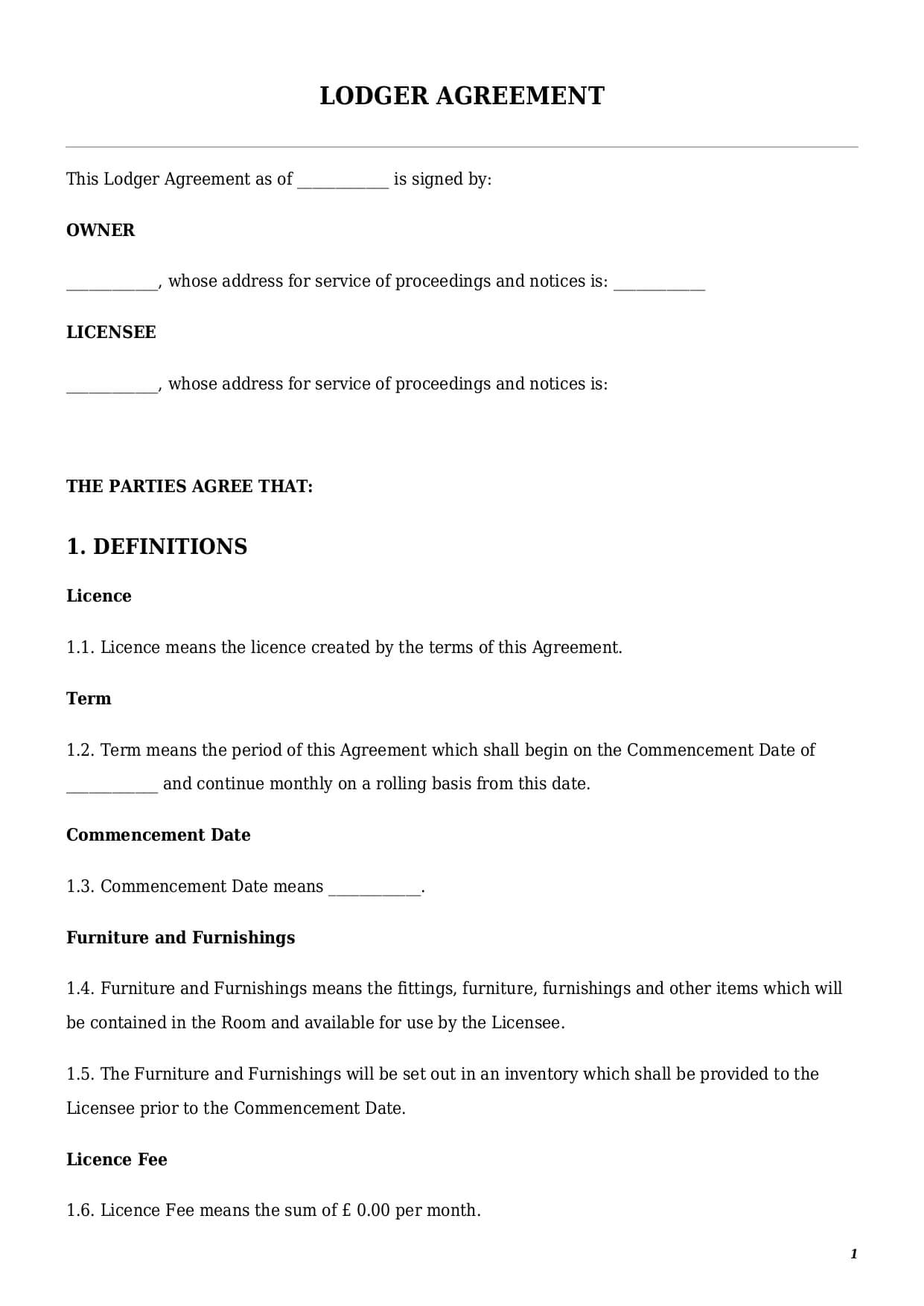
What is a lodger agreement?
A lodger agreement is a type of residential tenancy agreement under which a person gets the right to live and occupy the room in the residential unit, including a house or apartment, in England.
A standard sample lodger agreement defines the scope and type of the granted licence (i.e., the right to occupy), frequency and amount of rent payments in pounds, house rules, obligations of the tenant, etc.
This lodger tenancy agreement is different from an assured tenancy agreement, according to which the tenant occupies the whole residential property.
Who should use this lodger agreement template?
The present template for lodger agreement can be for short-term or long-term occupation of the room for:
- young professional starting their career in England;
- students or graduates;
- property owners of big houses willing to rent spare rooms;
- families taking in lodgers to get extra income;
- foreign workers coming on short-term working visas, etc.
What should be included in this sample lodger agreement?
A lodger agreement is a simple document that defines terms and conditions of licence to occupy the room in the residential unit:
Licence Fee
The contract must define the frequency of paying the licence or rental fee and its amount in pounds. The most common frequency of paying the rent under lodgers’ agreements in the UK is weekly, monthly or fortnightly.
Some landlords may ask tenants to place a deposit in the amount of one week’s or one month’s payment. If this is the case, such a deposit should be placed in one of the government-approved deposit schemes in England.
Duration
A lodger agreement contract in England can be of two different types:
- a fixed-term agreement (the licence shall expire on the agreed end date);
- a rolling basis (the licence continues on a monthly rolling basis until terminated by either party).
It is sometimes common for the parties to include a break clause allowing either party to terminate this lodger agreement earlier by sending a prior written 4 weeks’ notice.
House Rules
Unlike the assured tenancy agreement, under the lodger agreement contact, the property is occupied by both the landlord and the tenant at the same time. Therefore, the establishment of common rules for usage and occupation of the property is essential.
A solid lodger agreement sample shall outline the following:
- cleaning chores;
- garbage placement rules;
- kitchen usage;
- inviting guests and overnight stay;
- parties;
- smoking;
- keeping pets etc.
Utility Arrangement
Under the lodger agreement the tenant shall pay utilities bills only for the room occupied, as well as for the part of utilities consumed in the common areas such as the kitchen or bathroom.
Difference Between a Lodger Agreement and an Assured Tenancy Agreement in England
A lodger agreement sample and an assured tenancy agreement may appear similar, as they both set out rules of renting out residential property in England. However, there is a list of important legal considerations that make the completely different documents.
Right to Occupy vs. Tenancy
Under the lodgers agreement template the tenant only gets the so-called “licence” or permission to occupy the room in the residential property. The licence allows the landlord to access the property any time. The lodgers’ agreement does not protect tenants from eviction.
Under an assured tenancy, the tenant occupies the whole residential space and has extensive rights against “no fault” eviction. The landlord shall get permission from the tenant to access the property.
Duration
According to the new updates of the Housing Act 1988 as of 20th May 2026, the assured tenancy can be concluded only for an indefinite period of time.
A lodgers agreement template offers better flexibility, as it can be concluded for a fixed-term or rolling basis.
Parties
The parties to the assured tenancy agreement are the landlord, who is the owner of the residential property, and the tenant.
The parties to the lodger agreement template UK are the following:
- owner of the property or its tenant under the assured tenancy agreement; and
- licensee (a person who occupies the room).
How to customise this template for lodger agreement with FasterDraft?
To get a fully customisable document template, follow a few easy steps below:
- Click the “Create Document” button.
- Answer simple questions in the form.
- Select a template’s format – lodger agreement template PDF or Word.
- E-sign the document online (for the landlord).
- Make a payment.
The document is ready for immediate download and usage right after the purchase.