

.svg)
.svg)
Letter of Complaint to Neighbour about Nuisance
 PDF and
 Word
Word
This professionally drafted noise nuisance letter helps you to address a barking, party or other type of noise complaint to your neighbours in a professional manner across the UK.
Reviews

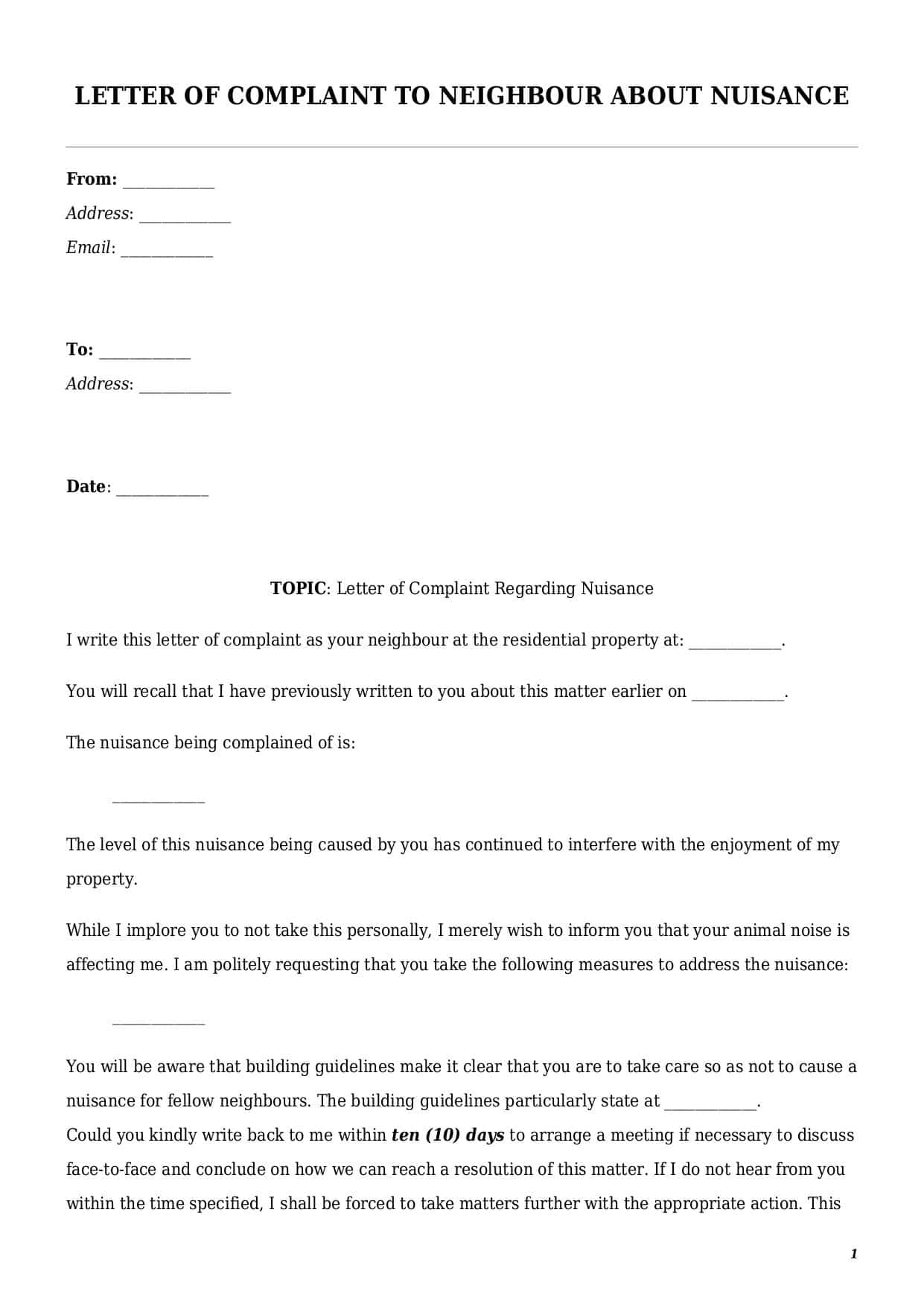
What is a noise nuisance letter template?
A complaint letter to a neighbour about the nuisance, also known as an ASB warning letter, is an informal document that is being sent by one neighbour to another to complain about nuisance in a residential area. The present letter template is being used for dispute resolution without involving courts, solicitors or council intervention.
This complaint letter to a neighbour can be used for various types of nuisance, including:
- party;
- dog barking;
- construction or repair works;
- other types of noise, including anti-social behaviour of neighbours involved.
The present document can be adapted to inform about the nuisance for the first time or on a continuous basis.
Letter to Neighbour vs Letter to Landlord: Complaining About Nuisance
A sample letter of complaint to a neighbour is being used by residents of apartments and houses across the UK to address their concern directly to their neighbour. This document can be used by either owners of a property or tenants. Many individuals prefer to approach their neighbours directly to facilitate the conflict resolution process.
If, however, you are a tenant under a tenancy or lodger agreement, you may prefer to address a problem indirectly by complaining first to your landlord or property management company. In such a case, a letter to complain to a landlord about the nuisance should be used instead.
How do I write a complaint letter to my neighbour?
In the UK there is no standard format to be used for a nuisance complaint letter. A good example of a sample letter of complaint to a neighbour must include the following:
- Sender’s Details. Include your full name and address of a property where you currently reside as well as contact details such as telephone number or email address.
- Type of Nuisance. Explain in detail the type of noise that bothers you, as well as how it interferes with your daily life and routine.
- Reminder. In case this is not the first complaint, include the reference about the same by pointing the date of the most recent complaint.
- Residential Association Rules. If the neighbours in your community are subject to certain council regulations or residents’ association rules, in such a case include a clause that is being violated by the nuisance.
- Solution. Additionally, you may also include a solution of how situation can be resolved in an amicable way.
- Timeframe. A solid ASB warning letter template should also define a timeframe within which the matters should be resolved. There is no particular timeframe established in the UK. However, it is common to set up a 7-10 day period for a dispute resolution.
- Legal Consequences. The recipient of such a letter should also be duly informed about the consequences should there be no improvements.
- Date & Signature. Once the noise nuisance letter is ready, the sender must sign and date it.
3 Common Mistakes to Avoid
Mistake 1: Going straight to a threat of legal action
Using violent or threatening language in the text of a complaint letter to neigbour is not the right strategy. Instead, a cooperative approach involving amicable resolution of a conflict may lead to better results.
Mistake 2: Not keeping evidence of the problem before sending the letter
We recommend attaching as much supporting documentation as possible along with your letter. If this is a template letter to neighbours about building works, attach photos of construction sites, for example. If the dispute is being brought to the council in the future, this evidence will be a strong legal point.
Mistake 3: Sending the wrong recipient
If the neighbours you want to complain to are the tenants, perhaps the better way to resolve the dispute is to complain directly to their landlord or a property management company. Sometimes sending a complaint indirectly may prevent uneaseness and not spoil relations.
Why use FasterDraft for nuisance ASB warning letter?
By customising this template for FasterDraft, you get the document with the following benefits:
- a letter written in a professional language;
- a document available for instant digital download;
- a template that can be customised for various types of noise, including barking dogs, ASB warnings, parties and building works;
- a template created by qualified UK solicitors and not generated by AI;
- a document that can be reused for multiple complaints in the future.
How to use this template?
To get a fully customisable UK letter to neighbour template, follow a few easy steps below:
- Click the “Create Document” button.
- Answer simple questions in the form.
- Select a template’s format – complaint letter to neighbour PDF or Word.
- E-sign the document.
- Make a payment.
The document is ready for instant download immediately after the purchase.
Table of content
Frequently Asked Questions (FAQ)
-
1. Do I have to write to my neighbour before contacting the council about noise?
No. Sending a sample letter of complaint to a neighbour is not a prerequisite for contacting the council. You can complain directly to the council from the start. However, many tenants and property owners prefer to mitigate conflicts with their neighbour amicably.
-
2. What counts as a "statutory nuisance" under UK law?
A statutory nuisance under the Environmental Protection Act 1990 is something — typically noise, smoke, smell, or similar — that is either prejudicial to health or unreasonably interferes with your enjoyment of your property and which is ongoing or likely to recur. A single incident is highly unlikely to count as a statutory nuisance.
However, repetitive incidents may result in the violation of local council regulations related to nuisances.
-
3. Is a barking dog automatically a statutory nuisance?
No. A single incident cannot result in a statutory nuisance. A dog barking should be persistent, prolonged, or frequent enough to disturb your daily enjoyment of the property.

Looking for something Different?
Start typing to find out our collection of legal documents and contract templates