

.svg)
.svg)
Letter Before Action (England and Wales)
 PDF and
 Word
Word
Set out your claim properly, give the other side a fair chance to pay up, and protect your right to costs if you end up in court.
Reviews

What is a letter before action in the UK?
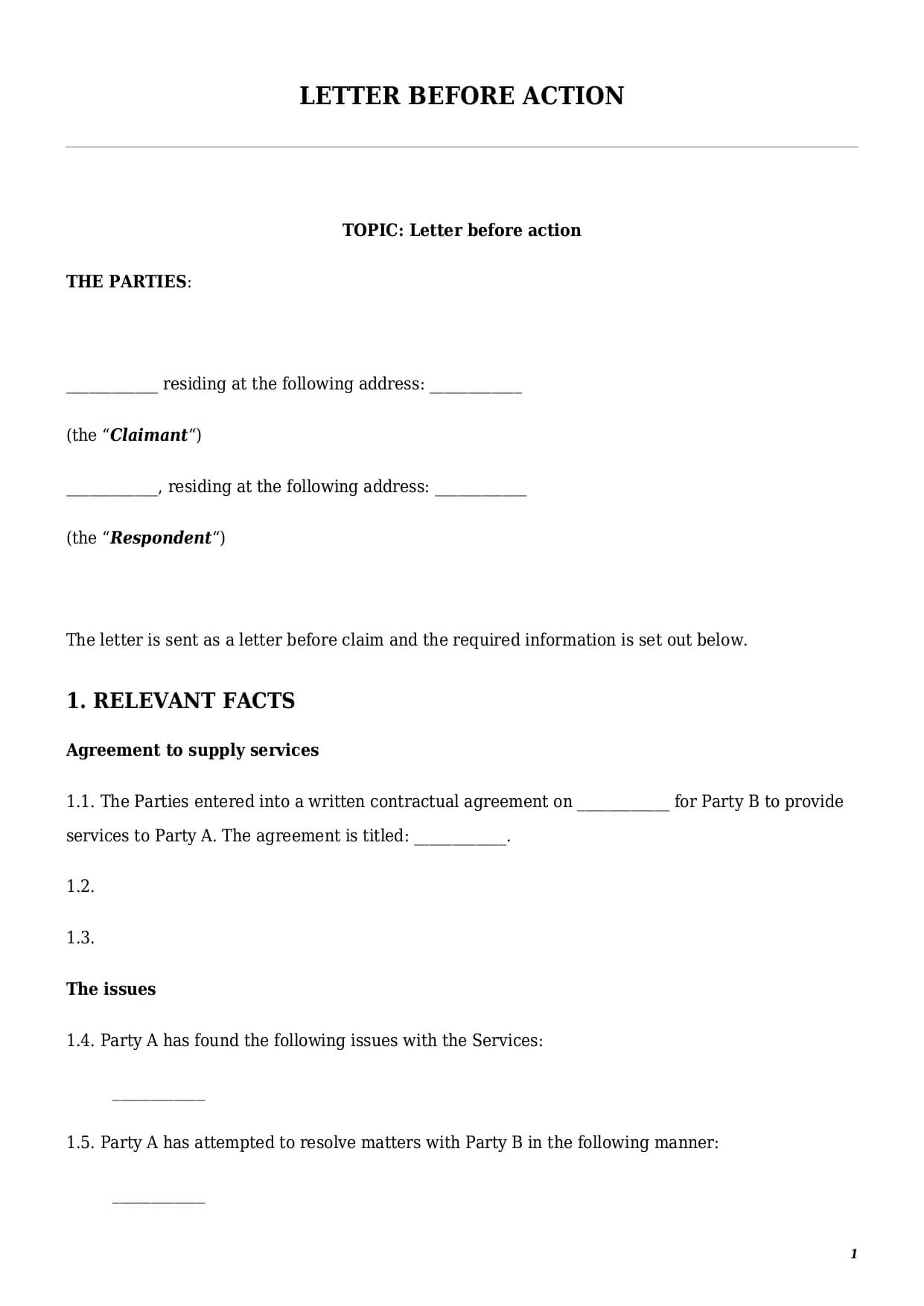
A letter before action, also known as a letter before small claim, is the formal written notice sent to the person or business you’re in dispute with before you issue court proceedings. The present template is being used for the claims up to £10,000 dealing with:
- faulty goods;
- unsatisfactory services;
- unpaid bills or money owed under the contract;
- landlords fail to repair the property under a residential tenancy agreement; or
- in case of a personal injury.
The present small claims letter before action helps to set out who you are, what happened, what you’re claiming, and how much time the other side has to respond before you go to court.
The present template is applicable for all small claims in England and Wales only.
In which circumstances should you not use this letter-before-action template?
This template can only be used in specific circumstances, including:
- Claims above £10,000. This threshold includes not only the amount of the main claims but also any other additional expenses, incurred interest or other costs the sender is willing to compensate. For example, when the sender is claiming an amount of £8,000 for unpaid goods only, then this claim falls within the small claim requirement. If, however, the sender is willing to add £2,500 for loss or damages incurred due to unpaid goods, in such a case a total amount of the claim cannot be covered by the “small claim” track.
- Time limitation. If the cause of action arose more than 6 years ago, this claim before action letter cannot be used.
- A specific pre-action protocol exists. For certain types of the claim, there is a specific pre-action protocol which must be followed by the parties. Therefore the present letter cannot be used. The specific claims which are not covered by this letter are professional negligence, personal injury in road traffic accidents, judicial review, housing despair, defamation, construction and engineering, etc.
Why choose FasterDraft for this letter before action template?
By customising this letter template with FasterDraft, you get the following benefits:
- Ready in minutes. You can customise a professional and tailored document to your specific needs in minutes without leaving your home.
- Saves legal costs. Get a professional and bespoke document at a fraction of the solicitor’s legal costs.
- Complies with UK laws. This document template is drafted in line with the Limitation Act 1980, CPR Part 27 — the Small Claims Track and Pre-Action Protocol for Debt Claims.
- Build credibility from the outset. A letter with a vague, unexplained figure damages your position. This template prompts you to break down exactly what you’re claiming and why, which strengthens your case if it does end up before a judge.
What is being covered by this letter before action sample?
The present letter template covers all necessary information, including:
- Parties Involved. Full names and addresses of both parties involved in a dispute.
- Subject Claim. The letter allows you to select the type of the claim – faulty goods, unsatisfactory services, unpaid bills, etc.
- List of facts. This section outlines if there is an ongoing contractual relationship between the parties, the reason for the claim, the date of the incident, etc.
- Sum of claim. The letter allows you to state the total amount of the claim in pounds, along with any accrued interest, when applicable.
- Clear statement of claim. In this part of the letter the sender outlines their demand – to pay the invoice, provide services again, and refund for goods.
- Deadline. This is not the date by which the recipient must satisfy the claim. In fact, this is the date by which the recipient’s answer should be received.
- Warning about consequences. Here the sender must inform about the upcoming steps – for example, the start of the Alternative Dispute Procedure, filing a court claim, etc.
- Additional document. If the sender is willing to attach any additional documents, they must be listed at the end of this letter.
- Date and Signature. The sender must put the date and their signature.
What factors will the court consider when reviewing the letter before action?
Once the sender has not received any answer from the recipient, they may proceed with submitting the claim directly to the court. However, be aware of the following things that may affect the court proceeding:
- The claim is older than 6 years. The provisions of the LA 1980 provide that the claim under a simple contract or debt claim can be brought within 6 years from the date of the cause, unless there are certain statutory limitations. If your claim is older than 6 years from the date of its cause and is not covered by any statutory exception, the court may not proceed further.
- Additional costs. If the total amount of the claim is £10,000 and lower, under the CPR Part 27 — the Small Claims Track — the parties can enjoy reduced costs for legal proceedings. If the claim is above that threshold, the sender may be exposed to a costs order they hadn’t budgeted for.
- Missing required protocol documents. For debt claims addressed by the business to individuals, forgetting the Reply Form, Information Sheet, or Financial Statement — all mandatory under the Debt Pre-Action Protocol — is one of the most common mistakes. In such a case, a claim itself is considered invalid and is being returned by the court back to the sender.
- The wrong pre-action protocol was used. Sending a general letter before claim where the Debt Pre-Action Protocol actually applied (or vice versa) is a genuinely common mistake — and courts can treat this as non-compliance in its own right, even though a letter was technically sent.
How long should I wait after sending this letter before action?
The duration of the waiting period depends on the type of the claim:
- for a landlord’s failure to undertake repairs – within 20 calendar days after the receipt of the letter;
- for the purchase of faulty goods – within 14 days of receipt;
- for the purchase of faulty services – within 14 days of receipt;
- for unpaid bills or money owed – any deadline defined by the sender;
- for personal injury that occurred due to an incident – any deadline defined by the sender.
In case there is a personal injury or unpaid bills or money owed to the owner, there is no statutory required minimum waiting period, therefore the sender may choose the one they prefer. However, considering in general the court practice of English courts, it is recommended to make a deadline period “reasonable” and sufficient for the recipient to have enough time for the response.
When, however, the letter is being sent by business to an individual, in such a claim that minimum standard reply period of 30 days to respond must apply. This is a direct requirement of the Pre-Action Protocol for Debt Claims.
How do I make this letter template work for me?
To get a fully personalised letter before action template, follow a few easy steps below:
- Click the “Create Document” button.
- Answer simple questions in the form.
- Select a template’s format – PDF or Word.
- E-sign the document online for free.
- Make a payment.
- The document is ready for immediate digital download right after the purchase.
- Print out the document.
- Send the letter to the recipient (by post, standard mail delivery, email or delivery in person).
- Wait for the answer.
If there’s no answer by the specified deadline, you can file a court dispute or apply for alternative dispute resolution (ADR).
Table of content

Looking for something Different?
Start typing to find out our collection of legal documents and contract templates