

.svg) USA
USA.svg) Australia
Australia

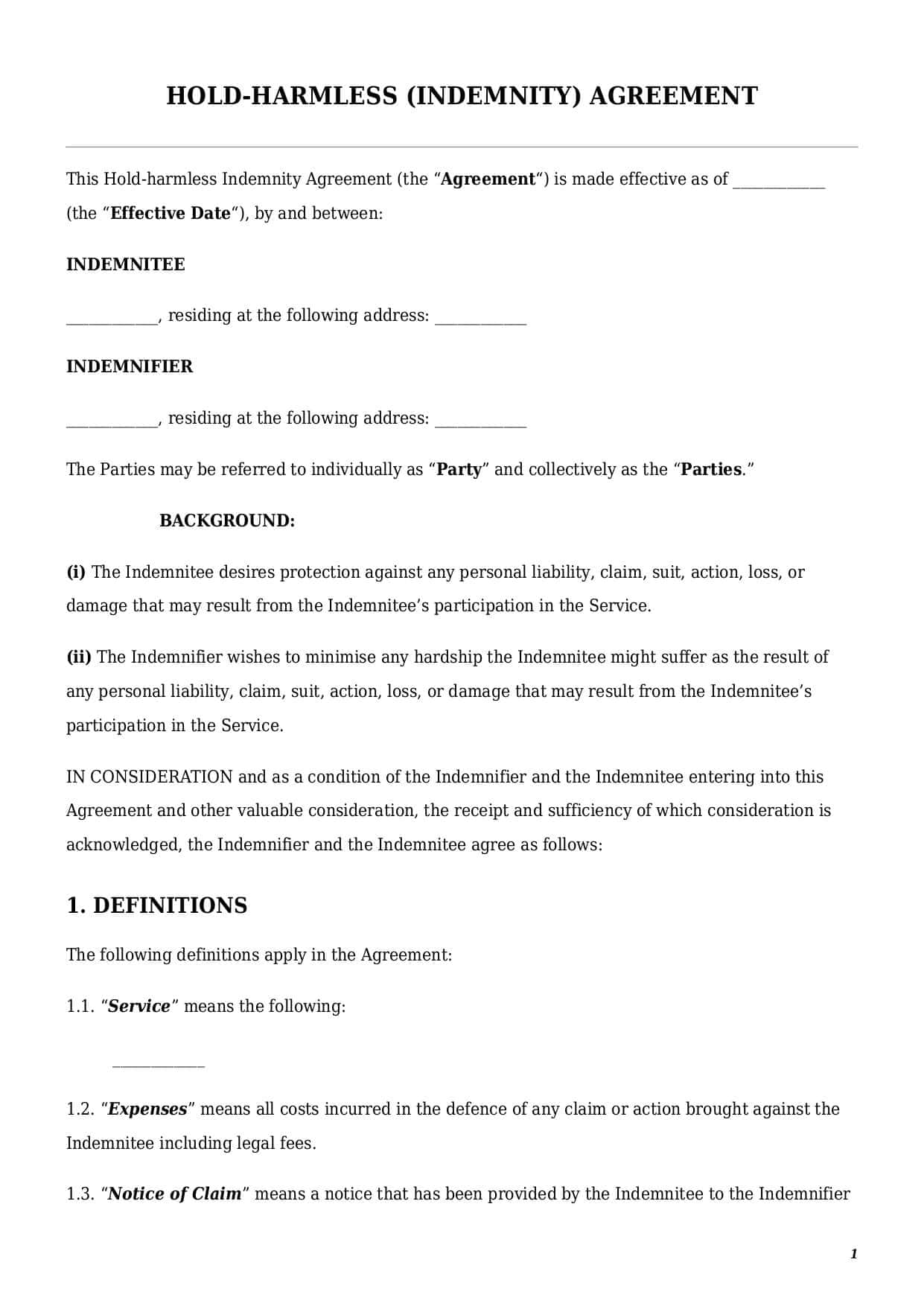
In which cases should you use a professional hold-harmless (indemnity) agreement?
A solid and well-drafted hold-harmless agreement is a helpful legal tool for various real-life situations, including:
- Running or hosting an event during which participants or attendees may face some risk (for example, a sports competition, charity marathon, training under the personal training agreement);
- Renting out equipment for your business, such as machinery, and protecting yourself from claims arising out of how a hirer uses it;
- Leasing commercial property under a business property lease agreement and protecting yourself as a tenant against the unexpected risk of loss or damage to the property;
- Engaging volunteers for a charity, community group, or informal organisation, where volunteers take part in activities carrying some risk;
- Engaging workers under a construction agreement, including maintenance, repair or similar services, where you want clarity on who bears responsibility if something goes wrong;
- Providing any sort of professional services under respective service agreements to limit a service provider’s liability for unexpected risks;
- Allowing third parties onto your premises for a specific purpose, including filming, photography, a one-off activity, or access for work;
- Business-to-business arrangements where one party wants the other to bear responsibility for losses arising from their actions or equipment;
- Entering a sale-purchase transaction of shares or other personal property, etc.
Why should you choose this template from FasterDraft?
By customising this hold-harmless (indemnity) agreement with FasterDraft, you get the following benefits:
- UK legal framework. This template fully aligns with the legal requirements and statutory limits of the UK legal framework, including the Unfair Contract Terms Act (UCTA) 1977, the Consumer Rights Act (CRA) 2015, and the case law of the UK courts.
- Applicable throughout Great Britain. You can customise this template to indemnify the other party in England, Wales or Scotland. This document, however, cannot be used for Northern Ireland, as it has the Unfair Contract Terms (Northern Ireland) Order 1987, which separately applies here.
- Precise and clear legal wording. The wording of the present template ensures the absence of any ambiguities that can create various interpretations in the future.
- Significantly reduces legal costs. Our template is created by qualified legal professionals and lets you save up legal costs compared to drafting this document template from scratch by a solicitor for £ 170–£ 230 pounds.
- No blanket liability exclusions. This template is built to survive the scrutiny of UK courts and their reasonableness test when it comes to assessing the limits of liabilities and scope of “hold harmless”.
What is a hold-harmless (indemnity) agreement?
An indemnity agreement is a contract in which one party agrees not to hold the other party legally responsible for specified losses, injuries, or damages arising from a defined activity, transaction or services and agrees to compensate the other party for losses they incur as a result. This template is built around “indemnity” and “hold harmless” clauses, allowing parties to reinforce the intention not to pursue a claim in the first place as well as to clarify the promise to compensate for defined losses.
The present template can be used to indemnify and hold harmless against liability arising from an activity, event, provision of services or transaction.
This document is suitable for application in England, Wales and Scotland.
What should a standard hold-harmless agreement template cover?
A standard UK indemnity agreement template includes a number of important legal clauses:
- identification details of the parties;
- scope of indemnification;
- if the parties plan to contract out negligence, this should be expressly stated in a separate clause;
- if the party’s liability should be limited to a specific amount, that amount should be stated in pounds;
- if the party anticipates the risk of criminal proceeding, in such a case the indemnitee party can also be indemnified against a criminal proceeding;
- an express carve-out should be included to preserve liability for death or personal injury caused by negligence;
- third-party claims provisions, addressing how claims from people outside the agreement are handled;
- governing law and jurisdiction clause defining which laws shall apply to the provision of this agreement and which courts are eligible to hear the dispute.
Consider these Legal Mistakes Before Signing this Agreement in the UK
Before entering a hold-harmless (indemnity) agreement in the UK, the parties must consider the following:
Identify whether the other party is a consumer
If you are a seller or service provider who enters into any type of contract with a consumer, the draft of a future indemnity agreement should be checked against the CRA 2015. In fact, consumers in the UK are treated more favourably, as they do not have enough negotiating power when entering a contract for services and goods. That’s why the fairness assessment test (Section 62 of the CRA 2015) and additional scrutiny (Section 65 of the CRA 2015) shall apply, in particular:
- no exclusion of liability for death from negligence; and
- no exclusion of liability for personal injury from negligence.
Statutory limits that cannot be contracted out
There are a number of statutory obligations the liability for which cannot be limited or excluded. These limits are:
- employer’s duties with regard to the health and safety of employees and workers defined in Sections 2 and 3 of the Health and Safety at Work etc. Act (HSWA) 1974. For example, reasonably practicable, safety and absence of risks to health in connection with the use, handling, storage and transport of articles and substances; maintenance of safe work conditions, etc.
- employer’s duties with regard to the health and safety of individuals other than employees who have access to the premises (Section 4 of the HSWA 1974). For example, this clause shall apply to volunteers who are engaged by profit or charity organisations in the UK.
- employer’s duties to insure against their liability for personal injury to their employees under the Employers’ Liability (Compulsory Insurance) Act 1969.
- any person’s liability for death or personal injury resulting from negligence (Section 2(1) of the UCTA 1977).
- any person’s liability to lawful visitors, meaning attempts to exclude liability to visitors for death or personal injury caused by the state of your premises (Section 2(1) of the UCTA 1977).
Confirm what risks the agreement is genuinely trying to cover
Ensure the wording of the final document is clear. According to the famous case Canada Steamship Lines Ltd v The King [1952] AC 192, the Privy Council set out the leading test — if a clause doesn’t expressly reference negligence and its wording is ambiguous as to whether negligence is covered, any doubt is resolved against the party seeking to rely on it. It means that the court is not ready to infer the existence of certain exceptions. If the wording of the liability exception is not clear enough, it means that you are not being exempted from any liability at all.
Witnessing
If an indemnity under this agreement is given without any valuable consideration, including payment or provision of services, in such a case this agreement must be executed as a deed. It means, that the parties’ signatures must witnesses by a signature of an additional witness. Along with that, a witnesses’ name and signature should also be mentioned in the document.
“Hold Harmless” vs “Indemnity”
This is genuinely the last essential element parties should understand before signing an indemnity agreement in the UK. You may have probably found on the Internet various templates titled “Hold Harmless Agreement” or “Hold Harmless Indemnity Agreement” and similar.
It is worth understanding that the “hold harmless” concept is not a defined legal term under English law. On the other hand, an indemnity clause, by contrast, has a well-established body of English case law behind it, including the Canada Steamship Lines and Smith v UMB Chrysler, giving far greater certainty about how courts will interpret it, provided the wording is precise.
Our template of indemnity agreement pairs the two clauses together.
How to sign and use this agreement template?
To get a fully customisable document template, follow a few easy steps below:
- Click the “Create Document” button.
- Answer simple questions in the form.
- Select a template’s format – PDF or Word.
- E-sign the document online for free.
- Make a payment.
- The document is ready for instant digital download immediately after the purchase.
- Print the document out in two copies.
- Read the document carefully.
- Make both parties sign the document in two copies.
- Each party’s signature must be witnessed by at least one witness.
- Each witness must put their signature and full name in the text of the document.
- Either party must keep a signed copy of the hold-harmless agreement for their personal record.
This article is reviewed by Daria Turanska, a lawyer with 15 years’ contract drafting experience