

.svg)
.svg)
Director Service Agreement
 PDF and
 Word
Word
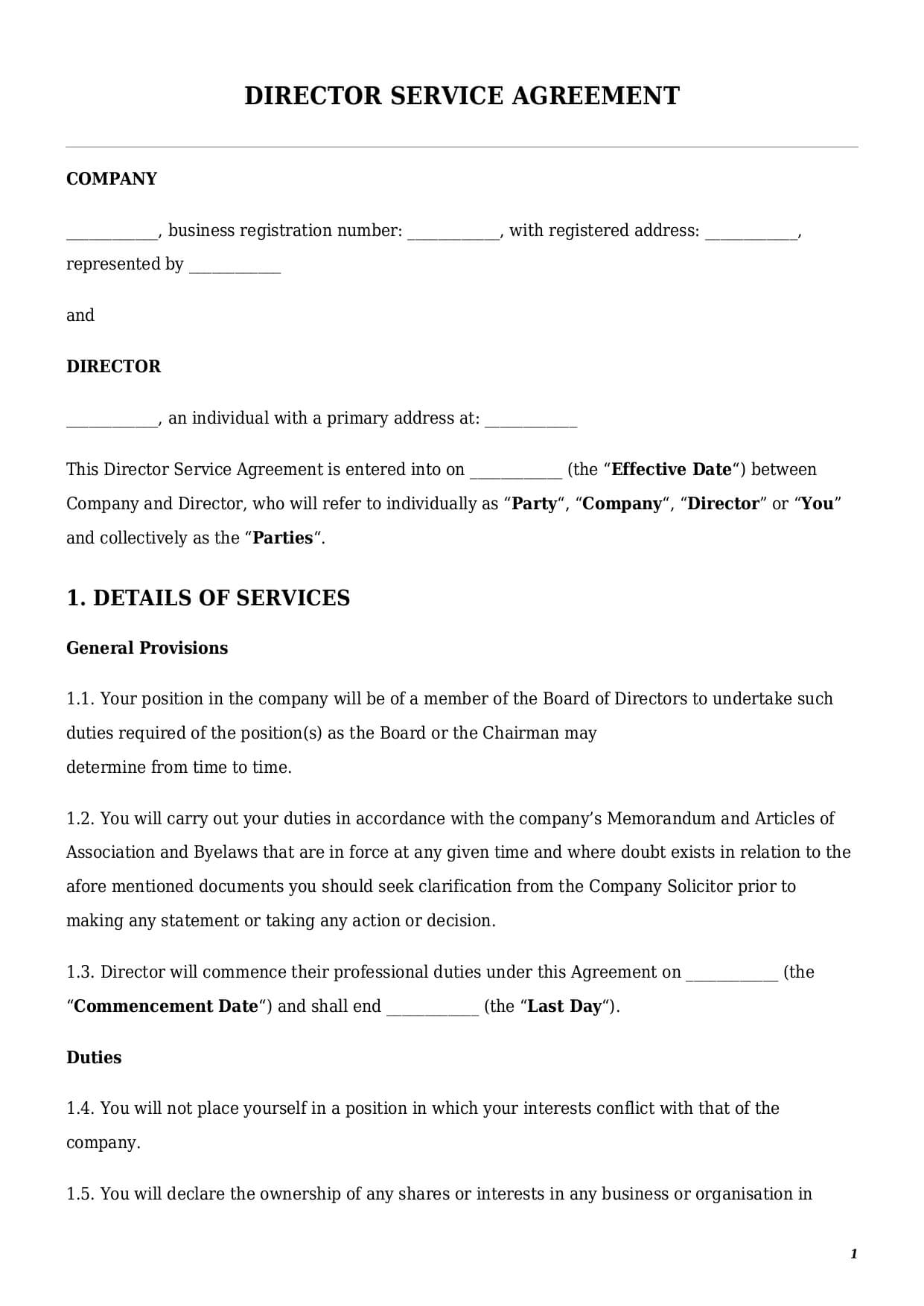
This director service agreement facilitates the appointment of a director for the UK limited company in compliance with the Companies Act 2006, HMRC and Companies House practices.
Reviews

What is a director service agreement?
A director service agreement is the contract between the company and the director that sets out the terms on which the director serves as a director of a company, including their role, remuneration, duration, termination rights, and post-termination restrictions.
By virtue of Section 227 of the Companies Act (CA) 2006, a director can be engaged by the company based on a “service contract”, which includes the following:
- a contract of employment;
- a contract for services; and
- a letter of appointment as director.
This template is specifically designed for the appointment of the company’s director based on the contract for services. If you are looking to establish employment relations with a director, a separate employment contract template should be used instead.
Employment Contract vs. Services Contract — which is right for a UK limited company?
This is one of the most consequential decisions a company makes when appointing a director. The selected type of document will have different tax implications, rights and duties, and procedures for the termination of relations.
| Contract of Employment (Contract of Service) | Contract for Services |
|---|---|
| The most commonly used type of engagement for executive directors. | Typical for non-executive directors, portfolio directors, or directors acting via a personal service company. |
| Provides statutory employment protection under the Employment Rights Act (ERA) 1996. | Offers flexibility of termination for both parties. |
| Provides statutory protection against unfair dismissal after two years of service (Section 94 of the ERA 1996). Starting from 1st January 2027 – protection applies after 6 months of services. | No statutory protection against unfair dismissal for a director. |
| Offers paid sick leave, annual leave entitlement, employer-paid National Insurance contributions, and other statutory employment benefits. | The contract can be paid or unpaid. |
An employment contract can be a more suitable option when the company is willing to engage a director for the long term and to prevent him/her from working simultaneously for other companies. On the other hand, a contract for services is more tax efficient for the company as well as preserves the independent contractual status of both parties involved.
Why does having a professional director service agreement matter?
A director’s duties in a UK limited company have two layers:
- statutory level – director’s duties are defined in Sections 171-177 of the CA 2006; and
- contractual level – private clauses dealing with payment, duration, trips abroad, additional incentives and bonuses, etc.
A properly drafted agreement should acknowledge both layers of duties. Besides that, having a written agreement is necessary:
- For due diligence procedure. If the company goes public, is listed or is being sold, having written contractual arrangements for directors is required under the UK Corporate Governance Code (2024).
- To avoid disputes. Once the document is terminated, parties may have a dispute regarding the post-termination rights as well as notice periods.
- For IP protection. Disputes over created IP rights in the course of directorship are common where there is no clear wording regarding who owns what in the company.
- For malus/clawback clauses. If a director is acting dishonestly or in breach of fiduciary duty, the company may immediately stop the directorship. However, a written agreement allows imposing a mechanism for reducing or recovering bonuses or incentives paid to the director before (Provisions 37-38 of the UK Corporate Governance Code 2024).
Important compliance requirements governing the appointment of the director in a UK limited company
Depending on the type of company, parties involved in the appointment of a new director under the director service contract should be aware of the following important compliance requirements:
Exclusion of liability limitation
Under the CA 2006, the director has a set of default fiduciary duties which cannot be compromised, including the following:
- the duty to promote the success of the company (Section 172);
- the duty to avoid conflicts of interest (Section 175);
- the duty to declare an interest in a proposed transaction (Section 177).
Exclusion of liability for the breach of any of these duties in the provisions of this director services contract is void by virtue of Section 232 CA 2006.
Companies House identity verification
Starting from 18 November 2025, the newly appointed directors must undergo mandatory identity verification under the Economic Crime and Corporate Transparency Act 2023. Failure to undergo such a verification is a ground for refusal of appointment even if the contract is already signed.
Disqualification of the director
Under the Company Directors Disqualification Act 1986, the law allows a director to be disqualified from serving as a director of the company for a defined period of time based on the court’s decision. Before the appointment, the company must check if there is any such ruling regarding the potential candidate.
Non-compete limitations
Whether the director provides their services directly or through the professional service company, it is worth checking if there is any ongoing non-compete agreement preventing the director from working for your company.
Charity Commission Consent
If the director is being appointed to the registered charity, in such a case, prior consent for the appointment is required from the Charity Commission.
Board Approval
Before signing the director services agreement, a separate board resolution appointing the director and approving contract terms is required. Such an approval and its procedure are being defined in the company’s Articles of Association (a director is usually restricted from voting on their own contract unless the Articles say otherwise).
Shareholder Approval
When the duration of the director service agreement is for more than 2 years, in such a case prior shareholder’s approval is mandatory before the appointment (Section 188 of the CA 2006).
Which essential clauses should every director service contract include?
A well-drafted director service contract must cover the following:
- full details of the company and director;
- appointment details such as start and end date, job title;
- termination procedure, including grounds for immediate termination of appointment, and notice period;
- If the contract is paid, details of salary, bonuses, incentives,
- IP standard waiver clause transferring full rights for created IP to the benefit of the company;
- confidentiality clause (supported by an additional signed non-disclosure agreement);
- list of statutory duties under the CA 2006, including conflicts of interest and related-party dealings, fidelity duty;
- list of contractual duties;
- additional covenants, including prior approval from shareholders, Companies House filing, etc.;
- governing law – usually the law of the jurisdiction where the company is registered (England and Wales, Scotland or Northern Ireland).
Common mistakes to avoid when drafting a director service contract
By knowing these most common mistakes, you reduce the likelihood of non-compliance with the UK legal framework significantly.
Mistake 1: Assuming duties are “created” by the contract.
The contract cannot override or contradict the statutory duties of a director defined in Sections 171–177 CA 2006. They should exist independently.
Mistake 2: Leaving director’s status ambiguous
The wording of the final document must clearly outline if this is an employment contract or services contract. Vague wording makes unclear the company’s obligations regarding whether additional employment statutory entitlements under the ERA 1996 should be granted to the director.
Mistake 3: Forgetting about non-compete limitations
Once the contract expires, the director most probably will find “another job” and, possibly, one with your competitor. To prevent this, it is better to sign a non-compete agreement for business well in advance, in addition to the present director services agreement.
Mistake 4: Forgetting about insurance
A director’s liability cannot be excluded in full, especially when it comes to the director’s statutory duties defined in the CA 2006. Therefore, valid professional insurance is always a good solution to protect against risks and liabilities.
How to use this template for the appointment of a director?
Follow the instructions below:
- Click the “Create Document” button to open the questionnaire.
- Answer simple questions in the form.
- Select a template’s format – PDF or Word.
- E-sign the document online (for the company’s representative).
- Make a payment.
- Download the document template in PDF or Word.
- Print it out and check for the correctness of the inserted information.
- Seek the board decision to approve the contract.
- Make the director and the company’s representative sign the agreement.
- Undergo necessary compliance checks (e.g., Companies House mandatory identification).
This description is provided for general information about the legal framework applicable to director service agreements in the UK. It is not legal advice. Company- or sector-specific circumstances (particularly regulated industries, listed companies, and cross-border appointments) may require bespoke legal review.
Table of content
Frequently Asked Questions (FAQ)
-
1. Is a director automatically classed as an employee under UK law?
No. Employment status depends on the substance of the relationship (control, personal service, mutuality of obligation), not the job title. Many non-executive directors are engaged as self-employed office holders or through their own company rather than as employees.
-
2. Is a written service agreement legally required for every director?
There’s no blanket statutory requirement for every director to have a written contract, but it’s strongly recommended, and it becomes a formal requirement in substance once the guaranteed term exceeds two years, since that triggers the shareholder approval process under Section 188 CA 2006.
-
3. Can someone be both an "employee" and a "director" at the same time?
Yes — this dual status is common for executive directors, who hold statutory office under the Companies Act while also being an employee under a separate or combined employment contract.
-
4. Can a company contract out of a director's fiduciary duties?
No. The general duties in Sections 171–177 CA 2006 can’t be diluted beyond what the Act itself permits, and provisions purporting to exempt a director from liability for breach of duty are generally void under Sections 232 CA 2006, aside from permitted indemnity and insurance arrangements.
-
5. Is this template suitable for non-executive directors and overseas-resident directors?
The template is built around the core Companies Act and applicable to any UK director appointment, with clauses that can be adapted for both situations. Overseas-resident directors may also need to consider immigration/work-authorisation requirements and cross-border tax issues, which sit outside the scope of the template itself.

Looking for something Different?
Start typing to find out our collection of legal documents and contract templates