

.svg) USA
USA.svg) Australia
Australia

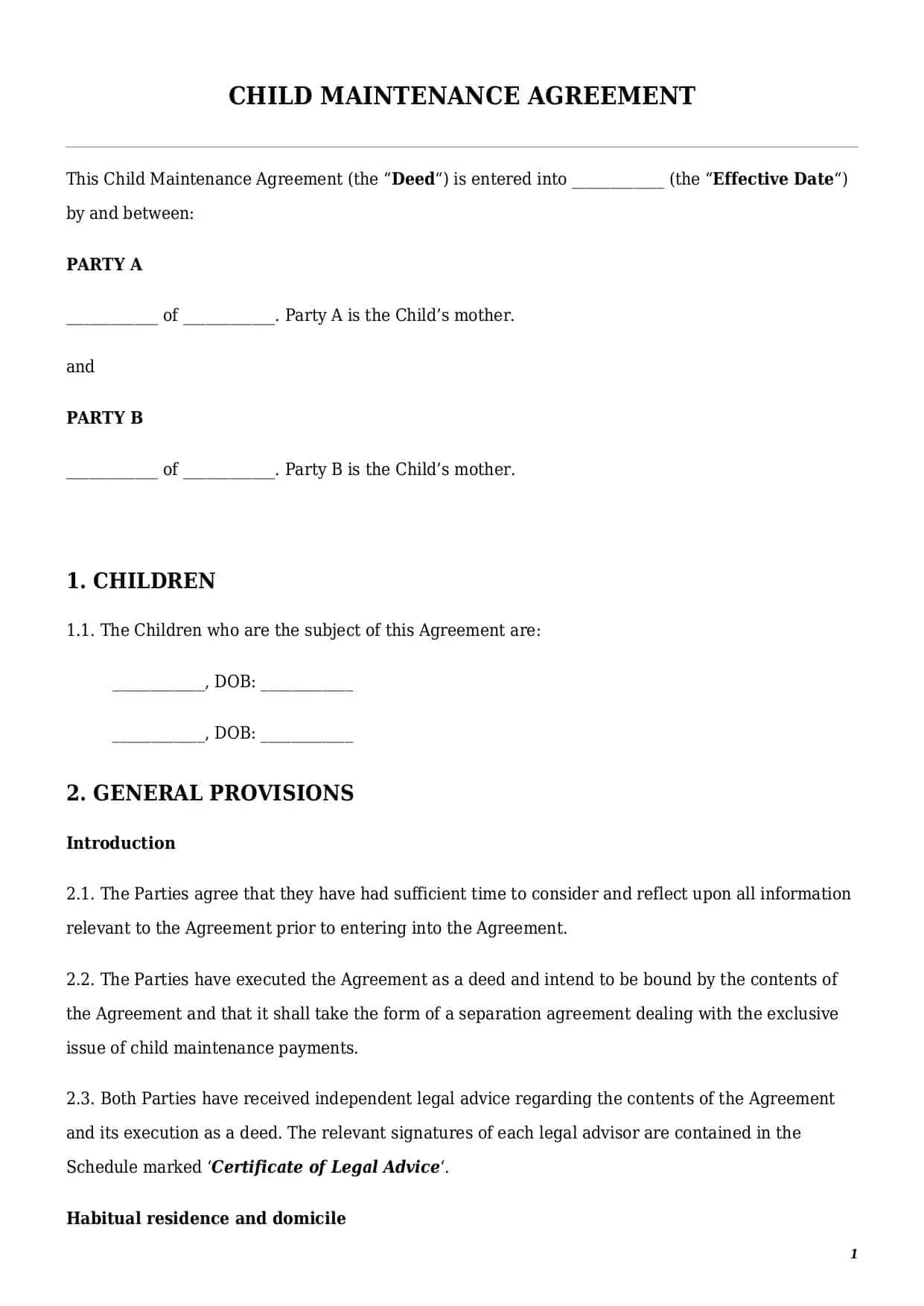
What is a child maintenance agreement?
A child maintenance agreement is a written document between two separated parents that sets out how the financial costs of raising their children will be shared after the divorce or separation. This document records how much the paying parent will contribute, how often payments will be made, what the money covers, and what happens if circumstances change. This document helps couples and parents in the UK to reach an agreement on child maintenance privately without involving courts or third-party mediators.
A child maintenance agreement template can be used to record:
- The agreed amount of regular maintenance payments;
- The payment frequency (weekly, fortnightly, or monthly);
- What the payments are intended to cover (day-to-day living costs, school expenses, childcare, clothing, and so on);
- How costs for one-off or exceptional expenses (medical, educational, extracurricular) will be handled;
- How and when the agreement will be reviewed; and
- What happens if the paying parent’s income changes significantly?
A child maintenance agreement is separate from a child arrangement agreement, which covers where children live and when they spend time with each parent. Both documents are usually used together to ensure smooth co-parenting after the divorce or separation.
What should be included in a family-based arrangement child maintenance?
A standard child maintenance agreement in the UK shall cover the following important information:
Identification Details
The text of the agreement shall outline the full name and contact information of both parents involved. This agreement can be signed in relation to one or several children below the age of 18.
If the parties do have children under the age of 18 from previous relations, this information should also be reflected in the text of the document. The main reason to do so is that in case a dispute is referred to CMS or court, there is sufficient information on the current financial circumstances of both parents, including any ongoing financial liabilities.
Maintenance Amount
In this section of the child maintenance agreement template parents must outline the following:
- full amount of the regular support in pounds;
- payment schedule (including the day of the week or month on which payments should be made); and
- list of expenses that should be covered by that sum.
Additional Costs
Sometimes parties may agree on paying an extra amount of financial support for additional expenses not covered by the main maintenance amount. These costs may include:
- school fees;
- extracurricular activities;
- domestic or international travels;
- pocket expenses;
- birthday gifts, etc.
Duration
A legally binding child maintenance agreement shall outline the period of time within which it shall remain in effect. A standard clause sets out that the agreement shall expire on the 18th birthday of a child. However, parties may agree on a shorter duration, for example, till the child is 12 or until a set date in the future.
What are the types of child maintenance in the UK?
This is one of the most important questions parents ask — and the honest answer is nuanced.
In case of a divorce or separation, the couple can agree on child maintenance and support in either of the following ways:
Family-based arrangement (private agreement)
This is what this template creates. It is one of the most efficient ways to agree upon the child care and maintenance that includes privacy and a significant reduction of the solicitor’s legal costs. You do not need a court or any other external third party to enter a child maintenance agreement template.
There is, however, one hidden pitfall parents should be aware of. A family-based arrangement is a private agreement between parents, which is not being enforced automatically. That means that parents shall apply further for the consent order to enforce the written agreement. If the paying parent duly performs their obligations under the child arrangement agreement, the consent order may not be necessary. However, should there be any delay or failure to make payments on a regular basis, a consent order may help.
Child Maintenance Service (CMS)
Either parent can apply to the CMS at any time to request a rough CMS calculation of a maintenance figure. This is not a private arrangement, therefore sometimes the payments assigned by CMS might be lower than those agreed on between the parties privately. The benefit of CMS calculation is that CMS can independently enforce payments from the paying parent’s account without the need to apply for a separate consent order.
Court Order
Parents who agree on maintenance can ask a family court to record that agreement in a consent order. A consent order is legally binding and enforceable in the same way as any other court order. However, in England and Wales, a consent order for child maintenance automatically lapses after 12 months if either parent applies to the CMS instead — meaning court orders for child maintenance are generally not permanent alternatives to the CMS. Courts in England and Wales retain the power to make child maintenance orders in limited circumstances (for example, for children in full-time higher education, children with a disability, or where the paying parent lives abroad).
Common Mistakes to Avoid in Child Maintenance Agreements
Many couples in the process of divorce or separation in the UK are not aware of the most common mistakes related to child maintenance.
Mistake 1: Agreeing Without the CMS Formula
Many parents choose to quickly decide on a round figure for child maintenance without relating to the CMS calculation for their circumstances. While CMS calculation is not mandatory itself, sometimes parents may find it surprising how the actually paid maintenance differs from the minimum statutory maintenance.
All that may lead to a situation when the receiving parent may feel underpaid or when the paying parent may suspect they are overpaying drastically. As a result, disputes may arise along the road. To prevent this, the following precautions should be made. First, apply for the CMS calculation before signing any child maintenance letter in the UK. Second, include a reference from the CMS calculation directly to the text of your private child maintenance agreement.
Mistake 2: Change of Financial Circumstances
A maintenance agreement that sets a fixed amount with no mechanism for downward adjustment is likely to create conflict if the paying parent’s income falls substantially. Life is unpredictable, which means that the paying parent may suddenly become unemployed, redundant, put on garden leave, bankrupt, etc. All those circumstances may significantly affect the paying capacity of that parent.
Therefore, a solid document template should also reflect how the maintenance amount should be adjusted to “mirror” the current financial circumstances of a paying parent.
Mistake 3: Treating the Agreement as Permanent
A child maintenance agreement is a living document that must consider the following circumstances:
- children getting older, which implies an increase of maintenance checks;
- unpredictable or force majeure circumstances, including disease, disability or other health issues;
- born of new children by either of the parents; or
- entering new marriages or civil partnerships.
Treating the agreement as fixed and refusing to revisit it is a recipe for resentment and, ultimately, breakdown of the arrangement. Inclusion of the clause in the contract that allows regular reviews of the document significantly prevents disputes between the parties and preserves execution of the current child maintenance arrangement for many years.
Why shall I use this child maintenance letter template from FasterDraft?
By customising this private child maintenance agreement form with FasterDraft, you receive a document with the following benefits:
- a document that fully aligns with the recent amendments to the Child Support Act 1991;
- a document that is suitable for application across England and Wales;
- a template drafted by qualified UK solicitors;
- a document that reflects particularities of your family situation, and not a generic template;
- a template drafted by lawyers, never by AI.
How to customise this child maintenance agreement template?
To get a fully customisable document template, follow a few easy steps below:
- Click the “Create Document” button.
- Answer simple questions in the form.
- Select a template’s format – child maintenance form PDF or Word.
- Make a payment.
The document is ready for instant digital download immediately after the purchase. The document is ready to use and to be signed within England and Wales.