

.svg) USA
USA.svg) Australia
Australia

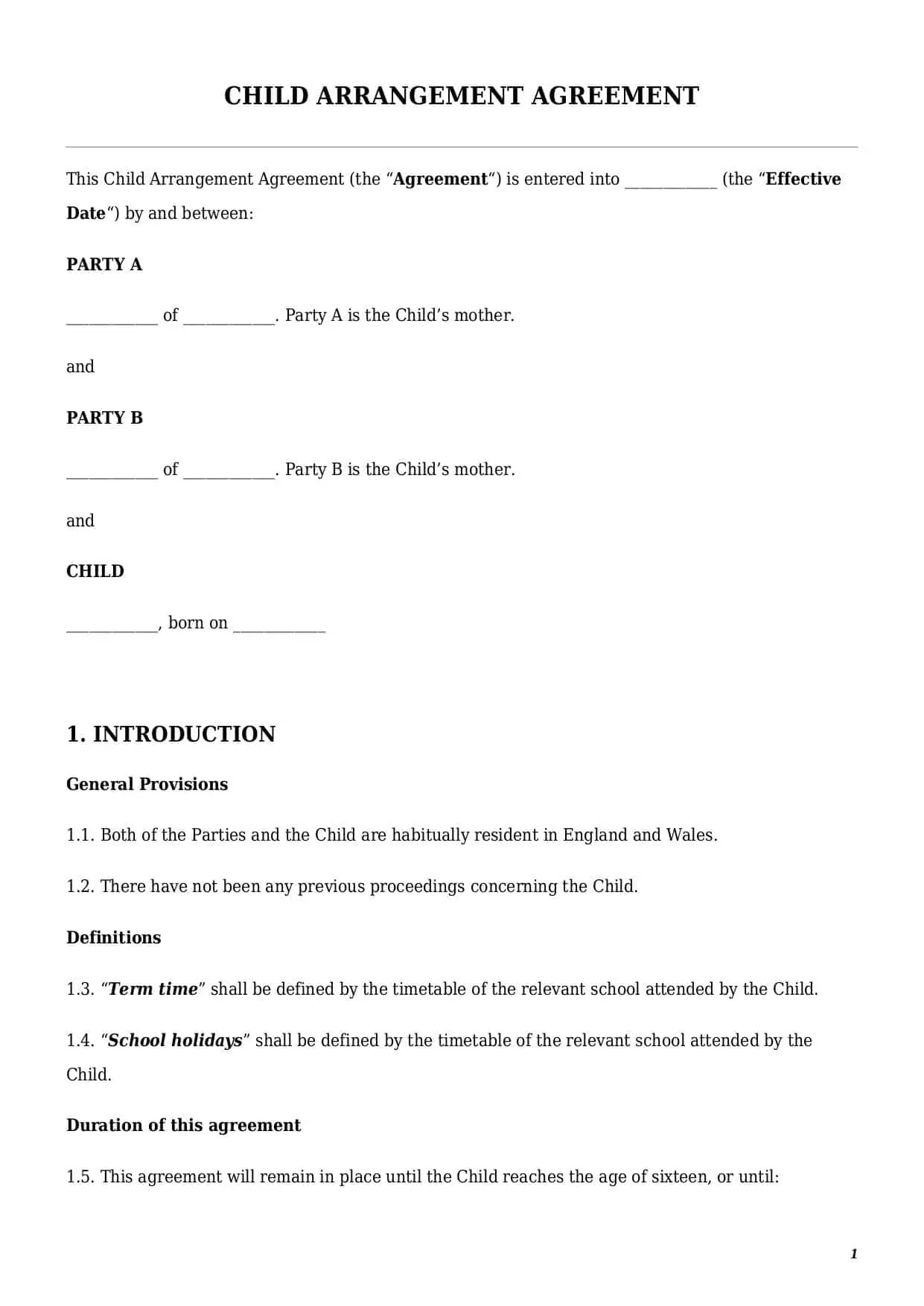
What is a child arrangement agreement?
A child arrangement agreement (sometimes called a co-parenting agreement) is a written document that sets out the practical arrangements for children when their parents separate or divorce. The document sets out clear expectations of both parties regarding:
- Where the child lives (which parent is the primary home, or how time is divided between two homes);
- When the child spends time with each parent;
- How communication between parents takes place;
- What is the process of the document’s amendment.
This document is being used by families in the UK that go through separation, divorce or dissolution of a civil partnership and who have children under the age of 18 in common.
A child arrangement agreement is a private contract between parents of a child and is different from a court order. The parties shall further apply for the additional consent order to be able to enforce this agreement the same as a court order.
This customisable co-parenting agreement template can be used by parents residing in England and Wales, Scotland and Northern Ireland.
What should be included in the child arrangement agreement UK?
This child arrangement agreement template UK covers all the key areas a co-parenting arrangement needs to address:
Details of Children
The document may address co-parenting and living arrangements for one or several children. The document must include the child’s full name and date of birth. The child does not need to sign the document.
Primary Residence
The most important section of every child arrangement agreement template UK includes the primary residence of a child. This is the place where the child normally leaves and could be:
- a place of residence of one of the parents; or
- a place of residence of both parents.
Regular Contact Schedule
The text of every co-parenting agreement template in the UK shall outline days and times of the week or month on which the child shall spend time with either parent. Another important component is to include the order of handover of a child between the parents, including:
- dates and times of handover;
- place of handover (for example, school’s parking); and
- additional belongings that should accompany the transfer (for example, spare clothing, toothbrushes, etc.).
Holidays
A solid child arrangement agreement template should define with whom and for how long the child shall stay during school holidays and any other holidays, including Christmas or mid-term breaks. It is also important to outline a separate handover schedule of a child for the holiday break.
Communication between parents
Parties to this agreement shall decide on the preferred methods of communication between each other. Once the specific method of communication is chosen, either party must ensure that all messages and notices are being sent specifically using this method of communication. In a situation when the method of communication is not active, for example, when the mobile phone is lost or stolen, the affected party shall immediately notify the other party about the same and suggest an alternative method of communication.
Top 5 Legal Considerations Before Signing a Child Arrangement Agreement
Parental Responsibility
If both parents, after the divorce or separation, hold a parental responsibility, in such a case they have to jointly adopt all major decisions related to a child’s life and well-being. Major decisions do not cover the type of food to be eaten or clothing to wear on a daily basis. The major decisions may include choosing a school, agreeing on the list of extracurricular activities, undergoing certain medical treatments or surgeries, etc.
In a situation when either parent holds a parental responsibility, it means that only that parent can decide on major decisions about the child’s well-being. When the other parent does not yet have parental responsibility, this should be addressed separately in a formal parental responsibility agreement.
Child’s Welfare
The courts in the UK are constantly emphasising that the child arrangement agreement should be built around the child’s welfare and genuinely be best for the child’s interest. Therefore, while creating a child arrangement agreement, parents should make sure that the child’s physical, emotional and educational well-being is the priority. Even in case of a dispute when the court needs to intervene, the child-focused agreement is much more likely to be respected and enforced further.
Plan for Change
When entering a child arrangement agreement UK parties should leave room for future changes along with their child as it is growing and maturing. It is important to consider that new important constraints such as schools, extracurricular activities, new families of either parent, friends and other relations may significantly affect proper execution of this contract. Therefore, the text of the contract shall outline a mandatory annual review to accommodate all the emerging changes. On top of that, it is also advisable to have an ad hoc clause allowing parents to quickly agree on changes without rewriting the whole document.
Taking the Child Abroad
Once the child lives with one of the parents while both parents retain a parental responsibility, taking a child abroad by one of the parents can be limited. To do so, a prior written travel consent shall be issued by a non-travelling parent with a parental responsibility. While this requirement does not apply for domestic travels, all international travels with a child under the age of 18 shall fall within this limitation.
Therefore, your separation agreement child arrangement shall include the clause addressing how international travel and holidays abroad will be managed and consented to.
3 Common Mistakes to Avoid in Child Arrangement Agreements
Before entering this co-parenting agreement template UK, parents must be aware of the following common mistakes:
Being Too Vague
The provisions of the future child arrangement agreement should be clear enough so that each party can understand what is expected from him or her. For example, when it comes to establishing a clear schedule, the parties must provide exact days of the week or the month on which a child shall spend time with one of the parents. It is better to avoid wording such as “couple of days per week or month” to prevent any future misunderstanding.
Being Too Rigid
Parents should understand that it is not possible to cover all future circumstances whatsoever. Therefore, the introduction of “extreme” coverage of all possible scenarios may negatively affect future performance of the contract. For example, requiring amendments of even a minor change in the agreed schedule may disrupt the daily life of both parents and children.
Special Occasions
Christmas, Easter, school holidays, birthdays, and Mother’s Day/Father’s Day are consistent flashpoints for separated families. Therefore, a well-written co-parenting agreement template UK shall specifically address with whom the children shall stay during these special occasions. For example, the common division includes that all Mother’s Days shall be spent with a mother, while all Father’s Days shall be spent with a father.
Ignoring the Child’s Evolving Voice
Children get older, and their wishes and feelings carry increasing weight. All this can significantly affect co-parenting relationships even if both parties have a perfect agreement. If minor (children under the age of 7) involvement into drafting a child arrangement agreement is not necessary, after 12 years old the picture changes significantly. Therefore, it is important for parents to engage their teenage children in discussing possible living arrangement well in advance.
What are the benefits of this child arrangement agreement template?
By customising this template with FasterDraft, you get a professionally drafted legal document in minutes with the following benefits:
- a document in PDF and editable Word document format;
- a document created by qualified UK solicitors, and never by AI;
- a document that can be re-used multiple times;
- a document that helps couples to significantly save solicitor’s fees during the divorce or separation;
- a document suitable for various parenting arrangements;
- a document that is used throughout England and Wales;
- a document drafted in full compliance with the Children Act 1989;
- a document that is customisable for various types of living arrangements.
How to customise this child arrangement agreement with FasterDraft?
To get a fully customisable document template, follow a few easy steps below:
- Click the “Create Document” button.
- Answer simple questions in the form.
- Select a template’s format – child arrangement agreement template UK Word or PDF.
- Make a payment.
The document is ready for instant download immediately after the purchase.