
.svg)
 United Kingdom
.svg) Australia
Australia

What is a vending agreement?
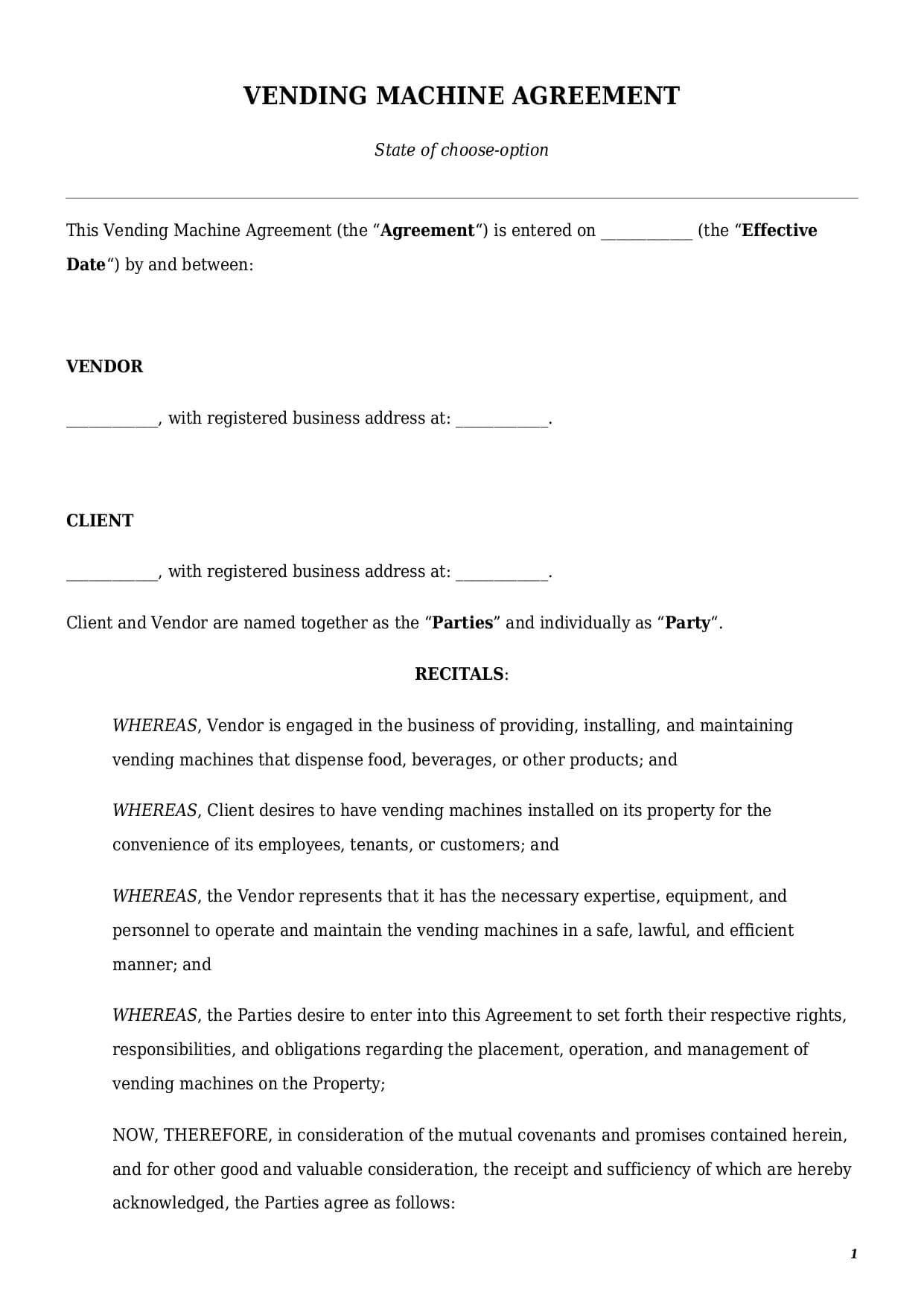
A vending machine agreement is a legally binding contract between a vending machine operator and a property owner who allows the placement of vending machines at their place. This type of commercial contract outlines the terms and conditions for installing, operating, and maintaining vending machines on a specified property.
The parties involved in a vending machine contract are a client and a vendor business. A client is a business or a property owner who wishes to install vending machines at their property, whether rented or owned. A vendor is a self-employed person or a business that operates vending machines, including their maintenance, installation, and repairs.
This agreement defines legal responsibilities, revenue-sharing arrangements, product stocking requirements, equipment ownership, liability coverage, and the rights of both parties in the event of service issues, damages, or termination.
A solid vending machine agreement template could be helpful for:
- property owners of office buildings (to offer extra perks for their visitors or staff);
- retailers (to enter new markets and increase customers’ engagement with their products);
- vending businesses (to supply their machines for new businesses and organizations);
- entertainment facilities like hotels and gyms that want to increase clients’ satisfaction and engagement, etc.
Equipment Rental vs. Commercial Lease vs. Vending Machine Agreement—Which document is the right legal foundation for a vending placement business in the USA?
When launching a vending business, the first thing you start with is finding a place to locate these vending machines. The common confusion many business owners have is to understand where they need a commercial lease agreement, a separate equipment rental contract, a vending machine agreement, or both.
| Equipment Rental Agreement | Commercial Lease Agreement | Vending Machine Agreement | General Service Agreement | |
|---|---|---|---|---|
| What is being rented? | Equipment, machinery, tools, vehicles, or other movable property. | Office, retail, warehouse, or other commercial premises. | Defined location within a property for placement of a vending machine. | Professional Services (accounting, legal, design, software). |
| Parties Involved | Owner of Equipment and Renter | Property owner or management company and tenant | Vending machine operator and property owner. | Service provider and client. |
| Possession | Renter receives in temporary possession and use the equipment. | Tenant receives leased property in possession. The property owner cannot freely access it without a prior request. | Operator receives the right to access (license) designated area. No possession of property where the vending machine is placed. | Client receives agreed services. |
| Term | Often short-term or fixed-term, depending on the equipment. | Commonly fixed-term, although other lease structures are possible. | Often a fixed period or continuing arrangement that can be terminated according to the agreement. | Fixed or recurring basis. |
| Termination | Short notice. Grounds for termination and termination formalities are governed by contractual provisions. | State-specific laws apply to eligible grounds for termination, eviction procedure, duration of termination notice. | Short notice. No formal eviction procedure. No state specific formalities compared to commercial lease. | Grounds for termination and termination formalities are governed by contractual provisions. |
| When to use? | When needing to rent out equipment/tools without purchasing it. | When needing a commercial property in exclusive possession for doing business. | When needing a non-exclusive access to the property for placement machine (e.g., hotels, schools). | When providing/ordering various types of services. |
Step 1: When you start your business from scratch and do not have enough funds to finance the purchase of vending machines, this is where the equipment rental agreement template can be used. Find someone who can rent you out the necessary equipment for a defined period of time.
Step 2: Find the exact location or property you want the placement for your vending machine.
Step 3: If you want exclusive possession of the property where your vending machine is, it is better to sign a commercial property lease agreement template or sublease agreement. If you only need access to the property to maintain and check a vending machine, a vending machine agreement is probably what you really need.
Is a Vending Machine Placement a lease or a license?
If you are hesitating which type of a contract you need for your vending machine placement business, you are in the right place. Selecting the document will directly change how your relationships are classified, which type of legal protection you get, as well as how relations between the parties can be terminated.
Courts distinguish a lease from a license using a small number of recurring factors, developed through common law property doctrine and applied by analogy to exactly this kind of equipment-placement scenario (the same test courts have used for boat slips, flea market stalls, and telecom equipment placements):
- Exclusive possession. If you want to own the place, control it, and solely possess it—this is the lease. A license, by contract, grants only permission to place equipment in a space, while the owner can access and control the space without any limitations.
- Owner’s access. If you do not want a landlord to visit the property occasionally, you need a lease agreement. If, however, you are fine with a landlord entering, inspecting, reconfiguring, or otherwise using the area where the machine sits, you can get a simple license to use property under the vending machine agreement.
- Termination. A license under the vending machine agreement can be ended any time by simply sending a prior written notice. If you want a better degree of protection against sudden termination and more predictability, use a commercial lease agreement instead. Under the lease agreement early termination of the contract is limited to a number of specified circumstances.
All in all, the main difference lies within the flexibility and scope of access rights the owner of equipment preserves over the space. By clearly stating that a vending machine agreement grants a revocable license to place and operate the equipment, you keep this contractual arrangement from accidentally becoming subject to your state’s landlord-tenant statute.
Why do you need a written Vending Machine Agreement?
Having a verbal contract for vending machine placement is a fast-track, which has lots of hidden legal pitfalls and potential negative consequences in the future.
Without a written agreement, you have no way to:
- your vending machine to be placed next to the machines of your competitor. A written contract allows parties to insert an exclusive clause preventing the property owner from licensing space to third parties competing with the renter.
- property owner to get the biggest revenue share from sales made by your vending machine. Only a written contract allows parties to specify the percentage of revenue shares that either party receives from the vending machine at the end of the month, week, or quarter.
- to claim your vending machine back at the end of the license. Upon the end of verbal vending, the property owner may claim that your vending machine is the property of the property, which cannot be returned back to you. This is only preventable with a written contract defining post-termination obligations of each party.
What are the responsibilities of a Vending Machine Operator under the contract?
A written template of the vending machine contract helps to define each party’s responsibilities for non-compliance, business registration formalities, federal food safety requirements, and product labeling.
General business license
A vending machine operator acts as an independent contractor under the vending machine contract. It means that no employment, partnership or subordination type of relationships can be created under this contract.
Depending on the state, every business must first apply for a business license before conducting any business. This also applies to operators of vending machines.
City or county coin-operated machine permits and decals
Many municipalities layer an additional, vending-specific requirement on top of general business licensing—often a per-machine permit, tag, or decal, renewed annually, sometimes tied to a small per-machine fee. For example, in the city of San Antonio (Texas), the tax fee for the coin-operator amusement machine is $15.
Calorie Labeling
This is a federal calorie-disclosure obligation for vending operators established under the 21 of Code of Federal Regulation § 101.8, implementing Section 403(q)(5)(H)(viii) of the Federal Food, Drug, and Cosmetic Act. Each product inside the vending machine should be visible for nutrition information. It helps customers to understand what they are actually buying, before making a payment. This rule applies, however, only to businesses that operate 20 or more vending machines. If your business falls within such a requirement, you must also register your business with the FDA.
Anchoring and anti-tip requirement
According to the U.S. Consumer Product Safety Commission’s own analysis, it found at least 37 deaths and 113 injuries between 1978 and 1995 resulting from consumers rocking or tilting vending machines in attempts to obtain free product. Once such an incident takes place with your vending machine, you and the property/space owner may start arguing about who shall be responsible for liability and insurance coverage.
It is common to include an anchoring and anti-tip requirement clause in a vending machine contract, obliging a machine operator to properly install and fix it. On top of that, the machine operator should discuss in advance with their insurance provider if any damage caused by a vending machine is being covered by the commercial general liability policy. It is better not to rely on the insurance policy of the property’s owner where the vending machine is being installed, as their insurance provider may treat the vending machine as equipment outside their control entirely.
UCC-1 financing statement
If the space where you are placing a vending machine is mortgaged or subleased from a landlord above, the vending operator may face a situation in which vending machines could get claimed as part of someone else’s property.
Under Article 9 of the Uniform Commercial Code, an owner of personal property that risks being treated as a fixture can file a UCC-1 financing statement (specifically, a fixture filing, recorded in the real property records for the location) to publicly establish and protect their ownership interest against exactly this kind of competing claim. This is a relatively low-cost, precautionary step that’s frequently skipped by smaller operators — but for anyone placing higher-value machines, or operating at scale across many properties, it’s a genuine, additional layer of protection that sits on top of, not instead of, the ownership clause already built into the agreement itself.
While this is not a clearly legal obligation of an operator, it is rather a smart precautionary measure worth taking.
What’s included in the vending machine contract?
Operation of a vending machine is not rocket science. Therefore, a vending machine agreement is not the most difficult or complex legal document. However, there are a number of important legal considerations parties have to discuss together before the start of cooperation.
Placement and installation
According to a vending contract, a vendor should be solely responsible for placement and installation of vending machines at the client’s property. Therefore, the parties to this agreement must agree upon:
- the exact number of machines that should be placed;
- their parameters (size, height, aesthetics); and
- list of products that should be available for sale in machines.
If a vending machine needs repair, a vendor should perform such repairs at their own cost. There is an exception to this rule, however. If a repair is caused by a client’s negligence or wrongdoing, in that case the repair should be made at the client’s cost.
Ownership of equipment
The text of every vending machine agreement template must define that a vendor remains the sole owner of all provided vending machines.
Once the agreement ends, a vendor should be given a period of time sufficient to safely de-install vending machines and remove them from a client’s property.
As an owner, a vendor should have a right of access to vending machines during business hours to examine, repair, stock, or perform necessary checks.
Revenue structure
A well-drafted vending machine contract must provide a clear revenue structure to answer the following questions: how much, when, and how a vendor should share generated revenue.
Parties may agree to either of the payment models listed below:
- a fixed recurring fee (e.g., weekly, monthly);
- a fixed percentage from generated weekly or monthly cash sales;
- other arrangement (e.g., a flat annual fee, etc.).
Besides that, the text of a contract must define available payment deadlines by which payment should be performed by vendors.
Termination
A good vending machine contract example must define the process of a contract’s termination. Usually both parties could end the contract at any time, provided a reasonable prior notice is being sent in advance.
The vending contract could also end naturally, for example, when its initial period expires, or either party dies or is liquidated.
If the text of a contract does not provide a right for earlier termination, in that case a contract could be ended only upon mutual consent of both parties.
How to customize a vending machine agreement at FasterDraft?
To get a fully customized legal document, follow a few easy steps below:
- Click the “Create Document” button.
- Answer simple questions in the form.
- Select a template’s format—vending machine contract PDF or Word.
- Make a payment.
- Download this document template in PDF or Word.
- Print it out in two copies.
- Make both parties sign the document.
- The document is ready for immediate use right after the download.
- Each party must keep a signed copy of this agreement for their record.
This article is reviewed by Daria Turanska, a lawyer with 15 years’ contract drafting experience. Fact-checked by Sarah Collins.