
.svg)
 United Kingdom
.svg) Australia
Australia

What is a retainer agreement?
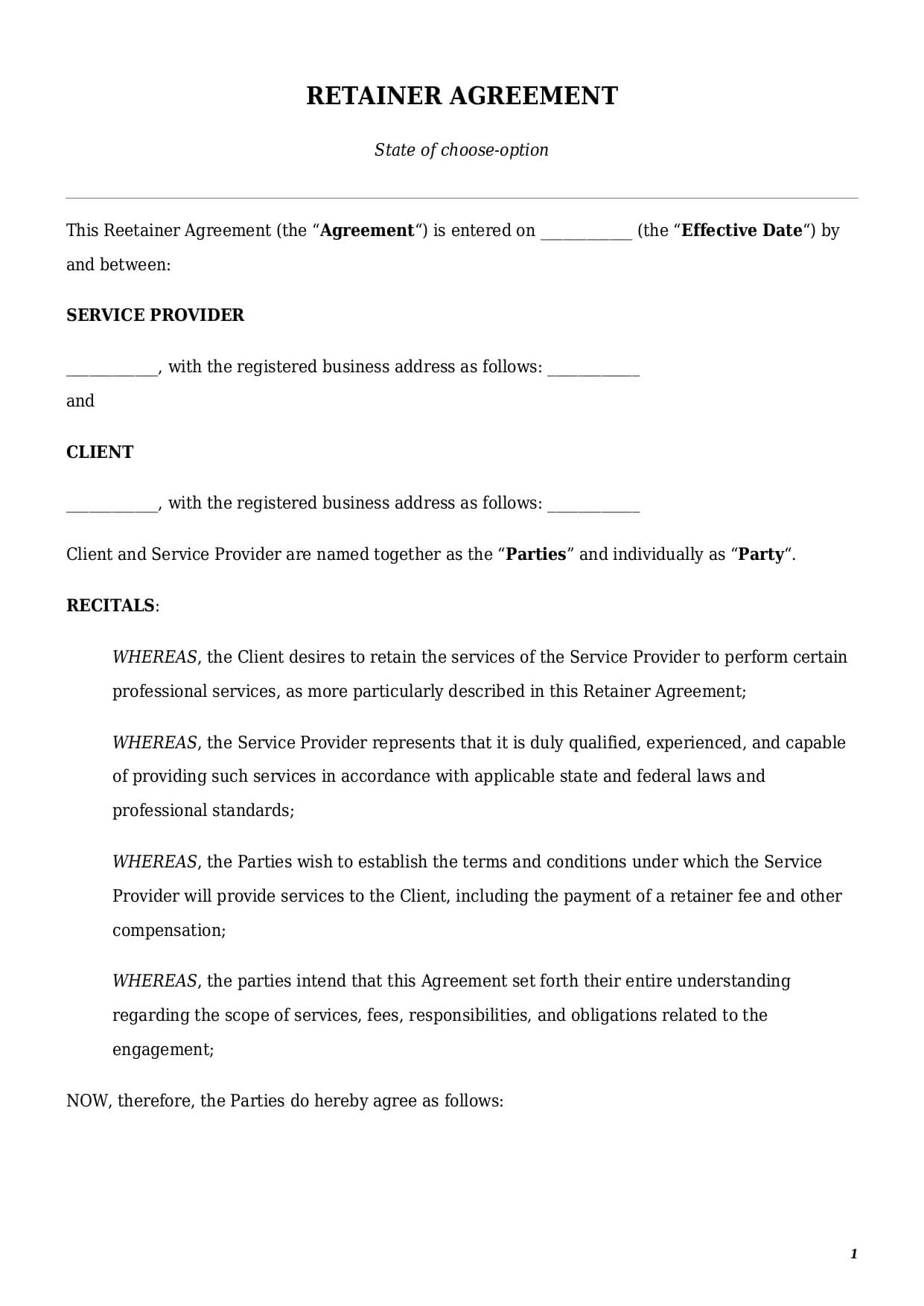
A retainer agreement is a legal contract between a service provider and a client in which the client pays a retainer fee to secure the provider’s availability and commitment to perform professional services over a defined period of time. This is a formal legal document that defines a framework for the provision of services, mutual rights and obligations, as well as a payment schedule. Having a solid legal retainer agreement is essential for many reasons, including:
- provision of legal protections for both parties;
- protection against misunderstandings;
- establishment of a clear roadmap for future cooperation, etc.
The parties involved in a retainer agreement sample are a client and a service provider. A service provider is a professional who has relevant expertise and skills and whose services shall be retained under this agreement. In the case of a lawyer retainer agreement, a service provider is an attorney or lawyer that has the necessary legal background and license to provide the requested services. A client is usually an individual or organization that wants to retain and engage the service provider for the provision of certain services.
Having a freelance or consultant retainer agreement allows you to protect both parties from possible future legal risks and clarifies mutual rights and obligations, as well as prevents lots of potential disputes.
When do you need a retainer agreement?
A retainer agreement sample is useful when:
- for clients who have ongoing consulting work and need someone to help them;
- for freelancers who want to solicit certain clients on a permanent basis;
- for independent contractors who need a professional legal template for retainer services with their clients; and
- for clients and consultants with long-term client relations, etc.
What to include in a consultant retainer agreement?
When it comes to drafting a consultant retainer agreement, the document’s content and structure remind a lot of a services provision agreement. At the same time, there are a number of important exceptions that are specific to a retainer agreement only and shall be taken into consideration. Below we made a summary of important clauses a solid retainer agreement template must have.
Parties’ Details
A good retainer agreement example shall include identification details of both parties involved—a client and a service provider. Those details are
- full name and business address of each party;
- contact details like phone number and email address;
- full name of a contact person for each party.
Type of a Contract
The final document’s structure and content of a contract will largely depend on the type of retainer agreement:
- Attorney retainer agreement template. For this type of contract, inclusion of a confidentiality clause is essential. Most lawyers and attorneys are being exposed to their clients’ sensitive information in the course of the provision of services. That’s why it is essential to make sure a lawyer or an attorney has a duty of confidentiality.
- Creative agency retainer agreement template. Provision of creative services could have various forms, including brand and logo design, visual or content creation, etc. Therefore, it is vital to make sure intellectual property (IP) rights created in the course of provision of such services are well protected. In this regard, inclusion of an IP rights clause into the text of a creative agency retainer agreement template is essential. It helps to define which party shall hold all rights with regard to created IP rights, as well as other important provisions.
- Consulting retainer agreement template. When it comes to the provision of professional services, it is vital to make sure that requested services are provided in accordance with professional and industry standards. Thus, inclusion of such a compliance clause is a must-have for this type of contract.
Terms and Conditions of Services
Another important pillar for every retainer agreement sample is the inclusion of detailed terms and conditions of services:
- Scope of services to be provided. To avoid a scope creep, the text of the retainer contract shall reflect services to be provided. This is especially important for an attorney retainer agreement—e.g., if a representative in a court is included or shall be paid separately.
- Commencement date. This is the date from which a retainer starts. This is not the date of signing the contract, but a date from which a service provider is being retained.
- Location. Service could be provided in a specific location agreed upon between the parties or from any location depending on a service provider’s choice.
- Engagement of subcontractors. Some clients may wish only an individual to be engaged in the provision of professional services. This is especially the case for a lawyer retainer agreement, when a client wants to hire a specific lawyer or attorney to work on their case.
- Exclusivity vs. non-exclusivity. Having an exclusive retainer means that a client undertakes to not engage any other service providers for the provision of requested services. Contrary to that, a non-exclusive retainer agreement means that either party can enter similar retainer contracts with other third parties without any limitation.
Payment Terms
Whether it is a consultant or an attorney retainer agreement, inclusion of payment terms is a key element for both types of contracts. Having a payment structure is vital to avoid lots of potential conflicts. Therefore, this clause must include:
- amount of a retainer fee;
- frequency of its payment (e.g., one-time, annually, monthly, weekly);
- acceptable payment methods (e.g., bank transfer, cash);
- application of late charges (when a client fails to pay a retainer fee on time); and
- compensation of additional expenses (i.e., maximum amount, type of expenses).
How to customize a retainer agreement sample at FasterDraft?
To get a fully customized legal document, follow the instructions given below:
- Click the “Create Document” button.
- Answer simple questions in the form.
- Select a template’s format—retainer agreement template PDF or Word.
- Make a payment.
- Download, print, and sign the document.